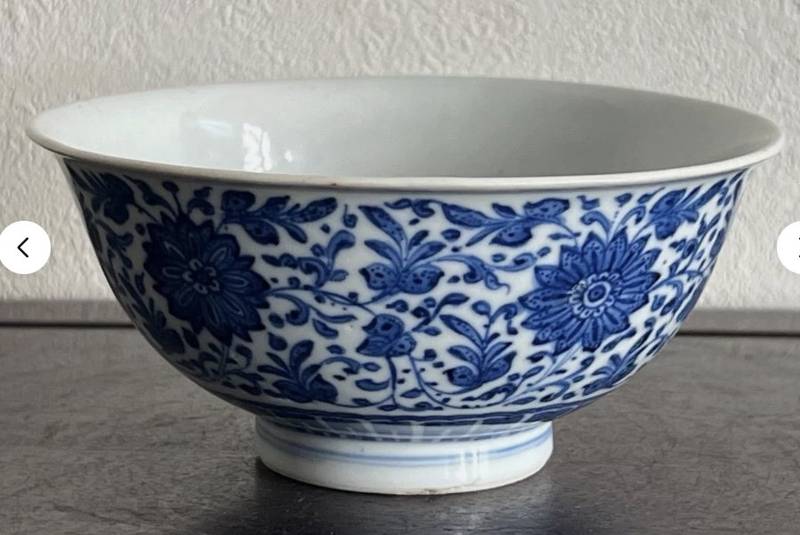
Chinese Blue and White Porcelain Lotus Bowl
Estimated value
$150 - $450Rarity
Average(4/10)Category
Ceramics & PotteryEra
Late 19th to early 20th centuryOrigin
ChinaAuthenticity
CHINESE BLUE AND WHITE PORCELAIN LOTUS BOWL: IDENTIFICATION
A deep circular bowl with an everted rim, decorated in underglaze cobalt blue with a continuous scrolling lotus motif. The exterior features large multi-petaled blossoms connected by undulating leafy vines above a band of stylized lotus lappets encircling the foot. The base bears a four-character apocryphal mark 'Xuan de nian zhi' (Made during the Xuande reign) in underglaze blue, however, the calligraphic style and pigment application are characteristic of late 19th or early 20th-century production.
PRODUCTION & FIRING
SCARCITY
Typical antique shop fare. Requires some searching but regularly available. This is where most genuine antiques fall.
Typical Characteristics
- Standard antique shop items
- Regularly available
- Moderate collector interest
Confidence Factors
- Apocryphal Xuande reign mark on a later body
- Modern cobalt uniformity suggests post-1850 production
- High prevalence of later 19th-century 'tribute' pieces in this specific pattern
Expert review recommended. Consider consulting a specialist before making purchasing decisions.
CERAMICIST'S ASSESSMENT
Ceramics Historian & Kiln Specialist
The form and decoration are highly standard for the period indicated. While the mark is apocryphal, the overall quality suggests an authentic antique of the 1880-1920 period rather than a modern plastic or transfer-printed reproduction.
KEY EVIDENCE
- 1Four-character mark '宣德年製' (Xuande Nian Zhi) is apocryphal, written in a later hand.
- 2Absence of 'heaping and piling' (iron spotting) in the cobalt pigment.
- 3Form and footrim profile are consistent with Late Qing/Early Republic export and domestic wares.
- 4Glaze consistency is more uniform than 15th-century examples.
UNCERTAINTIES
- •The mark is too precisely centered and lacks the slight irregularity of genuine Ming period marks.
- •The blue tone is very bright, suggesting chemically purified cobalt.
WHAT WOULD IMPROVE CERTAINTY
- →Close-up photo of the rim to check for 'mushrooms' or glaze fritting.
- →Transmitted light test: hold against a strong light to check body translucency.
- →High-resolution image of the interior center (well).
CONDITION & GRADE
Grading breakdown
The bowl retains excellent structural integrity with no visible hairline cracks or significant chips; the footrim shows natural age-related darkening.
Condition
Small firing flaws are visible in the glaze on the footrim. Moderate surface wear is present on the interior bottom, consistent with domestic use or long-term display.
CERAMICS MARKET VALUE
Updated: May 11, 2026
Who buys this
Collectors of Late Qing/Republic period blue and white porcelain and interior decorators seeking classic Asian aesthetics.
What increases value
- •Sharpness of the hand-painted lotus pattern
- •Absence of rim chips or hairline cracks
- •Quality of the potting and glaze clarity
What lowers value
- •Hidden cracks detectable only by 'ringing' the bowl
- •Misidentification as an 18th-century piece by inexperienced buyers
What makes top-tier examples
- •Deep, vibrant cobalt color with tonal variation
- •Exceptionally thin, resonant porcelain body
Grade & condition
Presence of chips, rim fritting, and the clarity/stability of the cobalt pigment.
Rarity & demand
For informational purposes only, not a formal appraisal.
ABOUT CERAMICS & POTTERY
Pottery, porcelain, stoneware, earthenware, and kiln-fired objects.
Ceramics & Pottery value and rarity guideSHARE THIS CURIOSITY
Have your own curiosities to discover?
Scan Your Curiosity
COMMENTS