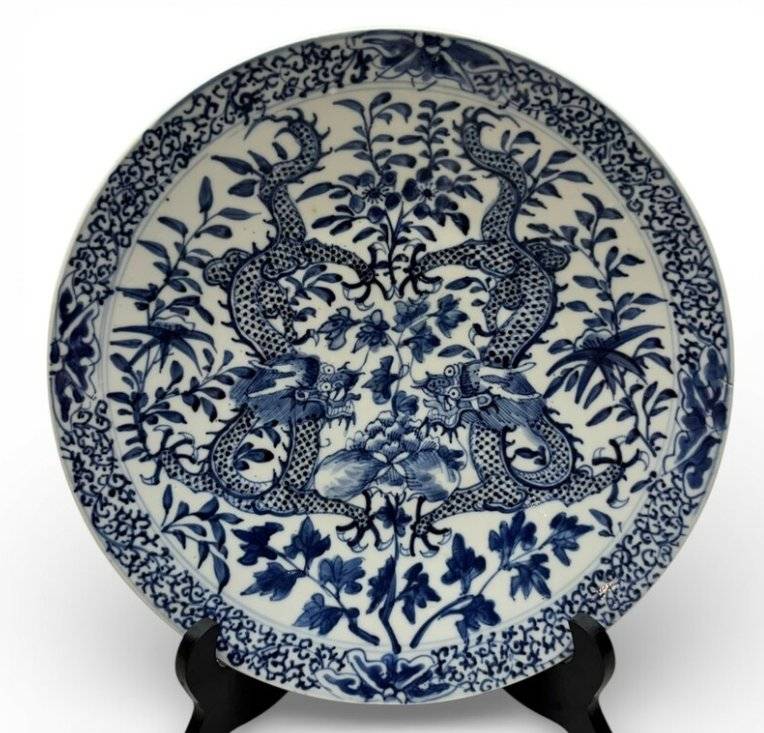
Chinese Blue and White Porcelain 'Dragon and Phoenix' Charger
Estimated value
$150 - $450Rarity
Average(4/10)Category
Ceramics & PotteryEra
Late 19th to Early 20th CenturyOrigin
ChinaAuthenticity
CHINESE BLUE AND WHITE PORCELAIN 'DRAGON AND PHOENIX' CHARGER: IDENTIFICATION
A substantial porcelain charger featuring a central medallion of two addorsed four-clawed dragons flanking a flowering peony. The composition utilizes cobalt blue underglaze on a slightly greyish-white ground. The cavetto and rim are decorated with a dense scroll border, while the reverse displays three stylized bats (wufu), symbols of happiness. The footrim is unglazed, showing a fine-grained white paste with minor iron spotting characteristic of provincial kiln firing.
PRODUCTION & FIRING
SCARCITY
Typical antique shop fare. Requires some searching but regularly available. This is where most genuine antiques fall.
Typical Characteristics
- Standard antique shop items
- Regularly available
- Moderate collector interest
Confidence Factors
- The lack of a reign mark makes specific dating a matter of stylistic interpretation
- Many 20th-century reproductions replicate 18th-century provincial styles closely
- Surface wear is consistent with age but easily faked by modern chemical aging
CERAMICIST'S ASSESSMENT
Ceramics Historian & Kiln Specialist
The identification is based on clearly visible diagnostic features like the footrim and bat motifs, though high-quality 20th-century copies of this specific style are common.
KEY EVIDENCE
- 1Unglazed footrim shows a vitrified white paste with orange iron-spotting typical of oxidation.
- 2Stylized 'wufu' bats on the reverse are a standard decorative shorthand for export chargers.
- 3The underglaze blue exhibits 'bleeding' into the glaze, a trait often seen in 19th-century provincial output.
- 4Dragon anatomy features the 'snout' and 'mane' style common to the Guangxu period (1875-1908).
UNCERTAINTIES
- •The central peony is somewhat crudely drawn compared to higher-end Kangxi examples.
- •Absence of 'chatter marks' on the footrim which are sometimes present in earlier 18th-century pieces.
WHAT WOULD IMPROVE CERTAINTY
- →Perform a 'long-wave UV light' test to check for invisible professional repairs to the rim.
- →Examine the depth of the glaze 'crazing' under 10x magnification to distinguish natural aging from forced aging.
- →Gently tap the rim with a wooden stick; a dull 'thud' rather than a clear ring would indicate more internal cracks.
CONDITION & GRADE
Grading breakdown
Lowered from 'Fine' due to the structural hairline crack and rim chip; otherwise, the glaze luster remains vibrant and the underglaze pigment is well-preserved.
Condition
A visible rim chip and an associated hairline crack are present at the 9 o'clock position on the reverse. Minor surface scratches indicate historical stacking and use.
Weight & feel
The piece appears substantial and thick-walled, likely weighing between 1.5 kg and 2 kg, suggesting it was potted for durability rather than the delicate translucency of imperial ware.
CERAMICS MARKET VALUE
Updated: May 10, 2026
Who buys this
Collectors of Chinese export porcelain and interior designers seeking authentic Asian focal pieces.
What increases value
- •Substantial size (charger scale usually commands a premium over standard plates)
- •Dragon motifs are among the most sought-after subjects in the Asian art market
What lowers value
- •The hairline crack significantly impacts value for purist collectors
- •Lack of an Imperial or documented workshop mark
What makes top-tier examples
- •Evidence of 18th-century potting techniques like 'V-shaped' footrims
- •Deep, sapphire-blue cobalt without muddy grey undertones
Grade & condition
Condition is determined by the presence of 'fritting' on the rim, chips, and the length of internal hairline cracks.
Rarity & demand
For informational purposes only, not a formal appraisal.
ABOUT CERAMICS & POTTERY
Pottery, porcelain, stoneware, earthenware, and kiln-fired objects.
Ceramics & Pottery value and rarity guideSHARE THIS CURIOSITY
Have your own curiosities to discover?
Scan Your Curiosity
COMMENTS