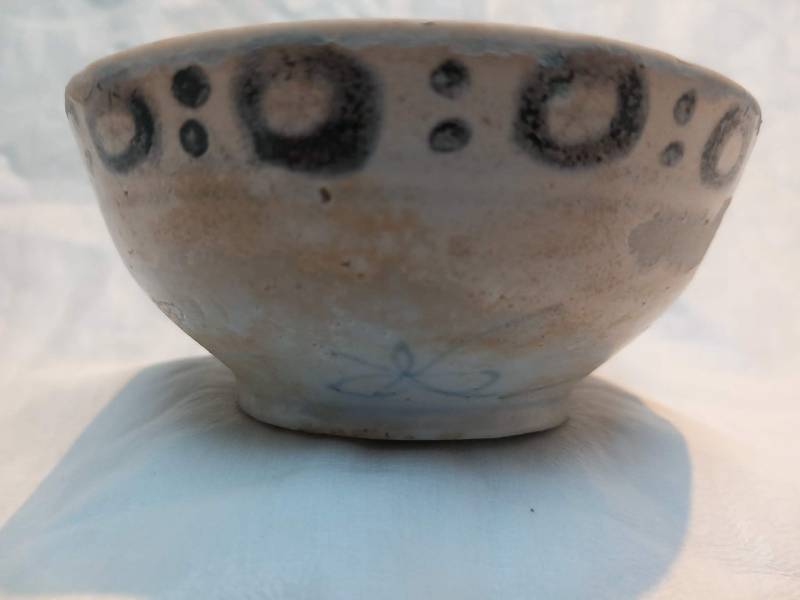
Chinese Blue and White 'Ring and Dot' Swatow Bowl, late Ming Dynasty (ca. 1570-1644)
Estimated value
$150 - $350Rarity
Average(4/10)Category
Ceramics & PotteryBrand
Zhangzhou KilnsEra
late 16th to mid-17th centuryOrigin
ChinaAuthenticity
CHINESE BLUE AND WHITE 'RING AND DOT' SWATOW BOWL, LATE MING DYNASTY (CA. 1570-1644): IDENTIFICATION
An underglaze blue and white porcelain bowl featuring a repetitive ring-and-dot motif along the exterior rim and a simplified floral or abstract medallion toward the base. This piece exhibits the characteristic gritty footrim and spontaneous brushwork associated with provincial Zhangzhou ware, commonly produced for the Southeast Asian export market during the Wanli period.
PRODUCTION & FIRING
COLLECTOR NOTES
A massive cache of Swatow ceramics was recovered from the Binh Thuan shipwreck, which sank off the coast of Vietnam around 1608.
SCARCITY
Typical antique shop fare. Requires some searching but regularly available. This is where most genuine antiques fall.
Typical Characteristics
- Standard antique shop items
- Regularly available
- Moderate collector interest
Confidence Factors
- Mineral staining and iron spots are consistent with authentic Ming provincial wares
- Gritty footrim construction aligns with known Zhangzhou kiln techniques
- Simple ring-and-dot motif is a documented provincial pattern from the Wanli era
CERAMICIST'S ASSESSMENT
Asian Art Specialist
The visual markers—specifically the grit on the foot, the milky glaze, and the specific export pattern—strongly align with 17th-century Zhangzhou production, though the staining makes a 100% surface assessment difficult.
KEY EVIDENCE
- 1Characteristic 'Swatow' sandy footrim visible at the base
- 2Underglaze cobalt blue application shows the 'heaped and piled' effect typical of Ming provincial blues
- 3Thick, opaque glaze with 'musher' or milky quality consistent with Fujian kilns
- 4Spontaneous, sketch-like execution of the dot-and-ring pattern
UNCERTAINTIES
- •The heavy staining could obscure modern repairs; a UV light test is recommended
- •Presence of iron spots is high, suggesting a lower-purity clay body
WHAT WOULD IMPROVE CERTAINTY
- →Provide a high-resolution photograph of the base and footrim to analyze the sand composition
- →Examine the interior base under UV light to check for restored cracks
- →Measure the diameter in millimeters to compare with standard Zhangzhou bowl sizes
CONDITION & GRADE
Grading breakdown
The grade is lowered by the heavy staining and potential hairlines, though the structural integrity remains largely intact for a 400-year-old export piece.
Condition
Significant surface discoloration and 'encrustation' are visible, likely due to contact with minerals. There is a visible hairline crack or deep scratch on the interior wall and typical rough-cut footrim with kiln grit.
CERAMICS MARKET VALUE
Updated: May 11, 2026
Who buys this
Collectors of shipwreck ceramics, Ming Dynasty export porcelain enthusiasts, and Japanese tea ceremony practitioners.
What increases value
- •Provincial charm and connection to maritime trade history
- •Authentic 'sandy foot' which is diagnostic of the period
- •Popularity of the 'Swatow' style in recent boutique auction cycles
What lowers value
- •Aesthetic degradation due to heavy mineral staining
- •Likely presence of structural hairlines hiding under the patina
- •Oversupply of similar shipwreck-recovered pieces
What makes top-tier examples
- •Clear, vibrant cobalt blue without grayish tints
- •Existence of a 'seal mark' in the center of the interior
- •Lack of intrusive staining or burial encrustation
Grade & condition
Surface clarity, presence of hairlines or chips, and the quality of the brushwork on the repetitive patterns.
Rarity & demand
For informational purposes only, not a formal appraisal.
ABOUT CERAMICS & POTTERY
Pottery, porcelain, stoneware, earthenware, and kiln-fired objects.
Ceramics & Pottery value and rarity guideSHARE THIS CURIOSITY
Have your own curiosities to discover?
Scan Your Curiosity
COMMENTS