
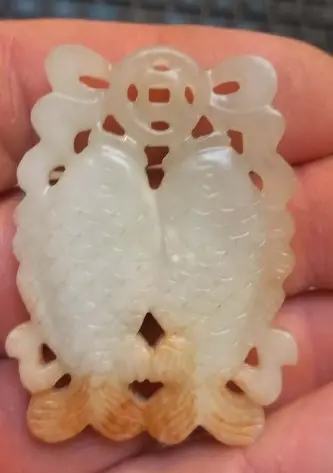
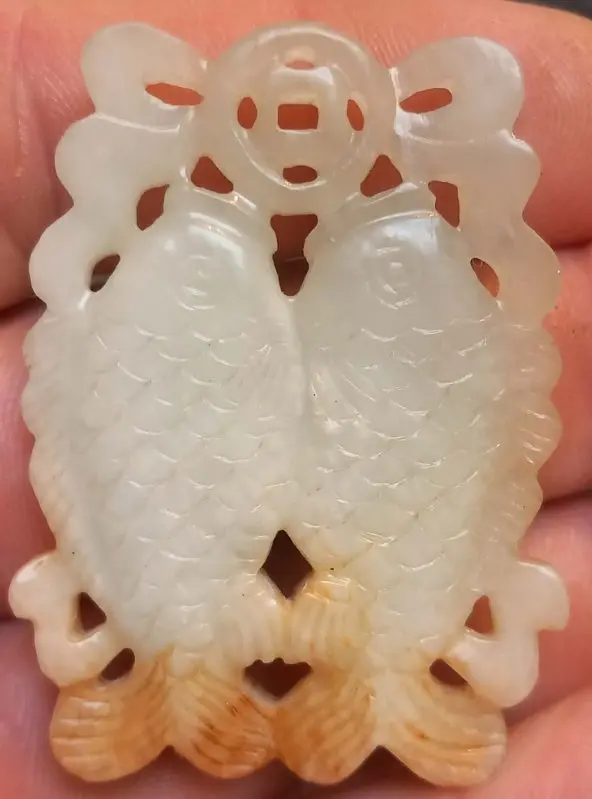
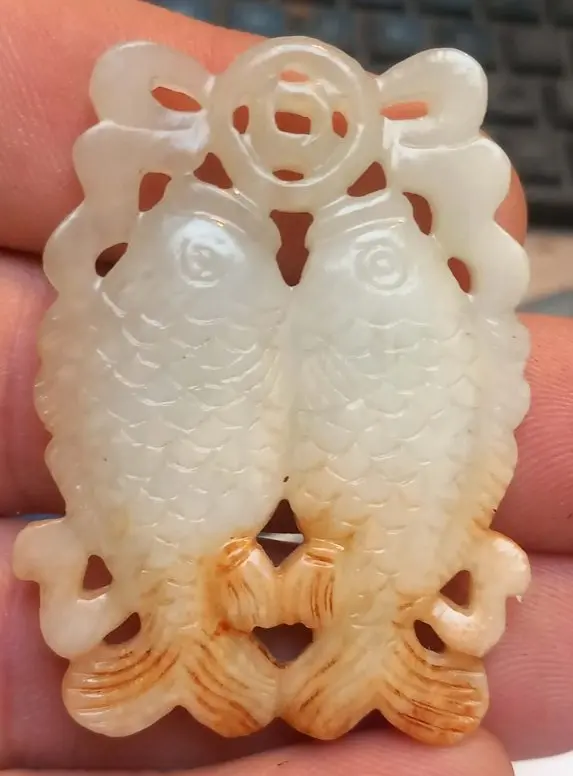
Chinese White Nephrite Jade 'Twin Fish' Pendant, late 20th Century
Estimated value
$150 - $350Rarity
Ordinary(3/10)Category
JewelryEra
Late 20th Century (circa 1970-1990)Origin
ChinaVisual assessment
Photo analysis
Save to revisit in your watchlist. This does not add the object to your own collection.
Chinese White Nephrite Jade 'Twin Fish' Pendant
A reticulated pendant carved from pale celadon-to-white nephrite jade depicting two carp (nian nian you yu) joined at the mouth by a silk ribbon and coin (lu) motif. The stone displays characteristic waxy luster and significant russet-orange inclusions focused at the base and tail sections, likely intended to simulate natural river skin or secondary weathering. The carving utilizes incised line work to define scales and radial grooves for the fins, typical of modern lapidary production.
Related traditions
Buddhist Iconography
1st Millennium CE to present
The Eight Auspicious Symbols (Ashtamangala) where fish represent the Ganges and Yamuna rivers.
Use and ceremony
Qing Dynasty
Primarily a symbol of marital fidelity and fertility due to the perceived 'pairing' of fish.
Modern Era
Broadly interpreted as a charm for financial prosperity and good fortune.
Origins and context
The 'Twin Fish' motif represents abundance and marital harmony, a staple of Chinese decorative arts popularized during the Ming and Qing dynasties. While this specific piece references Qing period aesthetics, the uniformity of the drill holes and the mechanical precision of the scale patterns suggest production from the late 20th century, likely originating from workshops in Suzhou or Henan province.
Further details
The 'Twin Fish' are one of the Eight Auspicious Symbols of Buddhism, signifying freedom from restraint and the state of fearless suspension in a sea of samsara.
In the Chinese language, the word for fish 'yu' is a homophone for 'abundance', making these pendants common gifts for Lunar New Year to wish for surplus wealth.
Attribution and evidence
The identification of the motif and material is highly stable, but the distinction between natural 'skin' and artificial color enhancement requires physical testing beyond photos.
Identifying details
- 1Material shows the greasy luster typical of nephrite jade rather than the glassy shine of jadeite.
- 2Traditional 'double fish' (shuangyu) composition with a standard lotus/coin top motif.
- 3Carving depth and finish suggest 20th-century production rather than 18th/19th-century lapidary work.
- 4Color distribution of the russet areas follows modern staining techniques often applied to lower-grade nephrite.
Open questions
- •Suspected dye or heat treatment to enhance the orange russet color at the base.
- •Uniformity of the scale patterns suggests semi-industrial manufacturing.
Photographs that would help
- Conduct a specific gravity test to confirm the material as nephrite (density approx. 2.90–3.03).
- Examine under a 10x jeweler's loupe for microscopic air bubbles (indicating glass) or dye concentrations in fissures.
- Perform a hardness test on an inconspicuous edge; jade should not be scratched by a steel blade.
Terms in this record
- Nephrite
- One of two minerals commonly called jade, known for its extreme toughness and waxy luster.
- Reticulated
- A carving technique involving piercing through the material to create a lace-like or openwork effect.
- Russet Skin
- The weathered outer layer of a jade pebble, often prized by carvers and frequently faked with dyes.
Wear and preservation
The piece appears structurally sound with no visible fractures or chips; the russet coloring at the base appears at home within the stone's natural fissures, though its intensity suggests possible artificial enhancement ('dyed skin').
Materials and construction
Sub-vitreous to waxy luster consistent with nephrite jade; the surface shows minor softening of edges from wear but retains sharp definitions in the recessed scale carves.
Recorded physical details
Estimated at 35-50 grams; nephrite has a high density and should feel cool to the touch with a substantial 'heft' for its size.
Scarcity and surviving examples
Ordinary · 3/10 estimated rarity
This is a qualitative collection score, not a measured survival count, market percentile or proof of authenticity.
What the photographs establish
Interpretation of the photographs and supplied context. This does not authenticate the object.
- The russet 'skin' at the base is very concentrated, a common feature in modern 'treated' jade to mimic aged artifacts.
- Tool marks in the reticulated areas suggest high-speed rotary tools rather than hand-abraded finishing.
- Nephrite must be distinguished from common serpentinite (Bownite) or quartz substitutes via a scratch or gravity test.
Value and its basis
Estimate recorded: May 11, 2026
How we estimate value
Estimate context (not a documented sale): Similar late-20th-century nephrite pendants frequently sell on platforms like Sotheby's (lower-tier sales) and specialized Asian art auctions for $200–$500.
Collectors and interest
Collectors of Chinese amulets, scholars of jade iconography, and buyers seeking traditional auspicious gifts.
What supports the estimate
- •Translucency of the white stone area
- •Complexity of the reticulation (pierced work)
- •Uniformity of color in the primary body
What could change it
- •Confirmation of artificial dye will significantly lower value to decorative levels
- •Detection of common stone substitutes such as 'Bowenite' or 'Henan Jade' (Serpentine)
Comparing quality
- •Pure 'mutton-fat' white color without green or grey tints
- •Authentic river-weathered skin with deep, varied oxidation
- •Provenance linking the piece to a pre-1911 collection
The effect of condition
Color purity, stone translucency, and the absence of internal 'clouds' or structural fractures.
Market interest
For informational purposes only, not a formal appraisal.
Related objects
Mid-Century 14K White Gold Modernist Star Ring
Shared title details
Mid-20th Century Gold Ring with Coral Cabochons
Shared title details
14K White Gold Cluster Pendant
Shared title details
Intricately Filigreed Silver-Tone Brooch or Pendant
Same category
Edwardian Peridot & Diamond Garland Brooch/Pendant c.1905
Same category
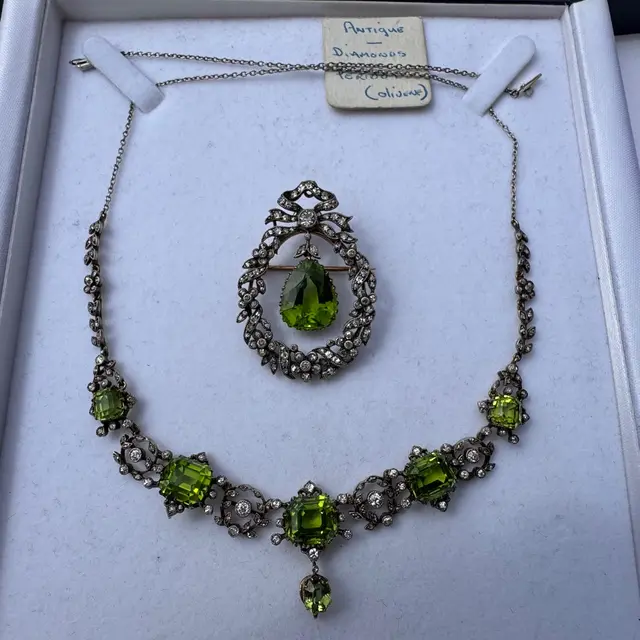
Late Victorian Peridot and Diamond Necklace and Brooch Suite c.1890
Same category
Explore Jewelry
Fine jewelry, costume pieces, rings, necklaces, bracelets, and brooches.
Jewelry value and rarity guideShare this find
A place for your jewelry
Keep its photographs, maker’s marks and the story you know in one object record. Start with a photo.
Create an account for 10 free scans. No credit card needed.
Join the conversation
Recognise a detail or have a question? Add what you know and cite your source. Suggested corrections stay in the discussion for the owner or a moderator to review.
Sign in to leave a comment
Sign in