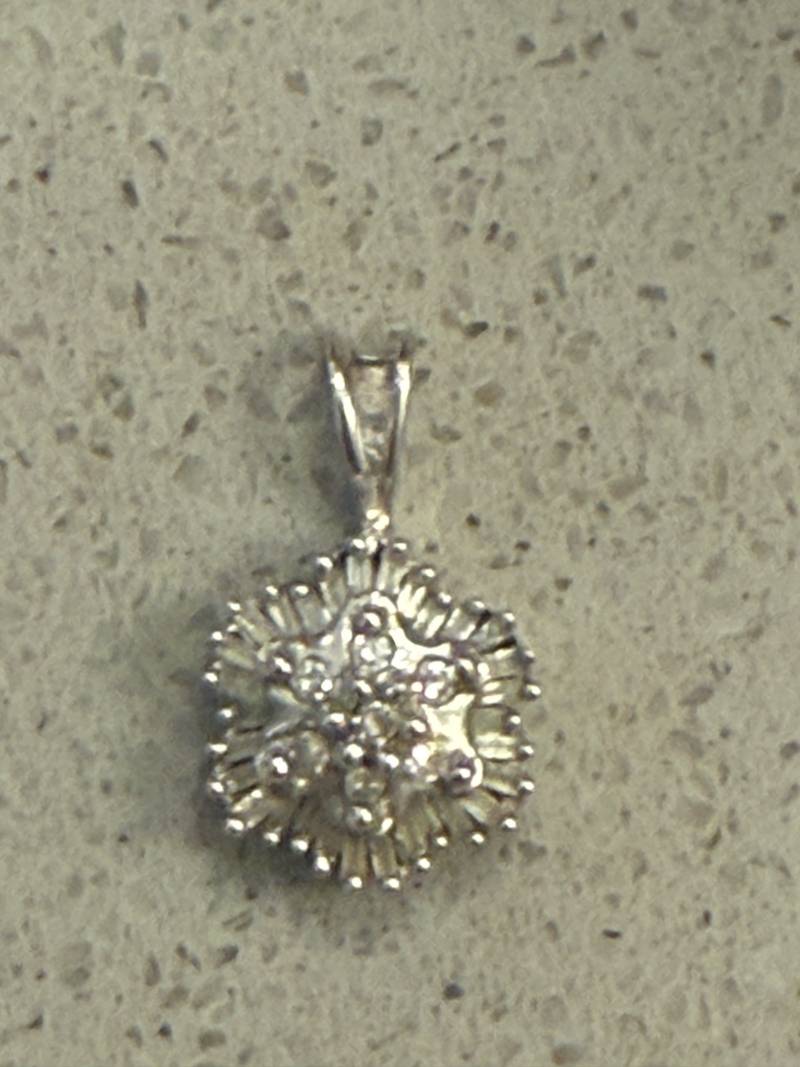
14K White Gold Cluster Pendant
Estimated value
$100 - $250Rarity
Common(2/10)Category
JewelryEra
Mid-to-late 20th Century (c. 1960-1990)Origin
InternationalAuthenticity
14K WHITE GOLD CLUSTER PENDANT: IDENTIFICATION
A 14-karat white gold pendant featuring a tiered floral or snowflake cluster motif. The primary stones, arranged in a central group surrounded by a radiating halo, are secured with standard prong settings. The piece is suspended from a polished, tapered 'rabbit ear' style V-bail. The reverse of the bail bears a standard '14K' purity stamp alongside a geometric maker's mark housed within a diamond-shaped cartouche.
CROSS-CULTURAL PARALLELS
Where This Object Echoes
The abstraction of floral elements into geometric multi-stone clusters reflects the broader 1950s movement toward stylized natural forms in American commercial adornment.
Ritual & Ceremonial Use
- •Utilized frequently as anniversary or 'sweet sixteen' milestone gifts during the latter half of the 20th century.
Meaning Through Time
Transitioned from being positioned strictly as formal evening wear to standard everyday jewelry for middle-class consumers.
SCARCITY
Older mass-produced items still widely available. Easy to find on eBay, antique malls, and estate sales in large quantities.
Typical Characteristics
- Mass produced historically
- High survival rate
- Readily available everywhere
Confidence Factors
- The '14K' stamp utilizes typography and uniform depth consistent with standard mid-to-late 20th-century commercial jewelry marking practices.
- The cast construction with integral prong settings aligns with documented mass-market manufacturing techniques for clustered goods.
GEMOLOGIST'S ASSESSMENT
Jewelry Historian & Gemologist-Informed Appraiser
The presence of a standard, verifiable purity stamp and recognizable casting techniques allows for accurate identification of the mount, though gemstone identity remains unverified pending physical testing.
KEY EVIDENCE
- 1Clear '14K' purity stamp indicating a 58.5% gold alloy.
- 2Unidentified geometric maker's mark struck within a diamond-shaped cartouche on the bail.
- 3Cast construction featuring tiered prong settings indicative of commercial volume production.
UNCERTAINTIES
- •The refractive index of the clear stones cannot be assessed via image, leaving it unverified whether they are natural diamonds, white sapphires, or synthetic substitutes.
WHAT WOULD IMPROVE CERTAINTY
- →Examine the stones under 10x magnification with a loupe to check for natural diamond inclusions or characteristic synthetic growth markers.
- →Perform a standard nitric acid test on an inconspicuous area to definitively verify the 14K metal composition.
CONDITION & GRADE
Grading breakdown
Assessed based on the structural integrity of the V-bail, the security of the visible prong settings, and the legibility of the stamped alloy hallmarks.
Condition
The metal shows surface wear primarily on the bail; all visible prongs appear intact and the central stones remain secure in their mountings. The hallmarks stamped on the reverse are struck evenly and remain legible.
GEMSTONE & METAL VALUE
Updated: Jul 23, 2026
eBay sold listings from 2023-2024 indicate unmarked 14K white gold small diamond cluster pendants typically trade between $100 and $250 depending on gross weight.
Who buys this
Bargain-conscious retail jewelry consumers and scrap gold aggregators sourcing secondary market materials.
What increases value
- •The intrinsic melt value of the 14K gold alloy based on daily spot market prices.
- •The measured carat weight of the stones if laboratory testing confirms them as natural diamonds.
What lowers value
- •If gemological testing determines the stones are cubic zirconia or paste, the value immediately drops to metal melt weight only.
- •Crushed or severed prongs requiring laser welding reconstruction.
What makes top-tier examples
- •The presence of high-color (G-H), eye-clean (VS) diamonds rather than standard commercial I-grade melee.
- •A recognizable, documented designer's mark accompanying the karat stamp.
Grade & condition
The integrity of the rhodium plating over the white gold alloy, the structural security of individual gemstone prongs, and the absence of deep gouges on the bail.
Rarity & demand
For informational purposes only, not a formal appraisal.
YOUR INPUT VS. SCAN
How your provided context compares with Curiosa.com scanner findings.
What Aligned
- The user's statement of 'Minor wear' is visually corroborated by the light micro-scratching present on the polished surface of the bail.
What Conflicted
- While the user identified the period as 'Mid-century', the specific casting style of this rabbit-ear bail indicates production likely extended into the 1970s or 1980s.
ABOUT JEWELRY
Fine jewelry, costume pieces, rings, necklaces, bracelets, and brooches.
Jewelry value and rarity guideSHARE THIS CURIOSITY
Have your own curiosities to discover?
Scan Your Curiosity
COMMENTS