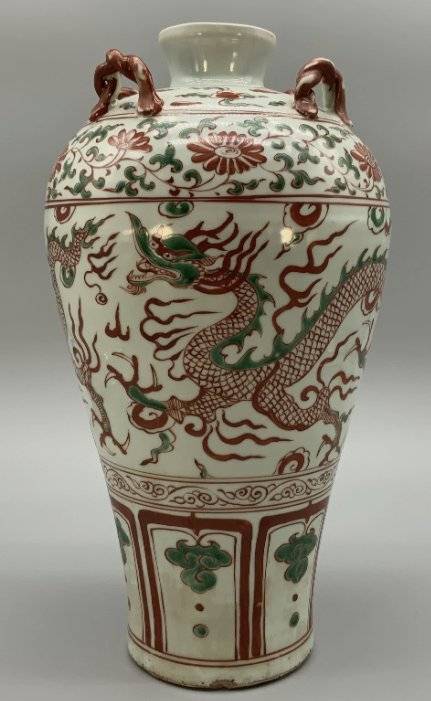
Wucai-style Meiping Vase with Dragon and Phoenix Motif
Estimated value
$150 - $450Rarity
Ordinary(3/10)Category
Ceramics & PotteryEra
Late 20th century to modernOrigin
ChinaAuthenticity
WUCAI-STYLE MEIPING VASE WITH DRAGON AND PHOENIX MOTIF: IDENTIFICATION
This ceramic vessel is a high-shouldered 'meiping' form featuring four applied 'cloud' or 'lingzhi' handles at the neck. The decorative program is executed in an iron-red and green enamel palette, simulating the Ming Dynasty Wucai tradition. Centrally, it depicts a four-clawed dragon amidst flame and cloud scrolls, bounded by a floral band at the shoulder and stylized petal lappets at the base. The base is unglazed, revealing a coarse, granular paste that has been artificially aged or patinated.
PRODUCTION & FIRING
SCARCITY
Standard antiques commonly found at estate sales and flea markets. Plentiful supply meets modest demand.
Typical Characteristics
- Moderate production runs
- Common at estate sales
- Entry-level collectibles
Confidence Factors
- Artificially aged/soiled unglazed base inconsistent with natural 400-year-old wear
- Stiff, repetitive brushwork in the dragon's scales and flame scrolls
- Glaze luminosity and enamel chemistry suggest modern chemical oxides rather than period minerals
Expert review recommended. Consider consulting a specialist before making purchasing decisions.
CERAMICIST'S ASSESSMENT
Ceramics Historian & Kiln Specialist
The identification is based on clearly visible stylistic inconsistencies and the highly suspicious treatment of the footrim, which is a hallmark of modern Jingdezhen 'fakes' or reproductions.
KEY EVIDENCE
- 1The unglazed base shows a 'biscuit' that is too uniformly dark; 16th-century pastes typically show orange 'oxidation rims' where the glaze meets the body.
- 2Form of the handles is atypical for the Wanli period; they appear somewhat clumsy in application.
- 3The 'white' ground is too bright and lacks the greenish or grayish-blue 'mutton fat' tint seen in early cobalt-rich glazes.
- 4Drawing of the dragon lacks the 'spirit resonance' (qiyun) found in genuine Ming brushwork; the line weight is too consistent.
UNCERTAINTIES
- •Intentional dirt/soot rubbed into the base to simulate age.
- •Absence of authentic glaze contraction or 'pinholing' expected in historic wood-fired kilns.
WHAT WOULD IMPROVE CERTAINTY
- →Conduct a 'tap test' with a wooden stick to check for a high-pitched ring (indicates high-fired porcelain) vs. a dull thud (indicates lower-fired pottery or cracks).
- →Inspect under UV light to see if the enamels fluoresce, which can distinguish modern chemical pigments from historical mineral-based ones.
- →Provide a high-resolution close-up of the dragon's face to assess the 'double-line' drawing technique.
CONDITION & GRADE
Grading breakdown
Structurally sound without visible cracks (fêlures) or major chips, though the base treatment suggests deliberate artificial aging used in modern Jingdezhen workshops.
Condition
Significant grit and 'kiln dirt' are present on the unglazed base, which appears intentionally applied rather than a result of natural firing accumulation. Minor surface abrasions are visible on the enamel, likely simulated wear.
Weight & feel
Based on the thick-walled foot and size, this vessel likely weighs between 2.5 and 3.5 kg, suggesting a heavy, sturdy construction common in modern reproductions.
CERAMICS MARKET VALUE
Updated: May 11, 2026
Who buys this
Primarily decorative buyers looking for 'Orientalist' room accents rather than serious numismatic or ceramic scholars.
What increases value
- •Large physical scale (approx 35-45cm) adds to 'presence' for interior design
- •Traditional dragon motif remains high in demand for gift-giving and feng shui
What lowers value
- •Disclosure as a modern reproduction significantly limits auction potential to local general sales
- •Artificial aging on the base is easily detected by specialists
What makes top-tier examples
- •Genuine 16th-century examples would have a slightly blue-ish glaze and irregular, handwritten reign marks
- •Natural iron spots ('heitao') in the paste from impurities
Grade & condition
Completeness of enamels, absence of structural cracks, and quality of hand-painting vs. stencil/transfer.
Rarity & demand
For informational purposes only, not a formal appraisal.
ABOUT CERAMICS & POTTERY
Pottery, porcelain, stoneware, earthenware, and kiln-fired objects.
Ceramics & Pottery value and rarity guideSHARE THIS CURIOSITY
Have your own curiosities to discover?
Scan Your Curiosity
COMMENTS