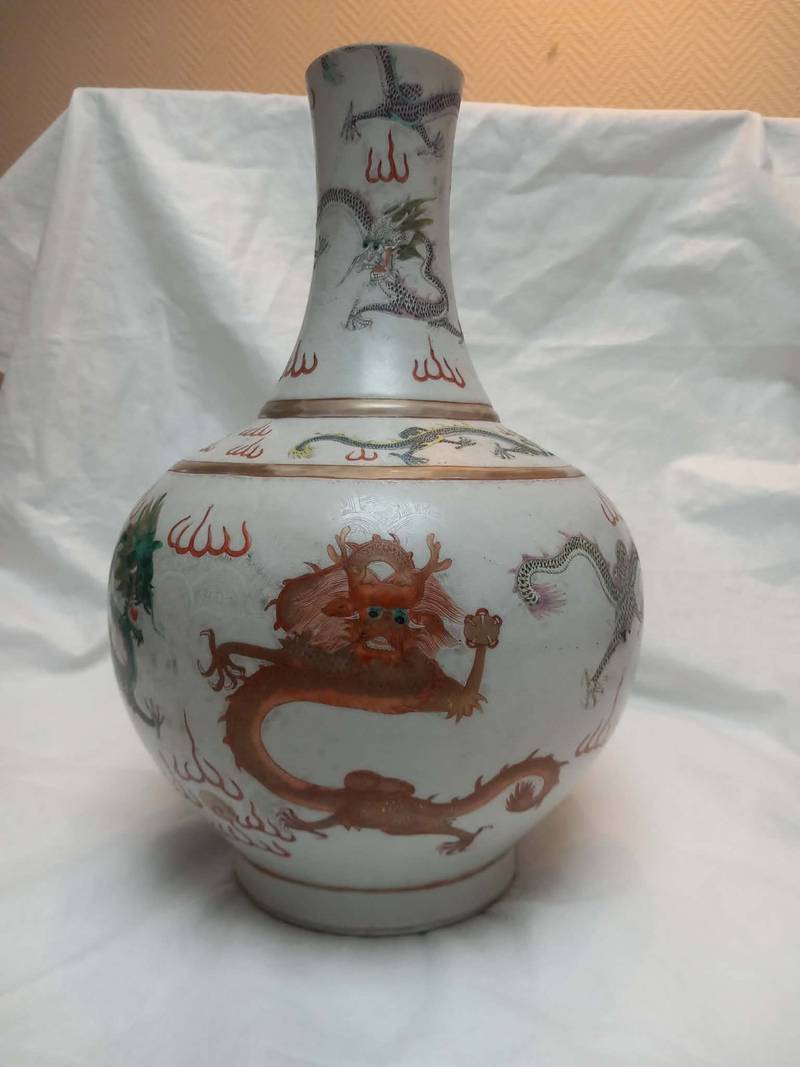
Chinese Famille Rose 'Dragon' Vase with Islamic Inscriptions, 20th Century
Estimated value
$150 - $450Rarity
Average(4/10)Category
Ceramics & PotteryEra
Circa 1920-1960Origin
ChinaArtist / Creator
Chinese vaasAuthenticity
CHINESE FAMILLE ROSE 'DRAGON' VASE WITH ISLAMIC INSCRIPTIONS, 20TH CENTURY: IDENTIFICATION
A globular porcelain vase with a tall flaring neck, decorated in the Famille Rose palette with five-clawed dragons chasing flaming pearls. The vessel is uniquely characterized by the inclusion of Arabic calligraphy rendered in iron-red enamel, likely repeating the word 'Allah'. The white glaze ground features an incised 'anhua' or secret decoration of swirling clouds, while the dragons are executed in polychrome enamels including green, pink, and iron-red. A central iron-red seal mark depicts two dragons flanking a rectangular cartouche containing pseudo-archaic seal script characters.
COLLECTOR NOTES
Similar 'Islamic-market' porcelain reached its peak popularity during the Zhengde period (1506-1521) when many court officials were Muslim Eunuchs.
SCARCITY
Typical antique shop fare. Requires some searching but regularly available. This is where most genuine antiques fall.
Typical Characteristics
- Standard antique shop items
- Regularly available
- Moderate collector interest
Confidence Factors
- Pseudo-archaic seal mark does not match standard Imperial reign marks
- Calligraphy appears stylized for decorative effect rather than formal script
- Enamel palette and gilding wear are consistent with mid-20th century decorative production
CERAMICIST'S ASSESSMENT
Asian Art Specialist
The object presents clear stylistic indicators of 20th-century export porcelain, but the absence of a shot showing the foot/base prevents a conclusive dating between the late Republic and mid-century periods.
KEY EVIDENCE
- 1Iron-red Arabic calligraphy integrated with traditional five-clawed dragons
- 2Presence of 'anhua' cloud motifs incised into the paste
- 3Famille Rose enamel palette featuring pink and light green translucent pigments
- 4Gold-painted bands showing significant surface oxidation and rubbing
- 5Atypical seal mark flanked by dragons, suggesting a private shop mark rather than an Imperial kiln mark
UNCERTAINTIES
- •The Arabic script is somewhat crude, suggesting the decorator may not have been literate in the language
- •The gilding appears to be a lower-quality overglaze 'liquid gold' rather than burnished leaf
WHAT WOULD IMPROVE CERTAINTY
- →Examine the footrim for unglazed paste texture and kiln grit
- →Check the interior of the neck for throwing rings or casting lines
- →Obtain a high-resolution image of the base under UV light to check for restorations
CONDITION & GRADE
Condition
Significant wear is visible on the gold-painted bands at the neck and shoulder. Frittering or minor glaze loss is evident near the base of the central seal mark.
Weight & feel
The globular form suggests a weight of 1.5 to 2.2 kg, typical for slip-cast or wheel-thrown export wares of this size.
CERAMICS MARKET VALUE
Updated: May 10, 2026
Who buys this
Collectors of Islamic-market Chinese porcelain and interior designers looking for unusual Chinoiserie accents.
What increases value
- •The rare combination of Islamic script and Imperial-style dragons
- •Large globular form with intact neck
What lowers value
- •Heavy wear to the gilding significantly impacts aesthetic value
- •The decorative nature of the mark limits appeal to high-end Imperial porcelain collectors
What makes top-tier examples
- •Authentic 16th-century examples of this hybrid style fetch exceeding $10,000 at Christie's
- •Superior calligraphy and thicker, vibrant enamel work
Grade & condition
Completeness of the gilding, clarity of the incised clouds, and lack of hairline cracks in the neck.
Rarity & demand
For informational purposes only, not a formal appraisal.
ABOUT CERAMICS & POTTERY
Pottery, porcelain, stoneware, earthenware, and kiln-fired objects.
Ceramics & Pottery value and rarity guideSHARE THIS CURIOSITY
Have your own curiosities to discover?
Scan Your Curiosity
COMMENTS