
Chinese Blue and Underglaze Red 'Dragon' Tianqiuping Vase, Yongzheng Mark
Estimated value
$400 - $1,200Rarity
Average(4/10)Category
Ceramics & PotteryEra
Mid-to-late 20th centuryOrigin
ChinaVisual assessment
Photo analysis
Save to revisit in your watchlist. This does not add the object to your own collection.
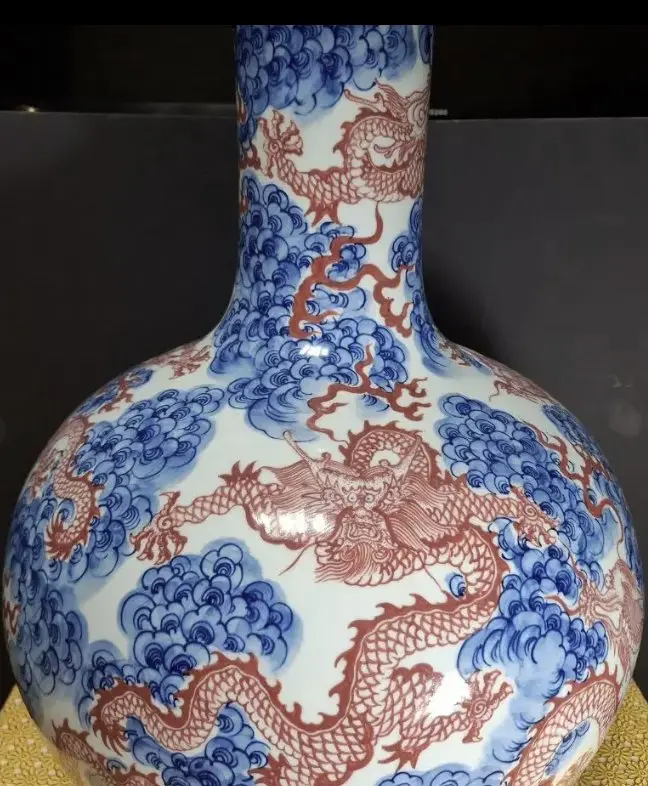
Chinese Blue and Underglaze Red 'Dragon' Tianqiuping
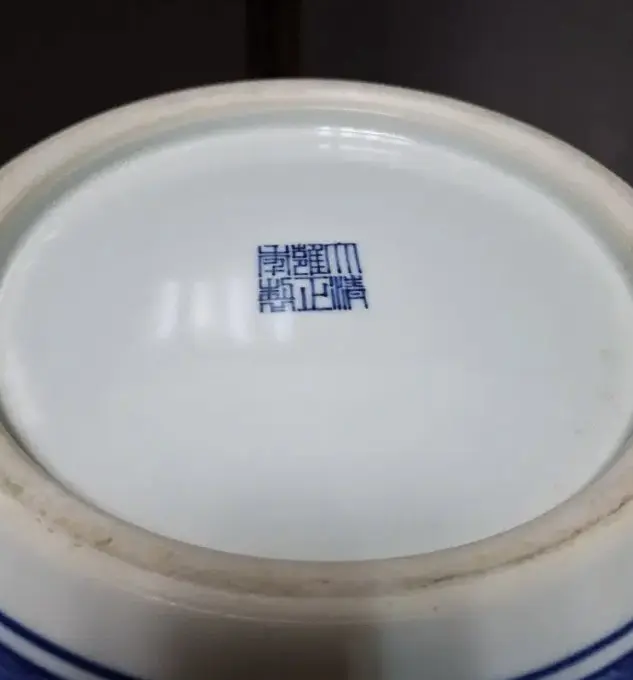
A Large globular 'Celestial Sphere' (Tianqiuping) vase featuring nine imperial five-clawed dragons writhing amidst stylized ruyi-form clouds. The decorative scheme utilizes underglaze cobalt blue for the clouds and copper red for the dragons. The base bears a six-character apocryphal seal mark in underglaze blue, written in archaic zhuanshu script, attributing the piece to the Yongzheng period (1723-1735). The execution of the copper red displays the characteristic 'mottled' texture often seen in 20th-century revivals.
Related traditions
Qing Imperial Court
1644-1912
The 'Tianqiuping' (Celestial Sphere) shape represents the Buddhist and Taoist concept of the round heavens.
Use and ceremony
18th Century
A display of extreme technical mastery over difficult kiln pigments.
Modern Era
High-end decorative interior objects evoking traditional Chinese 'Chinoiserie' aesthetics.
Origins and context
The Tianqiuping form originated in the Ming Dynasty Yongle period, inspired by Middle Eastern metalware. While the Yongzheng period was famed for its technical refinement in underglaze copper red—a notoriously difficult pigment that often turns grey or green in the kiln—this specific stylistic combination of vibrant blue clouds and sharply defined red dragons became a staple of 'Guangxu' revival and mid-20th century 'Jingdezhen' export productions. Sotheby's and Christie's have documented numerous 18th-century originals, which typically exhibit a deeper 'crushed strawberry' red and a more oily, unctuous glaze compared to the glassy surface visible here.
Further details
Underglaze copper red requires a reduction atmosphere in the kiln; if the oxygen level varies by even 1%, the red color can vanish or turn into a dull liver-brown.
The 'nine dragons' motif is deeply symbolic in Chinese numerology, as nine is the highest odd number and represents the supreme power of the Emperor.
Attribution and evidence
The form and motif are well-documented, but the visual indicators of the glaze and Mark-and-Period characteristics strongly suggest a 20th-century attribution rather than the claimed 18th-century origin.
Identifying details
- 1Apocryphal Yongzheng Nian Zhi seal mark in underglaze blue.
- 2Combination of underglaze blue and copper red (youlihong).
- 3Classic Tianqiuping globose form with a cylindrical neck.
- 4Sharp, precise lines in dragon scales indicative of modern stencil or highly controlled modern brushwork.
Open questions
- •The blue seal mark is centered too perfectly and the lines are of uniform thickness, common in 20th-century reproductions.
- •Lack of 'orange peel' texture in the glaze which is typical of authentic Yongzheng wares.
Photographs that would help
- Obtain a high-resolution close-up of the footrim paste and where the glaze meets the unglazed edge.
- Use a 10x jeweler's loupe to inspect for 'bubbles' within the glaze (the 'conjoined bubble' theory).
- Compare the specific calligraphy of the 'Zheng' character in the seal mark against known pieces in the Palace Museum collection.
Terms in this record
- Tianqiuping
- A large globular vase with a long neck, literally 'heavenly globe vase'.
- Youlihong
- Underglaze copper red decoration.
- Zhuanshu
- Archaic seal script used for imperial reign marks.
Wear and preservation
Condition appears excellent for a decorative piece, but the absence of natural calcification or micro-crazing suggests a more recent vintage.
The footrim shows moderate shelf wear and some artificial-looking grubbiness. No visible hairline fractures or glaze pops are evident in the provided images.
Glaze and painted decoration
The glaze exhibits a high-gloss, slightly mechanical reflective quality. The copper red shows 'heaping and piled' effects that appear intentionally applied rather than naturally occurring during firing.
Recorded physical details
Likely substantial and bottom-heavy, consistent with the 40-60 cm height common for this globose form.
Scarcity and surviving examples
Average · 4/10 estimated rarity
This is a qualitative collection score, not a measured survival count, market percentile or proof of authenticity.
What the photographs establish
Interpretation of the photographs and supplied context. This does not authenticate the object.
- The seal mark script is overly stiff and lacks the fluid calligraphic hand of authentic Yongzheng imperial wares.
- Copper red pigment color is too consistent and vibrant for an 18th-century firing.
- Footrim paste appears too white and smooth, lacking the 'oily' texture of period porcelain.
Value and its basis
Estimate recorded: May 11, 2026
How we estimate value
Estimate context (not a documented sale): Similar 20th-century 'Yongzheng mark' dragon vases typically realize $400-$1,200 at regional auctions (e.g., Bonhams regional or Leslie Hindman), whereas authentic period examples can exceed $500,000.
Collectors and interest
Primarily sought by interior designers for high-end decor or entry-level collectors of Chinese ceramics.
What supports the estimate
- •Large scale for impressive display
- •Popular 'Dragon' motif
- •Technical execution of the two-color underglaze
What could change it
- •Detection of modern chemical pigments
- •Surface scratches on the large globular body
- •Confirmation as a 1970s-80s export piece
Comparing quality
- •Presence of 'green splashes' in the red (sign of authentic 18th-century copper red)
- •Varying depths of blue in the clouds (mottle vs flat wash)
The effect of condition
Glaze integrity, clarity of the red pigment, and absence of chips on the footrim.
Market interest
For informational purposes only, not a formal appraisal.
Related objects
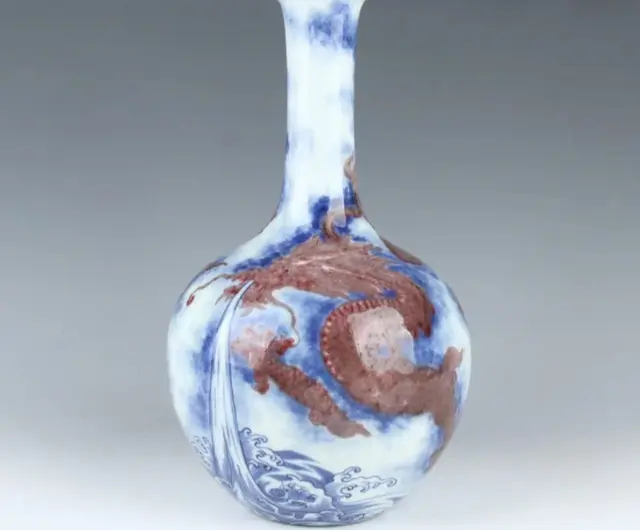
Chinese Blue and White with Underglaze Red 'Dragon' Bottle Vase, Qianlong Mark
Shared title details
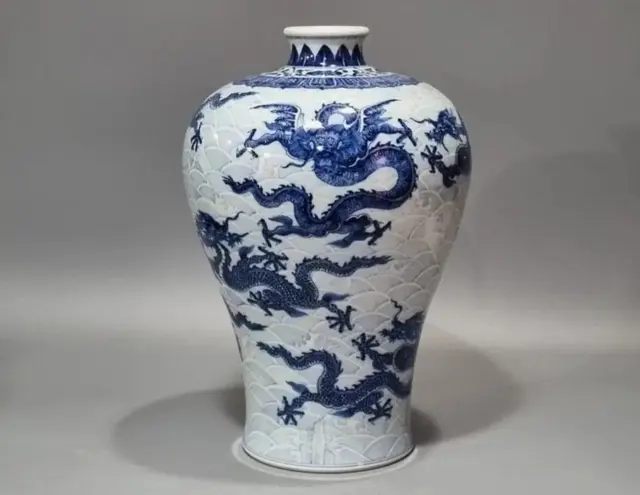
Chinese Blue and White 'Dragon' Meiping Vase, Qianlong Mark
Shared title details
Chinese Blue and White Porcelain 'Dragon and Phoenix' Charger
Shared title details
Chinese Famille Rose 'Dragon' Vase with Islamic Inscriptions, 20th Century
Shared title details
Chinese Blue and White 'Dragon' Dish
Shared title details
Blue and White Dragon Meiping Vase
Shared title details
Explore Ceramics & Pottery
Pottery, porcelain, stoneware, earthenware, and kiln-fired objects.
Ceramics & Pottery value and rarity guideShare this find
A place for your ceramics
Keep its photographs, maker’s marks and the story you know in one object record. Start with a photo.
Create an account for 10 free scans. No credit card needed.
Join the conversation
Recognise a detail or have a question? Add what you know and cite your source. Suggested corrections stay in the discussion for the owner or a moderator to review.
Sign in to leave a comment
Sign in