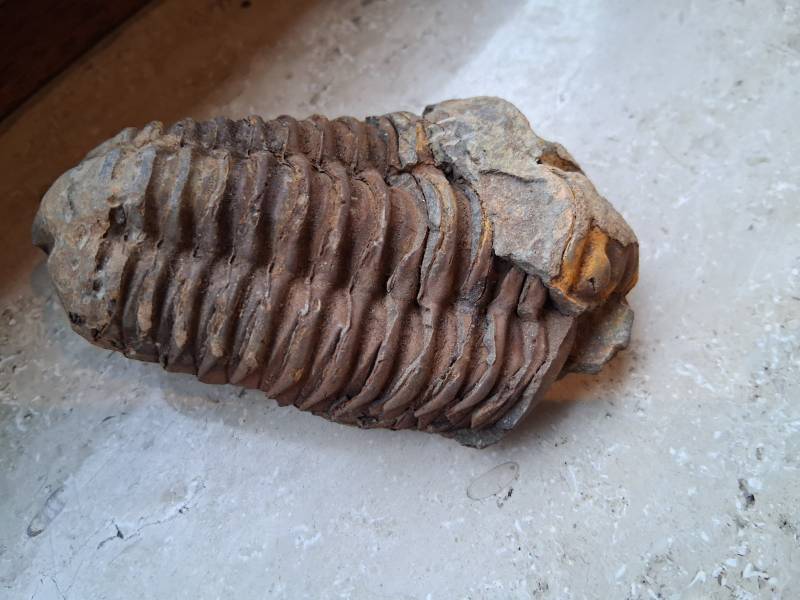
Trilobite - Flexicalymene ouzregui (Ordovician, Ktaoua Formation, Morocco)
Estimated value
$15 - $45Rarity
Common(2/10)Category
FossilsEra
Ordovician Period (c. 450 Million Years Ago)Origin
MoroccoArtist / Creator
trilobiteAuthenticity
TRILOBITE - FLEXICALYMENE OUZREGUI (ORDOVICIAN, KTAOUA FORMATION, MOROCCO): IDENTIFICATION
This specimen is a Calymenid trilobite, specifically of the genus Flexicalymene. The fossil demonstrates a robust enrollment or partial death-arch posture, preserving the articulated thoracic segments and cephalon. The exoskeleton displays a characteristic limonitic or sideritic oxidation, giving it a distinct reddish-brown ferruginous hue typical of the Ordovician outcrops near Alnif, Morocco. While the dorsal anatomy is largely visible, the cephalon is partially obscured by remaining parent matrix, and segments show some erosional weathering and lack of fine granular detail often found in professionally lab-prepared examples.
SCARCITY
Older mass-produced items still widely available. Easy to find on eBay, antique malls, and estate sales in large quantities.
Typical Characteristics
- Mass produced historically
- High survival rate
- Readily available everywhere
Confidence Factors
- Specimen shows natural growth variations and asymmetric weathering
- Highly common species where the cost of forgery exceeds the market value
- Matrix interface shows natural adhesion rather than resin carving
PALEONTOLOGIST'S TAKE
Paleontology Specialist
High confidence due to the distinct morphology, color, and matrix associations unique to the Moroccan Flexicalymene, which are extremely well-documented in paleontological literature.
KEY EVIDENCE
- 1Diagnostic glabella shape and thoracic segment count consistent with Calymenina suborder.
- 2Limonitic oxidation color is a hallmark of the Ktaoua Formation, Morocco.
- 3The presence of natural fracturing and matrix inclusions confirms this is a genuine permineralized fossil rather than a resin cast.
- 4Enrollment posture is a biologically accurate behavior preserved in the fossil record.
UNCERTAINTIES
- •Heavy matrix on the head may hide repairs, though unlikely for this value tier.
WHAT WOULD IMPROVE CERTAINTY
- →Examine the specimen under UV light to ensure no areas of the head have been reconstructed with resin or paint.
- →Determine if the matrix at the head can be further reduced using a pneumatic scribe to reveal facial sutures.
CONDITION & GRADE
Grading breakdown
The anatomical articulation is stable, but the lack of professional air-abrasive cleaning and the presence of significant obscuring matrix limit it to a 'commercial' rather than 'collector' grade.
Condition
The specimen is largely complete but roughly prepared. Significant matrix remains attached to the cephalon, and there is visible erosional loss on the pleural tips of the thoracic segments.
SPECIMEN MARKET VALUE
Updated: May 11, 2026
Similar specimens sell regularly on platforms like eBay and at mineral shows (e.g., Tucson Gem & Mineral Show) for $10-30 in bulk or $30-60 for selected singles.
Who buys this
Novice collectors, educators, and gift buyers seeking an affordable, recognizable fossil specimen.
What increases value
- •Degree of articulation in the thoracic segments
- •Presence of a visible cephalon (head)
- •Natural 'unfaked' appearance without heavy black paint
What lowers value
- •Rough preparation and obscuring matrix decrease aesthetic appeal
- •High market saturation for this specific locality and species
- •Mechanical damage to the segment tips
What makes top-tier examples
- •Perfect 3D preparation with no matrix
- •Retention of tiny 'genal spines' or granular surface detail
- •Large size exceeding 10 cm
Grade & condition
Completeness of the cephalon, level of matrix removal, and absence of modern restoration paint.
Rarity & demand
For informational purposes only, not a formal appraisal.
ABOUT FOSSILS
Prehistoric specimens, dinosaur fossils, amber inclusions, and ancient life forms.
Fossils value and rarity guideSHARE THIS CURIOSITY
Have your own curiosities to discover?
Scan Your Curiosity
COMMENTS