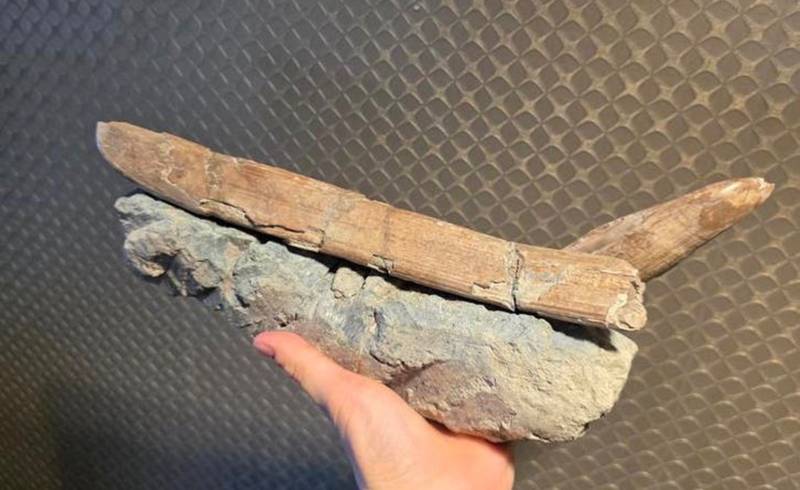
Fossilized Vertebrate Bone Fragments in Matrix (Likely Ribs/Limb Shafts)

Estimated value
$50 - $150Rarity
Average(4/10)Category
FossilsEra
Mesozoic Era (approx. 252 - 66 Million Years Ago)Origin
🌍 InternationalAuthenticity
FOSSILIZED VERTEBRATE BONE FRAGMENTS IN MATRIX (LIKELY RIBS/LIMB SHAFTS): ORIGINS & SIGNIFICANCE
This specimen consists of two substantial sections of permineralized fossil bone—likely fragments of ribs or limb bone shafts from a large vertebrate (such as a dinosaur or marine reptile)—presented on a block of hard grey matrix. The primary visible piece, measuring approximately 10–12 inches, exhibits genuine cortical bone texture characterized by longitudinal striations and deep diagenetic fissures resulting from ancient geological pressure. While the fossilized biological material itself is authentic, the dramatic, intersecting arrangement on the matrix block is highly indicative of a composite display piece. It is standard practice in commercial paleontology from regions like Morocco or Madagascar to take genuine but disjointed bones and aesthetically mount them into an augmented or reconstructed stone base to create a visually striking 'cabinet' specimen.
LIFE ACROSS EONS
Where This Object Echoes
The practice of romantically arranging disparate bone fragments into dramatic 'cabinet of curiosities' displays, prioritizing aesthetic wonder over strict geological accuracy.
Ritual & Ceremonial Use
- •The modern commercial practice of 'fossil preparation', a meticulous, sometimes highly interpretive process that transitions natural history relics from the earth into aesthetic collector's centerpieces in global markets.
Meaning Through Time
Often interpreted as the remainders of mythological creatures like dragons, giants, or cyclopes before the advent of modern paleontology.
Appreciated as deep-time relics, blending genuine scientific curiosity with high-end interior design aesthetics.
DEEP-TIME CHRONICLE
PREHISTORIC SURPRISES
The deep, prominent cracks visible on the surface of fossil bones are often referred to by preparators as 'diagenetic fracturing', which occurs over millions of years as the bone dehydrated and compressed under the immense weight of the earth.
Many novice collectors mistake large, pointed bone fragments or rib sections for 'giant dinosaur teeth', because commercial preparators often shape or orient them entirely for aggressive visual appeal.
HOW SCARCE IS IT?
Typical antique shop fare. Requires some searching but regularly available. This is where most genuine antiques fall.
Typical Characteristics
- Standard antique shop items
- Regularly available
- Moderate collector interest
Confidence Factors
- The geometric, highly aesthetic arrangement of two intersecting large bones strongly suggests a composite display where unrelated authentic fragments are mounted into an artificial matrix.
- The interface line between the bone pieces and the grey matrix appears unnaturally abrupt, lacking the gradual sedimentary transition typically seen in undisturbed geological burials.
- Commercial fossil markets frequently produce localized 'Frankenstein' pieces using real bone shards stabilized with adhesives and dyed rock dust.
Expert review recommended. Consider consulting a specialist before making purchasing decisions.
PALEONTOLOGIST'S TAKE
Paleontology Specialist
High confidence in recognizing the material as genuine, indeterminate fossilized vertebrate bone due to clear cortical textures, but somewhat structurally constrained in identifying exact taxonomy because critical diagnostic features (like articular ends) are missing or obscured.
KEY EVIDENCE
- 1Presence of authentic cortical bone texture with diagnostic longitudinal weathering and transverse diagenetic fracturing.
- 2Lack of enamel covering, serrations, or dental geometry completely rules out these being large teeth, firmly categorizing them as vegetative/skeletal bone structures.
- 3The uniform 'tool-marked' surface of the surrounding matrix block, combined with the artificially clean interface at the bone edges, points strictly toward post-extraction compositing rather than an undisturbed natural association.
UNCERTAINTIES
- •The main structural cracks threaten the integrity of the long horizontal fragment, necessitating stabilization with consolidants.
- •Without the articular ends (the terminal joints of the bones), assigning a specific taxonomic identification (exact species or limb type) remains effectively indeterminate.
WHAT WOULD IMPROVE CERTAINTY
- →Examine the specimen under short-wave UV light; adhesives, resins, and epoxies used in composite matrix reconstruction will typically fluoresce brightly, revealing the extent of the fabrication.
- →Carefully apply a professional, reversible fossil consolidant (such as Paraloid B-72 dissolved in acetone) directly into the prominent transverse cracks to halt further deterioration.
- →Inspect the tight seams where the bone meets the grey rock using heavy magnification to check for modern glue bubbling or a fabricated rock-dust slurry.
CONDITION & GRADE
Condition
The specimen exhibits significant transverse structural cracking across the primary bone shaft. The interface between the bone and matrix shows abrupt transitions, suggesting post-excavation assembly. The user accurately noted the need for restoration to properly secure the fracturing segments.
Surface
The bone specimens exhibit the classic weathered, fibrous micro-texture of natural cortical bone, complete with longitudinal channels and transverse fractures. The supporting grey matrix is unusually uniform and blocky, showing heavy tool marks characteristic of aggressive mechanical air-scribe preparation or artificial reconstruction.
Weight & feel
Due to the intense permineralization (where ancient organic bone marrow was replaced by heavy minerals like silica or calcite) combined with the stone block, this piece is likely quite dense and heavy, probably weighing several pounds.
SPECIMEN MARKET VALUE
Updated: Apr 9, 2026
Who buys this
Paleontology enthusiasts looking for striking, shelf-sized fossil displays, as well as interior designers seeking natural history decor pieces with dramatic profiles.
What increases value
- •The physical completeness and overall aesthetic silhouette of the bones themselves.
- •The capability to definitively tie the bone fragments to a highly sought-after species (e.g., T-Rex vs standard indeterminate reptile).
What lowers value
- •Confirmation that the matrix is purely fabricated and the bones are 'composited' limits museum or high-end scientific interest, restricting the piece entirely to the commercial decor market.
- •Further deterioration or splitting along the un-restored diagenetic cracks.
What makes top-tier examples
- •Undisturbed natural matrix associations proving the bones belonged together.
- •Professional, microscopically verified non-destructive mechanical preparation without the use of excessive fillers or colored slurries.
Grade & condition
The ratio of organic fossil material versus synthetic reconstruction filler, alongside total structural stability.
Rarity & demand
For informational purposes only, not a formal appraisal.
CONTEXT ANALYSIS
How your provided context compares with Curiosa.com scanner findings.
What Aligned
- The user's belief in the item's authenticity strongly aligns with the biological material itself; the bone displays undeniable, genuine cortical texturing and natural mineralization.
- The user's assessment that the item 'needs restoration' is exceptionally accurate, as the primary bone contains deep transverse fractures that risk fragmentation if not stabilized.
What Conflicted
- While the bone chunks themselves are 'original/authentic', visual evidence strongly suggests the overall physical presentation in the rock matrix is an engineered composite rather than an unbroken, naturally formed specimen.
SIMILAR CURIOSITIES
Trilobite - Phacops sp. (Devonian)
Megalodon Tooth (Carcharocles megalodon)
Fossil Megalodon Shark Tooth (Otodus megalodon)
Ammonite Fossil - Mortoniceras cf. inflatum
Petrified Wood (Silicified)
Fossilized Vertebra/Bone Fragment (Possibly Cetacean or other large mammal)
ABOUT FOSSILS
Prehistoric specimens, dinosaur fossils, amber inclusions, and ancient life forms.
Fossils value and rarity guideSHARE THIS CURIOSITY
Have your own curiosities to discover?
Scan Your Curiosity
COMMENTS
No comments yet. Be the first to share your thoughts!
Sign in to leave a comment