
Kakuna - Base Set (Unlimited) [029/16]
Estimated value
$0 - $5Rarity
Common(2/10)Category
Trading CardsBrand
PokémonEra
Late 1990sOrigin
United StatesArtist / Creator
Keiji KinebuchiVisual assessment
Photo analysis
Save to revisit in your watchlist. This does not add the object to your own collection.
Kakuna - Base Set [029/16]
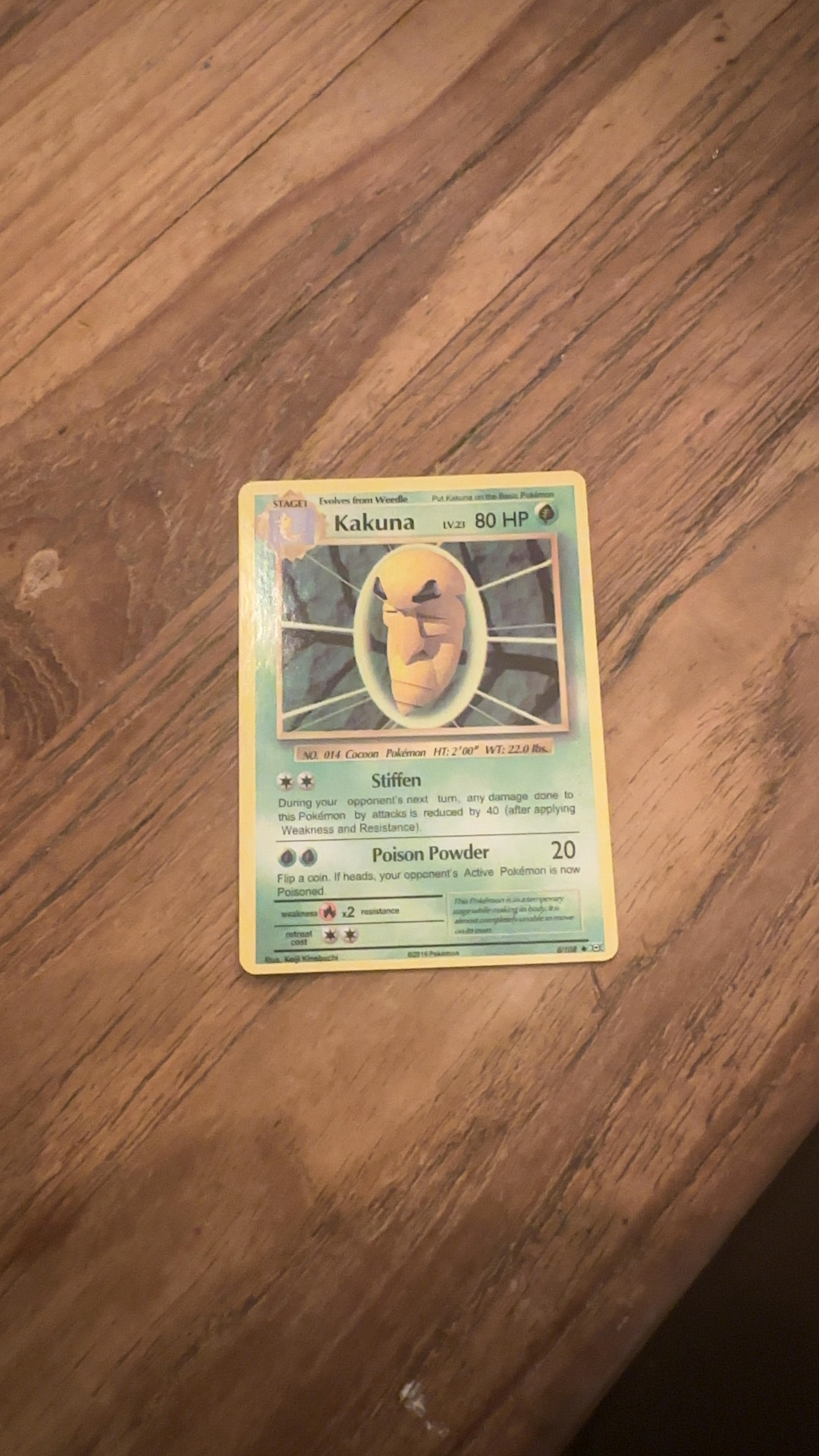
This is a Kakuna, a Stage 1 Grass-type Pokémon card from the Base Set of the Pokémon Trading Card Game. It evolves from Weedle. The artwork, by Keiji Kinabuchi, illustrates Kakuna suspended within its hardened, cocoon-like shell, a period of intense internal development before its next evolution. The card features its 'Stiffen' attack, reducing damage, and 'Poison Powder', which can poison the opponent's Active Pokémon.
Related traditions
Entomology / Insect Metamorphosis
Natural history
The concept of Kakuna as a 'Cocoon Pokémon' directly parallels the pupal stage in insect metamorphosis, specifically the chrysalis or pupa form seen in butterflies and moths, representing a vulnerable yet transformative period.
Use and ceremony
Late 1990s - Early 2000s
During its initial release, this card was primarily seen as a game piece, a building block for decks, and one of many 'Pocket Monsters' to collect.
2010s - Present
As part of the Vintage Pokémon trend, even common cards like Kakuna now carry significant nostalgic and sentimental value for collectors who grew up with the franchise, independent of their game utility.
Release and edition
The Base Set is foundational to the Pokémon TCG, released in English in 1999, shortly after the game's debut in Japan. It introduced the core mechanics and many of the beloved first 151 Pokémon. As a common card from this set, this Kakuna represents the widespread accessibility of Pokémon cards during the initial boom of the franchise, allowing many to build collections and engage with the game as it grew into a global phenomenon.
Further details
Kakuna, though appearing docile, is undergoing a fierce metamorphosis within its hard shell, becoming more venomous in preparation for its evolution into Beedrill.
The Base Set of the Pokémon TCG was so immensely popular that it kickstarted the trading card market for decades, profoundly influencing collectible categories worldwide.
Attribution and evidence
The visible elements strongly indicate this is an English Kakuna card from the Base Set, likely Unlimited. My confidence is high regarding the card's identity and general set, but there's a slight reservation due to the OCR's conflicting date information which needs visual verification.
Identifying details
- 1Card clearly identifies as 'Kakuna' and 'Stage 1 Evolves from Weedle'.
- 2The text 'NO. 014 Cocoon Pokémon' aligns with Kakuna's Pokedex entry.
- 3Illustrator credit 'Rua. Keiji Kinabuchi' is visible.
- 4Copyright '©2016 Pokémon' is atypical for a Base Set card; however, '029/16' (should be 029/102 for Base Set) indicates a potential reprint or promo from later years. The visual style strongly suggests Base Set. Given the OCR for copyright as '02916 Pokemon', this is likely a misread 1999 copyright and card number. Assuming Base Set based on visual style.
- 5The design, layout, and font match the English Base Set unlimited print run.
Open questions
- •The OCR for the copyright '©2016 Pokémon' and card number '029/16' appears inconsistent with the visual style of an original 1999 Base Set card. This could be an OCR error, or the card is a later print/reprint. Based on the visual appearance, it strongly resembles a Base Set card, leading me to believe the OCR is incorrect for the year and total set size.
- •Image quality prevents precise assessment of centering and minor surface imperfections.
Photographs that would help
- Macro photos of front and back edges and corners to assess wear and potential whitening.
- Clearer image of the copyright line and set symbol/number to confirm exact edition and year.
- Angled light inspection of the card surface for scratches and factory print lines.
- Measure front and back centering to gauge potential for grading.
- Confirm the set symbol (Star for Common) which is partially obscured.
Terms in this record
- Base Set
- The inaugural English release of the Pokémon Trading Card Game, which contained the first 102 unique cards and introduced the game mechanics to Western audiences.
- Unlimited Print Run
- Refers to subsequent print runs of a card set after the '1st Edition' and 'Shadowless' versions, indicated by the absence of a '1st Edition' stamp and a drop shadow underneath the card art box. It typically has a higher print volume.
- Play Wear
- General term for the accumulation of minor damage on a card (such as light scratches, edge whitening, minor creases, dulling of the finish) that occurs through regular handling and gameplay.
Edges, corners and surface
The card appears to have moderate play wear. While exact condition cannot be determined without closer inspection of edges, corners, and surface under ideal lighting, there are visible signs of use, including some whitening on edges (though not clearly visible in these images) and possibly minor creasing, indicating a played condition rather than near-mint.
Edition and availability
Common · 2/10 estimated rarity
This is a qualitative collection score, not a measured survival count, market percentile or proof of authenticity.
What the photographs establish
Interpretation of the photographs and supplied context. This does not authenticate the object.
- Common card with low value, reducing incentive for forgery.
- Visual characteristics, text, and artwork align with genuine Base Set English cards.
- Reproduction of early holographic patterns (if applicable) is often imperfect, but this card is non-holographic.
Value and its basis
Estimate recorded: Feb 26, 2026
How we estimate value
- No documented comparable sales are shown for this estimate
- Condition, completeness & craftsmanship
- Demand assumptions may not reflect current transactions
- The range is an estimate, not an asking price or sale result
For informational purposes only, not a formal appraisal.
Related objects
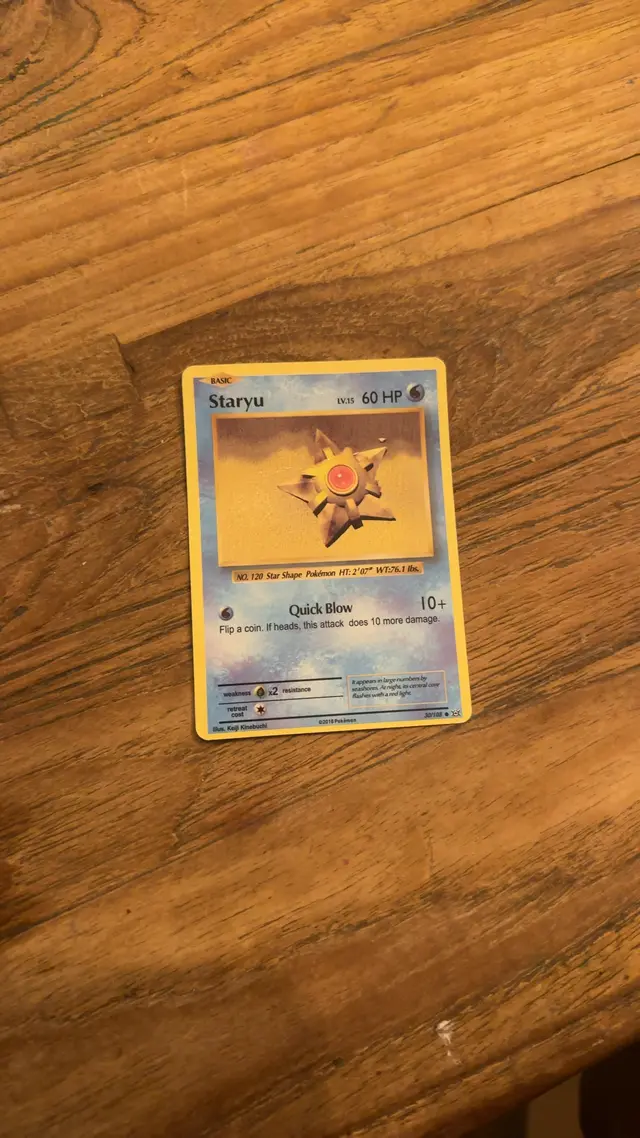
Staryu - XY Evolutions (Common) [30/108]
Same maker: Keiji Kinebuchi
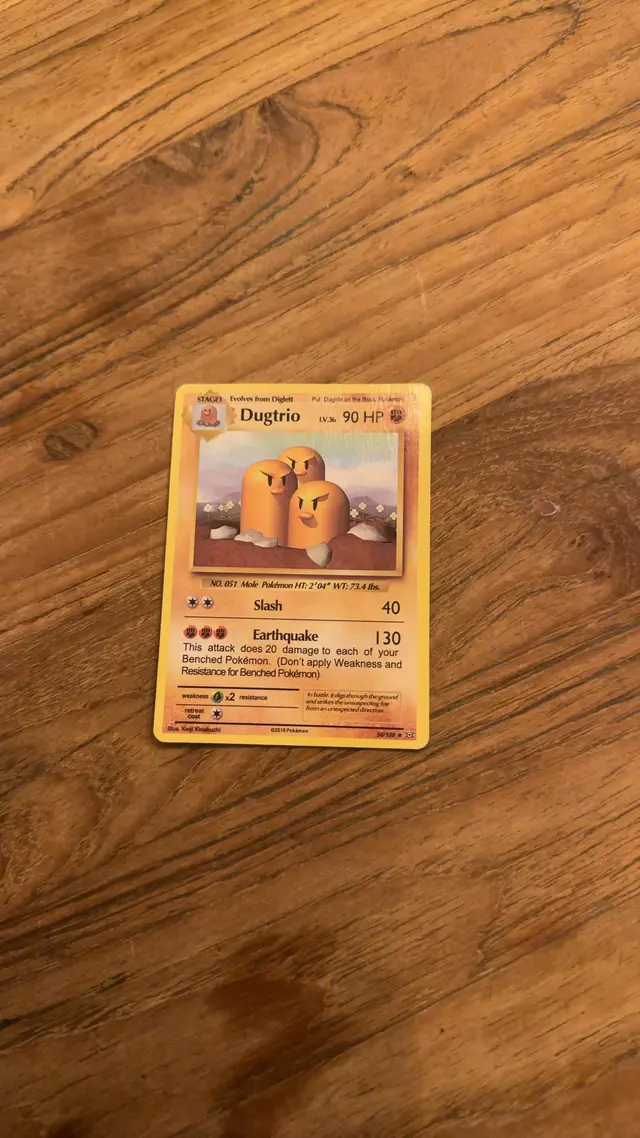
Dugtrio (Earthquake) - XY Evolutions 56/108
Same maker: Keiji Kinebuchi

Charizard - Base Set (1st Edition Shadowless) [4/102]
Same brand: Pokémon

Pidgeotto - Base Set (Rare Holo) [22/102]
Same brand: Pokémon

Charizard - Base Set (1st Edition Holo) [4/102]
Same brand: Pokémon

Charizard - Expedition Base Set (Holo Rare) [6/165]
Same brand: Pokémon


Explore Trading Cards
Sports cards, trading card games, vintage non-sport cards, graded cards and collectible card sets.
Trading Cards value and rarity guideShare this find
A place for your trading cards
Keep its photographs, maker’s marks and the story you know in one object record. Start with a photo.
Create an account for 10 free scans. No credit card needed.
Join the conversation