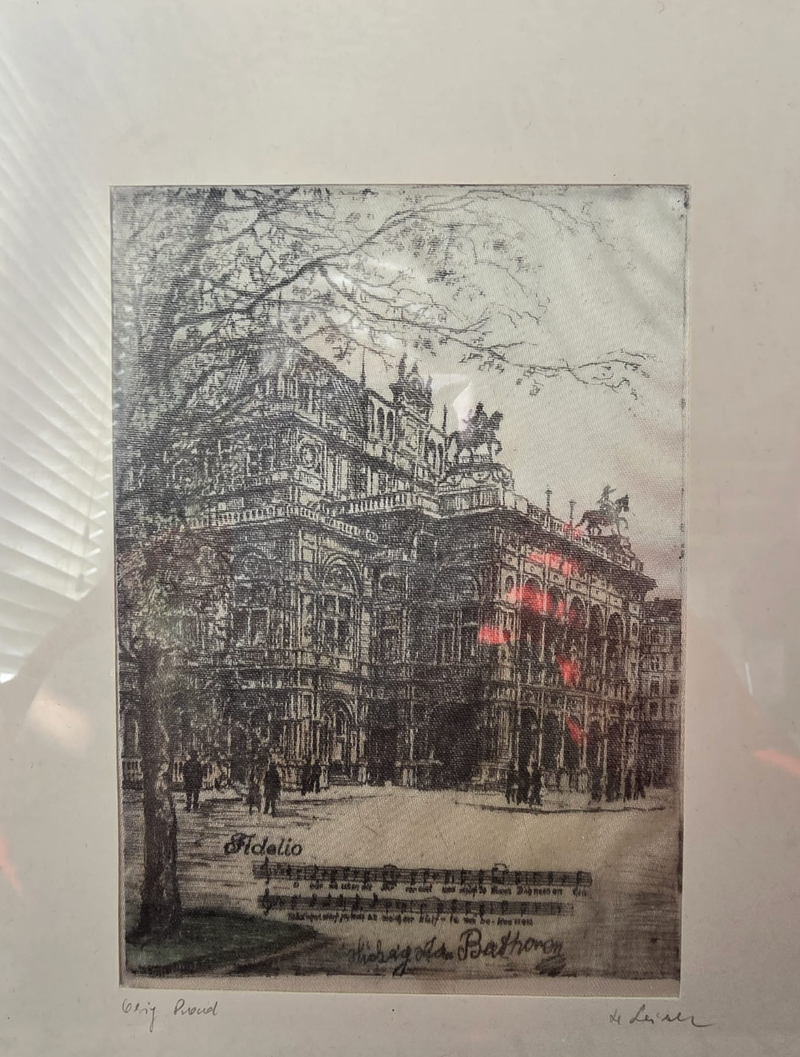
Luigi Leisner (1889-1970) - 'Fidelio', Etching of the Vienna State Opera, c. 1920-1940
Estimated value
$75 - $175Rarity
Average(4/10)Category
Prints & PostersEra
c. 1920-1940Origin
AustriaArtist / Creator
Luigi LeisnerAuthenticity
LUIGI LEISNER (1889-1970) - 'FIDELIO', ETCHING OF THE VIENNA STATE OPERA, C. 1920-1940: IDENTIFICATION
Original etching on paper depicting the Vienna State Opera (Wiener Staatsoper) under a bare winter tree. The lower portion of the plate features a hand-etched musical staff with notes from Beethoven's opera 'Fidelio' and the inscription 'Ludwig van Beethoven'. The work is signed in pencil 'L Leisner' in the lower right margin and inscribed 'Orig Rad' (Original Radierung) in the lower left.
PRINT LINEAGE
COLLECTOR NOTES
The 'Fidelio' musical motif depicted is specifically the quartet from Act I, a piece often used to symbolize Viennese musical heritage.
SCARCITY
Typical antique shop fare. Requires some searching but regularly available. This is where most genuine antiques fall.
Typical Characteristics
- Standard antique shop items
- Regularly available
- Moderate collector interest
Confidence Factors
- Hand-penciled signature and inscription 'Orig Rad' follow standard period professional standards
- Plate mark indentation is visible along the border, confirming it is an intaglio print rather than a reproduction
- Style and subject matter are consistent with Leisner's cataloged oeuvre from the early 20th century
PRINT SPECIALIST'S TAKE
Museum-Trained Art Historian
The artist is well-documented within this specific niche of Austrian printmaking, and all visual markers—signature, inscription, and plate mark—align with period originals.
KEY EVIDENCE
- 1Clear intaglio plate mark visible on all four sides of the image
- 2Pencil signature 'L Leisner' matches known auction examples from Dorotheum (Vienna)
- 3German shorthand 'Orig Rad' (Original-Radierung) confirms contemporaneous Austrian origin
- 4The architectural rendering reflects the pre-WWII facade of the Staatsoper
UNCERTAINTIES
- •Paper cockling indicates the print has been framed without acid-free materials
- •Presence of red reflections in the image are artifacts of photography through glass, not on the artwork itself
WHAT WOULD IMPROVE CERTAINTY
- →Examine the reverse of the frame for original gallery labels or inventory marks
- →Remove from the current frame to check for acid-free mounting and assess full paper condition
- →Verify the watermark on the paper by holding it up to a light source
CONDITION & GRADE
Grading breakdown
The etching itself remains Crisp, but the paper support shows significant cockling and signs of mat burn around the edges of the window. No visible foxing or moisture staining is present in the central image area.
Condition
The paper shows evident wave-like distortions (cockling) suggesting it is not currently held under uniform tension or has been exposed to humidity. There is visible toning (yellowing) to the margins consistent with non-archival matting materials commonly used in mid-century framing.
PRINT MARKET VALUATION
Updated: May 11, 2026
Similar Luigi Leisner etchings of the Vienna Opera and St. Stephen's Cathedral frequently realize between $80-$150 at European regional auctions such as Dorotheum.
Who buys this
Collectors of Viennese memorabilia, opera enthusiasts, and enthusiasts of early 20th-century European cityscapes.
What increases value
- •Association with Beethoven's Fidelio increases the cross-category appeal to music collectors
- •Authentic pencil signature and 'Orig Rad' inscription verify it as a lifetime print
What lowers value
- •Paper condition (cockling) may require professional flattening and re-matting
- •High volume of similar city etchings from this period limits maximum price ceiling
What makes top-tier examples
- •Large margins and lack of mat burn
- •Pristine white paper without foxing
- •Earlier proofs with sharper line definition
Grade & condition
Condition grade is primarily determined by paper oxidation (toning) and the severity of mechanical distortions like cockling.
Rarity & demand
For informational purposes only, not a formal appraisal.
ABOUT PRINTS & POSTERS
Vintage prints, posters, advertising signs, and graphic art.
Prints & Posters value and rarity guideSHARE THIS CURIOSITY
Have your own curiosities to discover?
Scan Your Curiosity
COMMENTS