Mid-Century Abstract Ink Wash Drawing, Dated 1963
Authenticity
MID-CENTURY ABSTRACT INK WASH DRAWING, DATED 1963: IDENTIFICATION
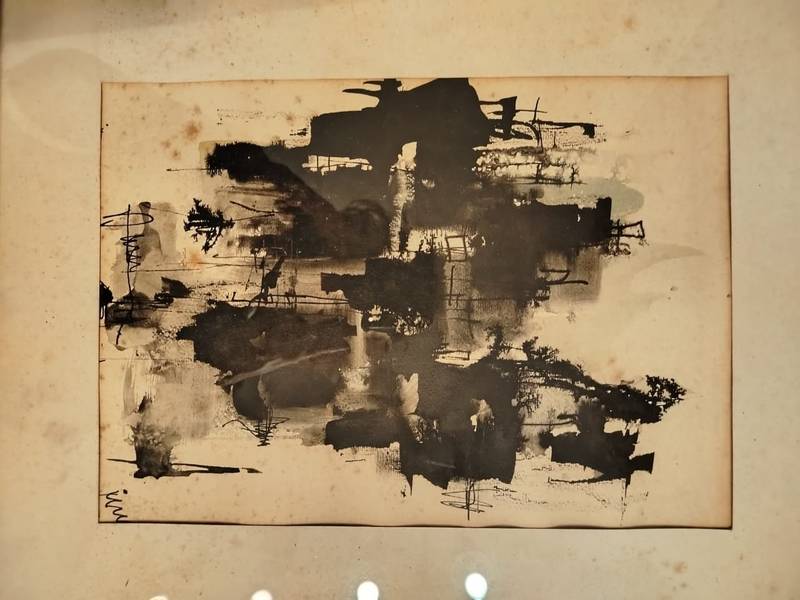
An original abstract composition executed in black ink wash and fine pen on paper. The artwork features bold, gestural pooling contrasted with sharp, architectural linear scaffolding. A signature appears in the lower margin reading 'jiri' or similar, accompanied by the date 'II 63' (February 1963). The paper substrate exhibits significant age-related foxing and acid burn from prior framing.
CROSS-CULTURAL PARALLELS
Where This Object Echoes
The use of spontaneous ink wash mirrors the Tachisme movement popularized in postwar Paris and Eastern Europe.
Ritual & Ceremonial Use
- •The mounting of works on paper using acidic cardboard mats was standard domestic framing practice in the mid-20th century, a convention that has since been replaced by archival conservation methods.
Meaning Through Time
Mid-century abstract works on paper transitioned from contemporary gallery pieces in the 1960s to sought-after vintage interior design anchors by 2010.
PERIOD & ATTRIBUTION
Created in 1963, this work reflects the global influence of Art Informel and Tachisme during the postwar period. The integration of spontaneous, fluid ink washes with rigid, geometric linework was a standard method among mid-century modernists in Europe seeking to balance gestural abstraction with structural form.
COLLECTOR NOTES
The Roman numeral 'II' followed by '63' in the signature line is a standard European dating convention indicating February 1963.
The technique of contrasting broad ink washes with delicate pen lines is characteristic of Tachisme, a European abstract movement that peaked between 1945 and 1960.
SCARCITY
Genuine antiques with fewer examples on the market. Named makers, documented provenance, or early production examples.
Typical Characteristics
- Limited production
- Named makers
- Growing collector demand
Confidence Factors
- Natural aging of the paper and ink is visually consistent with a 1963 creation date.
THE ART SPECIALIST'S TAKE
Museum-Trained Art Historian
The era, medium, and physical condition are clearly legible from the images, but the lack of definitive signature identification limits attribution confidence.
KEY EVIDENCE
- 1Dated 'II 63', establishing creation in February 1963.
CONDITION & GRADE
Grading breakdown
Significant foxing and acid burn severely detract from the visual integrity of the unpainted negative space; requires professional paper conservation to stabilize.
Condition
The paper exhibits pervasive foxing across the sheet, likely caused by iron impurities in the paper reacting with high humidity over 60 years. Severe acid burn is visible along the perimeter where a non-archival mat previously rested.
ART MARKET VALUATION
Updated: Sep 1, 2026
- Market comparables from auctions & retail
- Condition, completeness & craftsmanship
- Current collector demand & trends
- Low = quick sale, high = patient seller
For informational purposes only, not a formal appraisal.
YOUR INPUT VS. SCAN
How your provided context compares with Curiosa.com scanner findings.
What Aligned
- User's belief that the item is original is supported by the visible fluid dynamics of the ink wash and distinct pen impressions on the paper grain.
- User's note that the piece 'needs restoration' is accurate, as evidenced by severe foxing and acid mat burn visible on the substrate.
What Conflicted
- User requested the artist's identity, but the stylized signature combined with the lack of provenance prevents a definitive attribution; 'jiri' points toward a potential Czech origin, but confirmation requires physical inspection.
ABOUT PAINTINGS
Oil paintings, watercolors, acrylics, and painted works on canvas, panel, and paper.
Paintings value and rarity guideSHARE THIS CURIOSITY
Have your own curiosities to discover?
Scan Your Curiosity
COMMENTS