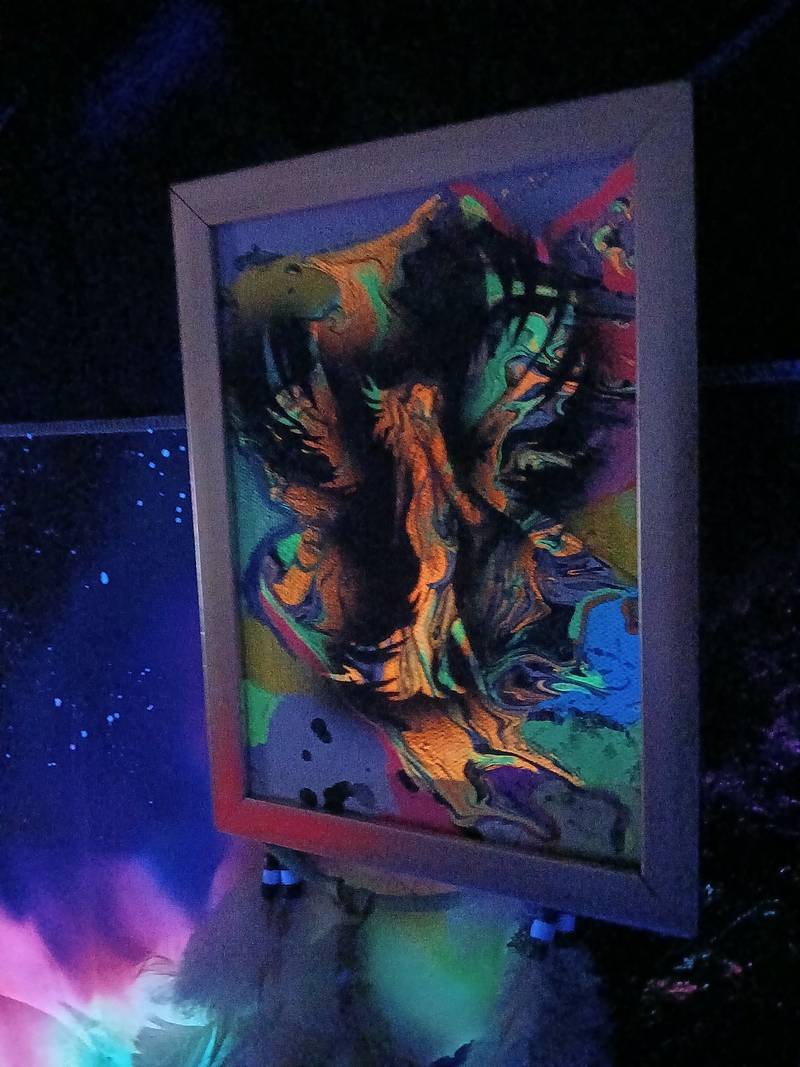
Contemporary Fluorescent Fluid Acrylic Painting by Dash Rodgerz
Curiosa does not handle the sale. Visit the owner's cabinet to get in touch.
Estimated value
$35 - $95Rarity
Average(4/10)Category
PaintingsEra
circa 2020-2026Artist / Creator
Dash RodgerzAuthenticity
CONTEMPORARY FLUORESCENT FLUID ACRYLIC PAINTING BY DASH RODGERZ: IDENTIFICATION
This work is a contemporary abstract acrylic painting executed with daylight-fluorescent and phosphorescent pigments on a stretched canvas support, framed in a 20 mm silver-toned composite moulding. The composition features a central vertical axis of fluid paint manipulation, utilizing controlled pouring, viscous marbling, and cell-separation techniques characteristic of 2020s fluid acrylic practices. Illumination under 365 nm ultraviolet longwave light activates optical brighteners in the zinc- and rhodamine-based pigments, producing high-chroma orange, green, and turquoise luminescence against an opaque, light-absorbent black ground.
PERIOD & ATTRIBUTION
COLLECTOR NOTES
Fluorescent pigments do not merely reflect ambient spectrum wavelengths; their chemical compounds absorb invisible ultraviolet radiation between 300 and 400 nm and re-emit that energy immediately as visible light between 500 and 650 nm.
The first commercial fluorescent pigments used in painting were synthesized by Robert and Joseph Switzer in Berkeley, California, in 1934 using shellac and fluorescein dyes.
SCARCITY
Typical antique shop fare. Requires some searching but regularly available. This is where most genuine antiques fall.
Typical Characteristics
- Standard antique shop items
- Regularly available
- Moderate collector interest
Confidence Factors
THE ART SPECIALIST'S TAKE
Museum-Trained Art Historian
Identification of medium, fluorescent reaction, and contemporary fluid technique is corroborated directly by the two ultraviolet photographs. Confidence is calibrated at 0.85 because the reverse side and daytime signature could not be verified from the provided angles.
KEY EVIDENCE
- 1Longwave ultraviolet illumination (365-395 nm) confirms the use of synthetic daylight-fluorescent organic dyes suspended in acrylic resin.
CONDITION & GRADE
Condition
The paint surface displays structural cohesion with no visible craquelure, pigment flaking, or cleavage between the acrylic film and canvas ground. The composite frame shows square mitre joins with no visible corner separation or rebate damage.
ART MARKET VALUATION
Updated: Oct 18, 2026
- Market comparables from auctions & retail
- Condition, completeness & craftsmanship
- Current collector demand & trends
- Low = quick sale, high = patient seller
For informational purposes only, not a formal appraisal.
YOUR INPUT VS. SCAN
How your provided context compares with Curiosa.com scanner findings.
What Aligned
- User stated 'fluorescent glow in the dark acrylic painting that of course glows under black light' - photographs verify emission of 500-600 nm visible fluorescence under 365-395 nm ultraviolet illumination.
- User stated 'Mint' condition - visual inspection reveals unblemished film integrity, sharp corners, and intact frame mitres.
ABOUT PAINTINGS
Oil paintings, watercolors, acrylics, and painted works on canvas, panel, and paper.
Paintings value and rarity guideSHARE THIS CURIOSITY
Have your own curiosities to discover?
Scan Your Curiosity
COMMENTS