
Mid-Century Modern Cantilever Armchair
Visual assessment
Photo analysis
Save to revisit in your watchlist. This does not add the object to your own collection.
Mid-Century Modern Cantilever Armchair
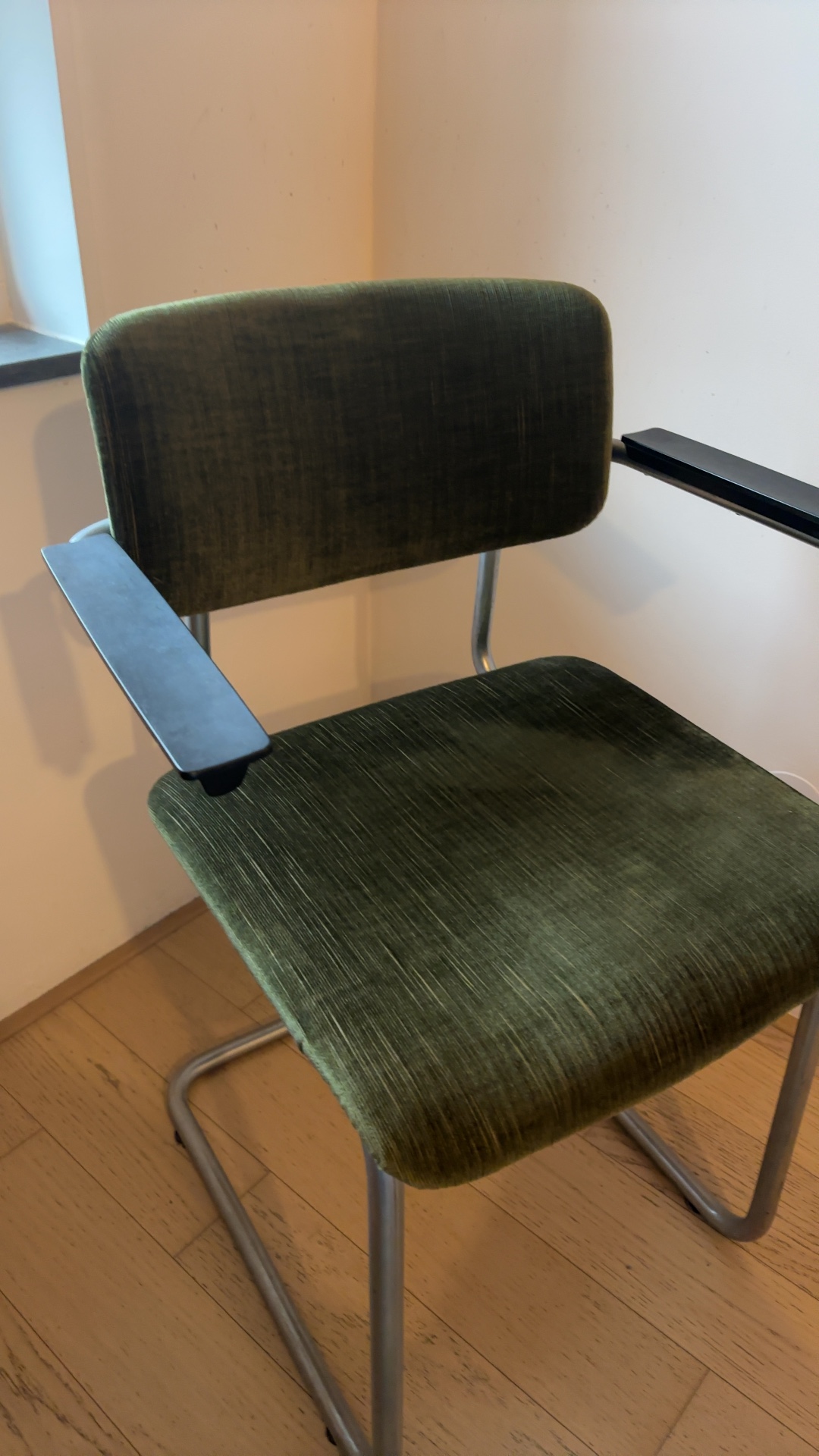
This appears to be a Mid-Century Modern cantilever armchair, likely from the 1970s or 1980s. The design features a tubular metal frame forming a continuous 's-bend' that supports the seat and back, a hallmark of cantilever furniture. The upholstery is a ribbed, olive-green fabric, possibly corduroy or a similar blend, suggesting a comfortable yet functional aesthetic typical of the era. The squared-off seat and backrest cushions are well-padded, and the black armrests provide a contrast to the metal frame.
Related traditions
Bauhaus Movement
1920s-1930s
The emphasis on functional design and innovative use of industrial materials like tubular steel, as seen in the early cantilever chairs by Mart Stam and Marcel Breuer.
Mid-Century Modern Design
1950s-1980s
The chair's clean lines, functional form, and material choices (tubular metal, textured upholstery) align with the accessible design principles popular from the mid-20th century onwards.
Use and ceremony
Early 20th Century
Cantilever chairs represented a radical innovation in furniture structure, challenging traditional four-legged designs and embodying modernist ideals.
Late 20th Century
By the 1970s-80s, the cantilever design became more democratized and commonly used in mass-produced office and domestic furniture, signifying contemporary yet comfortable living.
Origins and context
Cantilever chair designs gained significant popularity in the early 20th century, pioneered by designers like Mart Stam and Marcel Breuer, who explored the structural possibilities of tubular steel. By the mid-century, and particularly in the 1970s and 80s, this structural concept was widely adopted and adapted for office and home furniture, often emphasizing comfort and a slightly industrial yet inviting aesthetic. This specific chair's style, with the padded upholstery and simple metal frame, aligns with the broader trends of functional and accessible design from that period.
Further details
The cantilever design, where the seat appears to float as it's not supported by rear legs, was a revolutionary concept in furniture, first introduced in the 1920s.
Many early cantilever chairs were inspired by bicycle handlebars and frames, utilizing the strength and flexibility of tubular steel.
Attribution and evidence
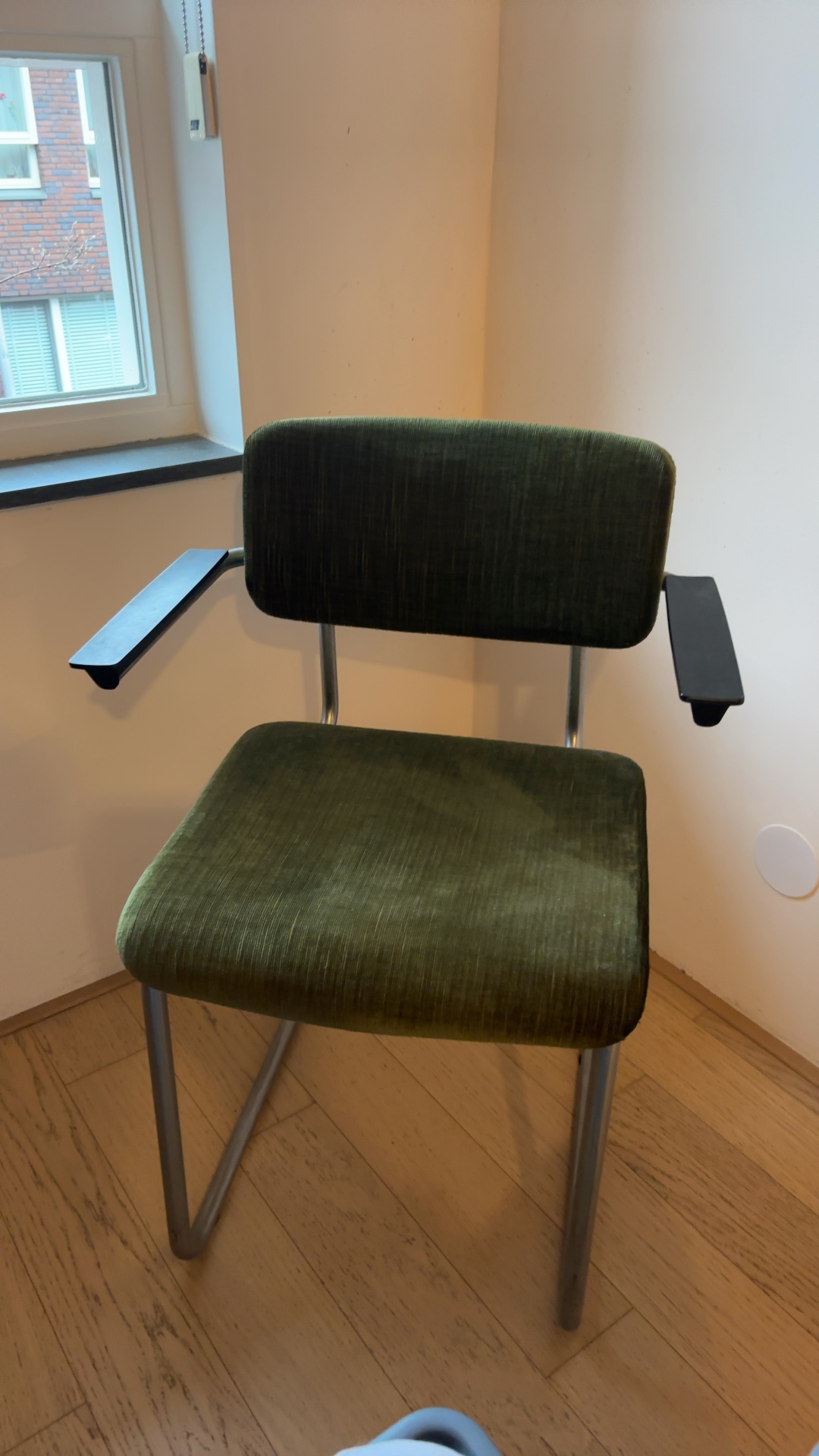
The visible design elements, materials, and apparent construction align strongly with Mid-Century Modern cantilever chairs, allowing for confident identification of the type and likely era. Without manufacturer marks, specific attribution is not possible, but the general style is clear.
Identifying details
- 1Tubular metal cantilever frame construction directly supports the seat and back.
- 2Upholstered seat and backrest in a ribbed, olive-green fabric consistent with 1970s-80s trends.
- 3Square-profile padded cushions for comfort, a common feature in office and functional seating of the period.
- 4Simple, black, flat armrests attached to the frame, maintaining the minimalist aesthetic.
Photographs that would help
- Examine the underside of the chair for any manufacturer labels, stamps, or origin marks.
- Inspect the joinery of the frame for welding quality or specific connection methods.
- Obtain close-up images of any hardware (e.g., screws holding armrests) for potential maker's marks or period-appropriate fasteners.
- Assess the condition and type of foam used in the cushions, if possible without damage, to help refine dating.
Terms in this record
- Cantilever
- A structural support where a beam or plate is anchored at only one end, allowing the unsupported end to project outwards. In furniture, this creates a 'floating' appearance, most notably seen in chairs without traditional rear legs.
- Tubular Metal
- Hollow metal tubing, typically steel, used for furniture frames. Its strength, flexibility, and light weight made it popular in modernist design.
Wear and preservation
The upholstery shows signs of use, with some flattening and potential discoloration on the seat and backrest, but no obvious tears or significant stains are visible. The metal frame appears structurally sound, though minor surface scratches or scuffs are likely. The armrests seem in good condition.
The reflective finish
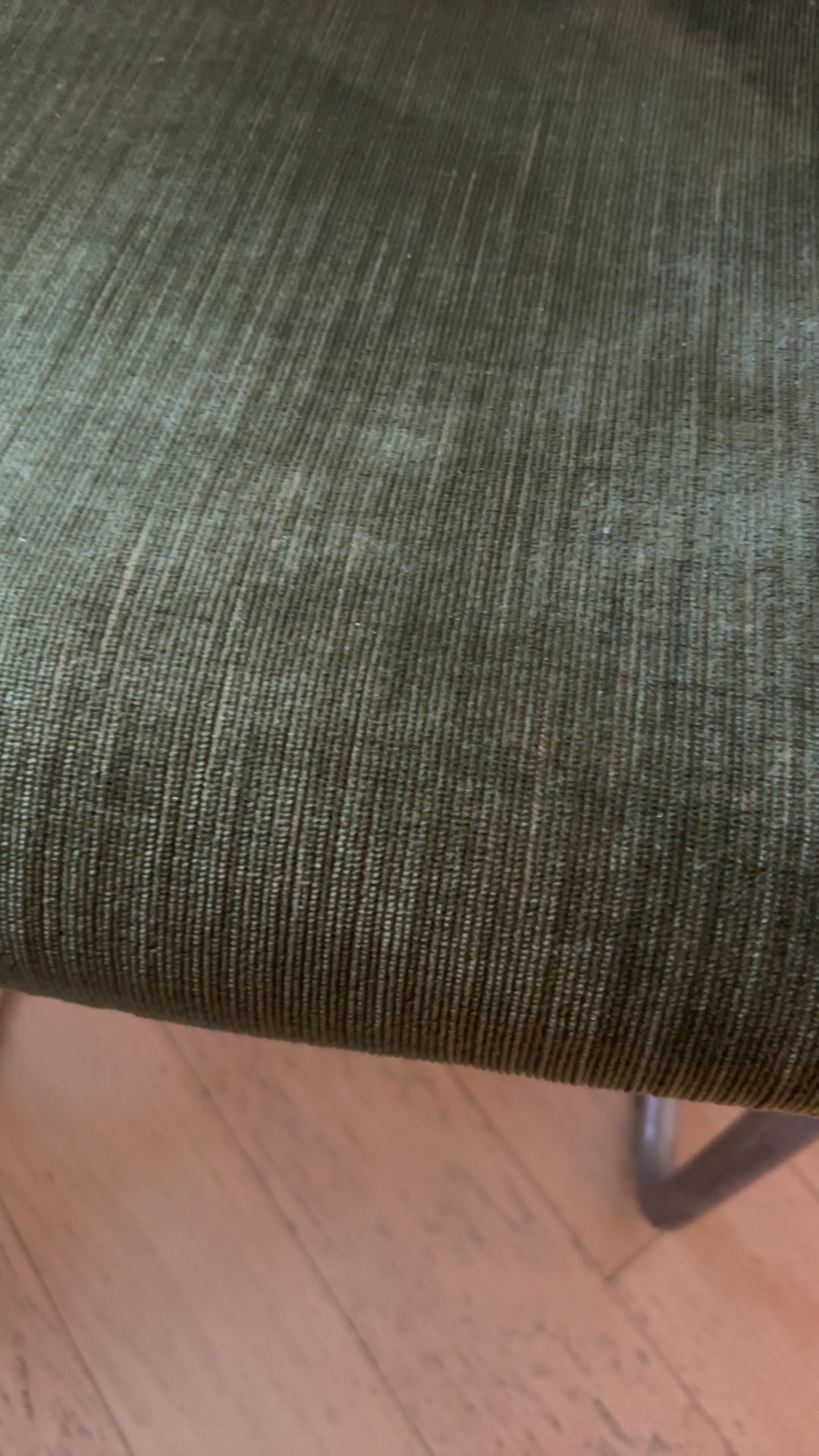
The metal frame exhibits a smooth, possibly chrome or brushed silver finish, showing some minor wear consistent with age, particularly on the contact points. The olive-green fabric has a distinct horizontal ribbing, typical of corduroy or similar chenille-type textiles, and appears to be somewhat matted from use but generally intact.
Recorded physical details
Given the metal frame, the chair would likely feel moderately heavy, offering stable seating without being overly cumbersome. The padded cushions add to its perceived solidness.
Scarcity and surviving examples
Ordinary · 3/10 estimated rarity
This is a qualitative collection score, not a measured survival count, market percentile or proof of authenticity.
What the photographs establish
Interpretation of the photographs and supplied context. This does not authenticate the object.
- Common design typology for the era.
- No specific high-value maker attribution attempted.
- Materials and construction are consistent with typical mass production of the period.
Value and its basis
Estimate recorded: Feb 27, 2026
How we estimate value
- No documented comparable sales are shown for this estimate
- Condition, completeness & craftsmanship
- Demand assumptions may not reflect current transactions
- The range is an estimate, not an asking price or sale result
For informational purposes only, not a formal appraisal.
Related objects
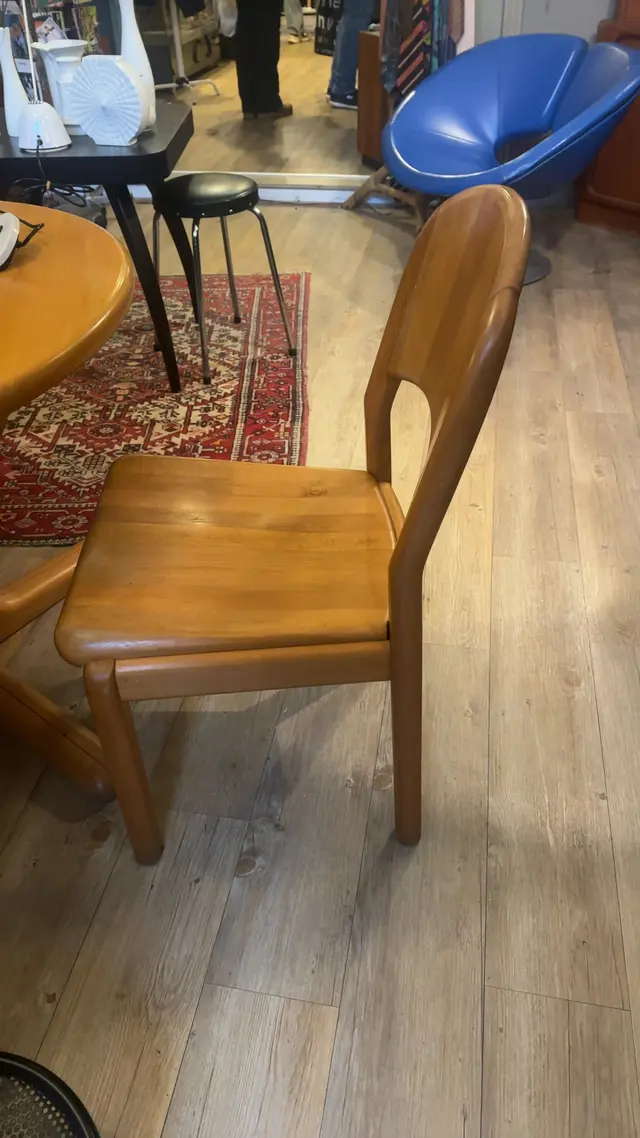
Mid-Century Modern Wooden Dining Chair
Shared title details

Modern Fitted Kitchen with Neff Appliances
Same category
French Rococo Revival Armchair
Same category
Mid-20th Century Tufted Leather Wingback Chair
Same category

Mid-20th Century Electrified Ceramic Hurricane Lamp
Same category
French Rococo Revival Armchair
Same category
Explore Interior
Furniture, lamps, lighting, chandeliers, decorative objects for the home.
Interior value and rarity guideShare this find
A place for your interior
Keep its photographs, maker’s marks and the story you know in one object record. Start with a photo.
Create an account for 10 free scans. No credit card needed.
Join the conversation