Sancai-Style Ceramic Camel Figures with Musicians
Estimated value
$250 - $600Rarity
Ordinary(3/10)Category
Ceramics & PotteryEra
Mid-to-late 20th centuryOrigin
ChinaAuthenticity
SANCAI-STYLE CERAMIC CAMEL FIGURES WITH MUSICIANS: IDENTIFICATION
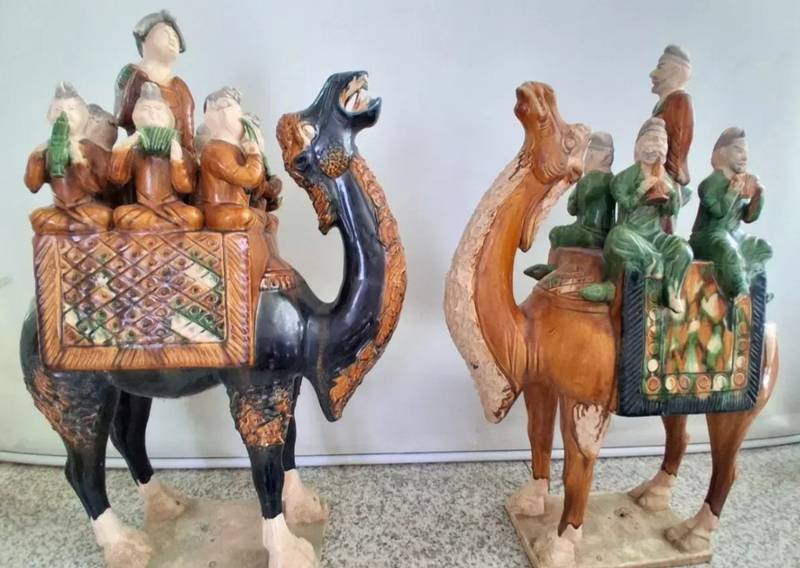
A pair of lead-glazed earthenware figures depicting Bactrian camels carrying a platform of seated musicians. These pieces emulate the Tang Dynasty Sancai (three-color) tradition, featuring the characteristic amber, green, and cream palette. One camel is finished in a rare cobalt-blue 'four-color' variation, while the other maintains the standard amber ground. The musicians are modeled with Central Asian features, reflecting the Silk Road iconography of the 7th-10th centuries.
PRODUCTION & FIRING
SCARCITY
Standard antiques commonly found at estate sales and flea markets. Plentiful supply meets modest demand.
Typical Characteristics
- Moderate production runs
- Common at estate sales
- Entry-level collectibles
Confidence Factors
- Uniform glaze thickness and lack of burial degradation/encrustation
- Sharp, repetitive modeling indicative of modern mold use
- High prevalence of high-quality 20th-century replicas of the Xi'an National Museum originals
Expert review recommended. Consider consulting a specialist before making purchasing decisions.
CERAMICIST'S ASSESSMENT
Ceramics Historian & Kiln Specialist
The iconography is clearly identified as Tang Sancai revival; however, distinguishing between a 1920s high-quality revival and a 1970s export piece requires tactile inspection of the base and interior casting.
KEY EVIDENCE
- 1Sancai glaze distribution (amber, green, cream) localized to specific molded sections.
- 2Presence of cobalt-style blue on the left camel, a high-value pigment in original Tang wares.
- 3Unglazed heads allowing inspection of the pale buff earthenware paste.
- 4Iconography directly matching the 1957 Xianyu Tinghui archaeological find.
UNCERTAINTIES
- •Lack of 'root marks' or calcium carbonate encrustation typical of excavated low-fire glazes.
- •The uniform condition of the pair suggests they were manufactured as a modern decorative set.
WHAT WOULD IMPROVE CERTAINTY
- →Examine the interior of the hollow bases for modern slip-casting lines.
- →Perform a UV light inspection to check for modern adhesive repairs on the camels' legs.
- →Check the footrims for any 'Made in China' export stamps often found on mid-century revivals.
CONDITION & GRADE
Condition
The glazes appear well-saturated with no significant crazing or flaking. Minor structural losses are visible on the camel manes and musician instruments, consistent with 40-60 years of domestic display.
Weight & feel
Estimated at 3.5 to 4.5 kg per figure; the hollow-cast slip construction provides a balanced heft consistent with modern kiln-fired decorative ware.
CERAMICS MARKET VALUE
Updated: May 11, 2026
Who buys this
Interior designers and collectors of 20th-century Chinese decorative arts or Silk Road-themed historical objects.
What increases value
- •The blue-glazed camel typically commands a 20-30% premium due to the desirability of 'four-color' Sancai.
- •Visual symmetry as a matched pair.
What lowers value
- •Damage to fragile protrusions like the camels' ears or musicians' instruments significantly reduces resale value.
- •Saturation of the market with mass-produced modern souvenir versions.
What makes top-tier examples
- •Evidence of authentic archaeological 'silvering' (iridescence) from long-term soil exposure.
- •Hand-modeled details as opposed to repetitive mold-stamped features.
Grade & condition
Completeness of the musicians' instruments, lack of leg repairs, and glaze luminosity.
Rarity & demand
For informational purposes only, not a formal appraisal.
ABOUT CERAMICS & POTTERY
Pottery, porcelain, stoneware, earthenware, and kiln-fired objects.
Ceramics & Pottery value and rarity guideSHARE THIS CURIOSITY
Have your own curiosities to discover?
Scan Your Curiosity
COMMENTS