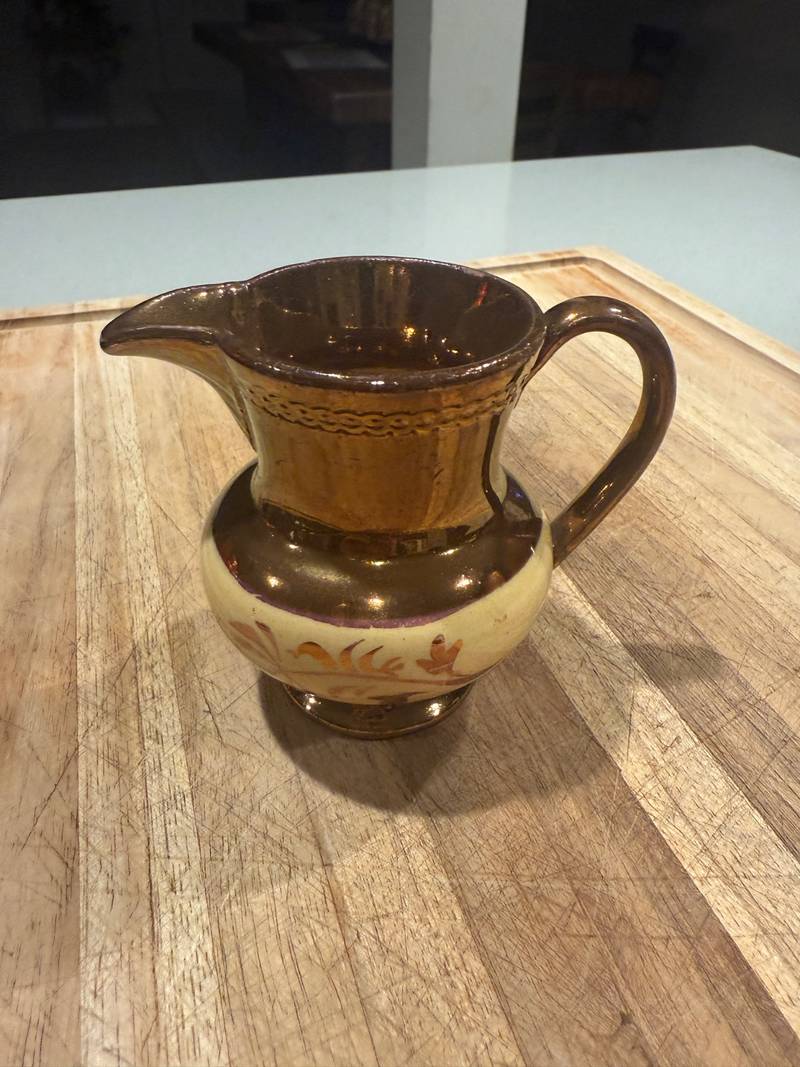
Copper Lustre Creamer with Enamelled Band
Estimated value
$35 - $85Rarity
Common(3/10)Category
Ceramics & PotteryBrand
Staffordshire PotteryEra
circa 1840–1870Origin
United KingdomAuthenticity
COPPER LUSTRE CREAMER WITH ENAMELLED BAND: IDENTIFICATION
This is a 19th-century English copper lustreware creamer, likely of Staffordshire origin. The vessel features a specialized metallic glaze achieved by applying a thin layer of copper oxide over a dark clay body, resulting in a reflective, bronzed appearance. A central horizontal band of cream-colored slip is decorated with hand-painted polychrome enamel floral motifs in ochre and sienna. The form includes a flared spout, a characteristic C-scroll handle, and a molded bead or cable border at the shoulder, typical of early-to-mid Victorian utilitarian wares.
CROSS-CULTURAL PARALLELS
Where This Object Echoes
The democratization of luxury, mimicking expensive metalwork through industrial ceramic processes.
Ritual & Ceremonial Use
- •Victorian daily tea service and the presentation of the cream and sugar on the sideboard.
Meaning Through Time
Transitioned from a daily utilitarian vessel to a 'curio' or 'cabinet piece' for collectors of provincial antiques.
PRODUCTION & FIRING
COLLECTOR NOTES
Staffordshire potters produced tens of thousands of these creamers for the American market between 1840 and 1890, making them a common sight in 19th-century immigrant households.
SCARCITY
Standard antiques commonly found at estate sales and flea markets. Plentiful supply meets modest demand.
Typical Characteristics
- Moderate production runs
- Common at estate sales
- Entry-level collectibles
Confidence Factors
- Form and glaze type are consistent with 1850s Staffordshire production standards
- Natural wear patterns on handle and base align with century-plus age
- Low value-to-effort ratio makes modern forgery unlikely
CERAMICIST'S ASSESSMENT
Ceramics Historian & Kiln Specialist
The form, glaze chemistry, and decorative style are highly standardized for 19th-century English production, making identification relatively straightforward even without a maker's mark.
KEY EVIDENCE
- 1Metallic copper reduction glaze over a dark earthenware body is diagnostic for 19th-century lustreware.
- 2C-scroll handle shape is characteristic of mid-Victorian creamer molds.
- 3Hand-painted sienna enamels on a cream slip band indicate a period-specific decoration budget.
- 4Beaded molding on the shoulder was a common feature of Staffordshire designs from 1840-1860.
UNCERTAINTIES
- •Base is not visible; usually these were unmarked, but a base view confirms footrim wear.
WHAT WOULD IMPROVE CERTAINTY
- →Examine the base for a maker's mark or hand-incised numbers.
- →Conduct a tap test to listen for high-frequency vibration to ensure no hairline cracks are present.
- →Check the interior for 'pitting' which occurs when acidic liquids like cream sit in the vessel for decades.
CONDITION & GRADE
Grading breakdown
The high retention of metallic sheen and lack of significant chipping on the spout—a high-impact area—places this in the upper tier for its age.
Condition
Minor loss of lustre visible on the high points of the handle and rim, consistent with manual handling. No visible 'crazing' in the cream band, but slight oxidation of the copper glaze is evident near the base.
CERAMICS MARKET VALUE
Updated: Jul 23, 2026
Similar Staffordshire lustreware creamers frequently sell for $40-$75 on eBay and at regional antique malls (2024 data).
Who buys this
Collectors of provincial English pottery and enthusiasts of Victorian-era kitchenalia.
What increases value
- •Retention of the metallic sheen without excessive 'dulling'
- •Integrity of the hand-painted enamels in the central band
What lowers value
- •Spout chips or 'fleabites'
- •Large-scale lustre loss from over-cleaning with abrasives
What makes top-tier examples
- •Signed or marked pieces (rare for lustreware)
- •Unusual shapes like 'pedestal' bases
Grade & condition
Percentage of lustre remaining and presence of chipping on the fragile spout pouring lip.
Rarity & demand
For informational purposes only, not a formal appraisal.
YOUR INPUT VS. SCAN
How your provided context compares with Curiosa.com scanner findings.
What Aligned
- User's claim of 'Original/Authentic' aligns with the visible Victorian-era manufacturing techniques and natural metallic oxidation.
- User's claim of 'Minor wear' aligns with the slight lustre thinning on handle contact points.
ABOUT CERAMICS & POTTERY
Pottery, porcelain, stoneware, earthenware, and kiln-fired objects.
Ceramics & Pottery value and rarity guideSHARE THIS CURIOSITY
Have your own curiosities to discover?
Scan Your Curiosity
COMMENTS