Modern Greek Carnelian Intaglio Swivel Ring
QUICK FACTS
Categories
Era
c. 1970-2020
Origin
🇬🇷 Greece
Rarity
Common (2/10)
Discovered
Feb 27, 2026
1 day ago
DESCRIPTION
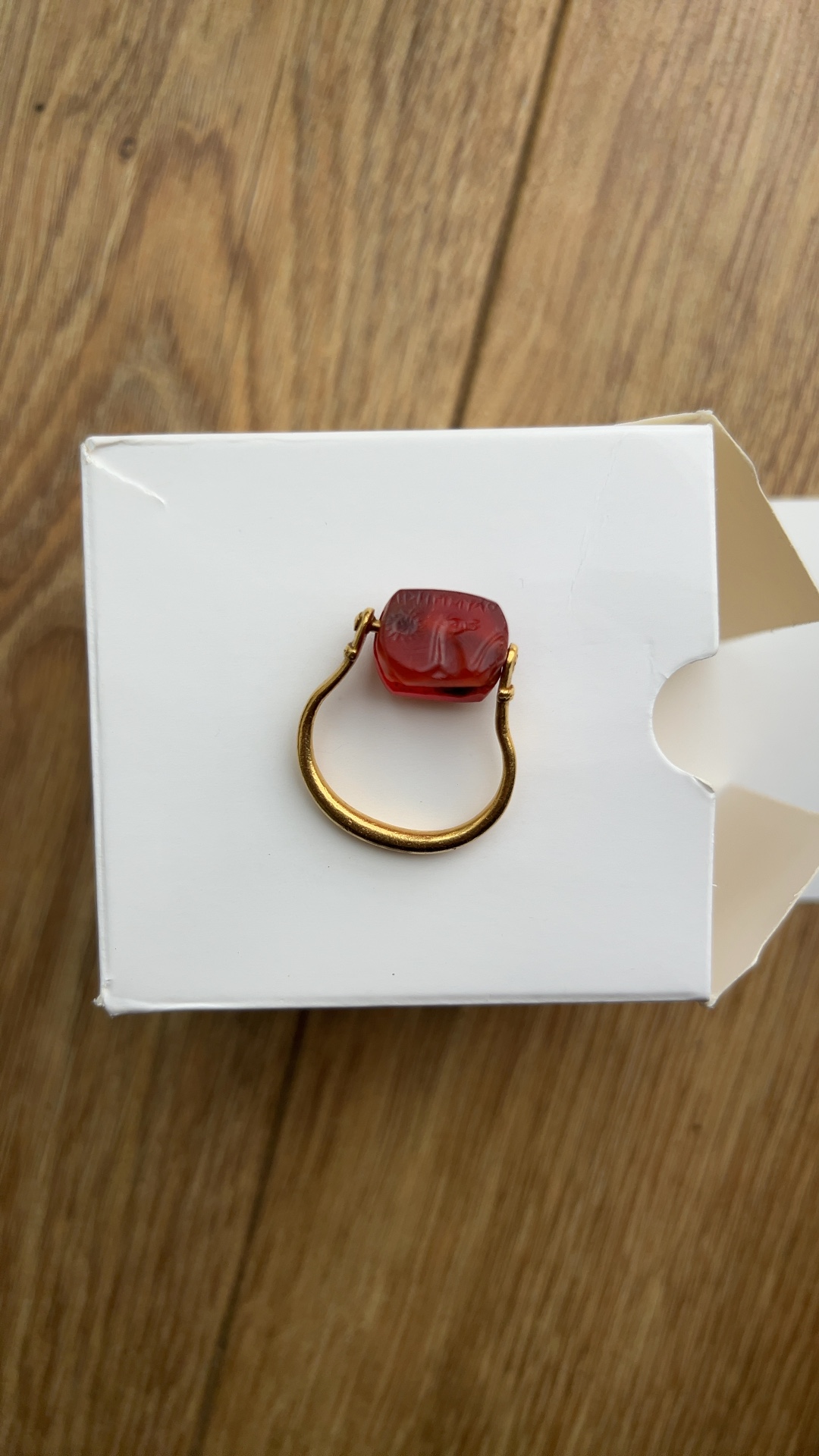
My initial observation is of the construction. This is a modern swivel ring, featuring a D-shaped shank supporting a rotating intaglio. The style is a clear homage to ancient Roman and Greek seal rings, a popular motif in jewelry for centuries. The centerpiece is a rectangular tablet, likely carnelian or a similar chalcedony given the reddish-orange hue, carved with an intaglio design. The simple, clean lines of the shank suggest 20th or 21st-century manufacture, contrasting with the historical carving.
CULTURAL ECHOES
Where This Object Echoes
The Roman 'annulus vertibilis' (turn-over ring) is the direct ancestor of this swivel design, allowing a stone to be flipped for use or protection.
Wealthy Europeans undertaking the Grand Tour would purchase intaglio rings and other souvenirs carved with classical scenes as mementos of their travels in Italy and Greece.
Major Greek jewelry houses since the mid-20th century have built their identity on reinterpreting ancient and Byzantine motifs, making this style a hallmark of contemporary Greek design.
Ritual & Ceremonial Use
- •Historically, the primary use was to press the intaglio into hot wax to seal letters and documents, authenticating the sender's identity.
- •In modern times, wearing such a ring serves as a connection to cultural heritage and a display of appreciation for classical art and history.
Meaning Through Time
A tool of legal and personal authority; a functional signature.
A symbol of erudition, classical education, and worldly travel for the aristocracy.
A decorative piece of heritage jewelry, often sold as a high-quality tourist souvenir or a modern fashion item celebrating historical aesthetics.
HISTORICAL STORY
DID YOU KNOW?
An 'intaglio' is carved *into* the stone to create a negative image, so that when pressed into wax, it produces a raised, positive 'relief'. The opposite, a raised carving, is called a 'cameo'.
Swivel rings (or 'turnover' bezels) were known in Roman times, allowing the wearer to display the carved stone or flip it over to protect the carving against a flat metal backing.
MATERIAL & CONDITION
Surface
The yellow metal shank is highly polished with a uniform, bright finish. The intaglio appears to be carnelian, showing some natural internal banding, with matte recessed carved areas contrasting against the polished surrounding tablet.
Weight & Feel
The slender, D-shaped shank suggests this ring is quite lightweight and would not feel particularly hefty on the finger.
Condition
The ring appears to be in excellent condition with minimal surface scratching to the metal shank. The edges of the intaglio carving look crisp, indicating it has not been heavily worn. The swivel mechanism appears functional.
RARITY ANALYSIS
Older mass-produced items still widely available. Easy to find on eBay, antique malls, and estate sales in large quantities.
Typical Characteristics
- Mass produced historically
- High survival rate
- Readily available everywhere
EXPERT ANALYSIS
Jewelry Historian & Gemologist-Informed Appraiser
Confidence is high in identifying this as a modern Greek revival piece due to the combination of ancient-style intaglio and modern shank construction. The specifics of the material (karat of gold, type of stone) remain unconfirmed, preventing higher confidence.
KEY EVIDENCE
- 1The simple, uniform, D-shaped shank is characteristic of modern (post-1950) casting and finishing techniques.
- 2The swivel mechanism, while ancient in origin, is a common feature in neoclassical revival jewelry from the 19th century to the present.
- 3The user-provided transcription 'olympike' (ΟΛΥΜΠΙΚΗ) is Greek and points directly to a Greek theme and likely origin.
- 4The stone appears to be carnelian, a type of chalcedony historically favored for intaglios, due to its reddish color.
- 5The object's excellent condition and crisp carving are inconsistent with an ancient artifact, which would show significant wear.
UNCERTAINTIES
- •The exact metal (solid gold vs. gold-plated) and its purity cannot be determined from images alone and significantly impacts value.
WHAT WOULD IMPROVE CERTAINTY
- →Photograph any hallmarks or stamps on the inside of the shank, which would identify the metal content (e.g., '925' for sterling silver, '14k' or '585' for gold).
- →Have a jeweler test the metal to confirm if it is solid gold or plated.
- →Examine the stone with a gemologist's loupe to confirm if it is natural carnelian or glass.
ESTIMATED VALUE
Updated: Feb 27, 2026
- Market comparables from auctions & retail
- Condition, completeness & craftsmanship
- Current collector demand & trends
- Low = quick sale, high = patient seller
For informational purposes only, not a formal appraisal.
CONTEXT ANALYSIS
How your provided context compares with Curiosa.com scanner findings.
What Aligned
- User description of a 'seal ring' aligns with the object's intaglio design.
- User stated origin of 'Greece' is supported by the Greek inscription 'olympike' they noted.
- User claim of 'minor wear' is consistent with the excellent condition visible in photographs.
- User description of the design ('horse and sun') is plausible for a Greek-themed intaglio, even if not fully clear in the images.
What Conflicted
- User's belief that it is 'Original/Authentic', if interpreted as an ancient artifact, conflicts with the modern style of the ring's shank and finish. The piece is assessed as an authentic modern creation, not an antiquity.
ABOUT JEWELRY
Fine jewelry, costume pieces, rings, necklaces, bracelets, and brooches.
Browse all JewelrySHARE THIS CURIOSITY
Have your own curiosities to discover?
Scan Your Curiosity
COMMENTS
No comments yet. Be the first to share your thoughts!
Sign in to leave a comment