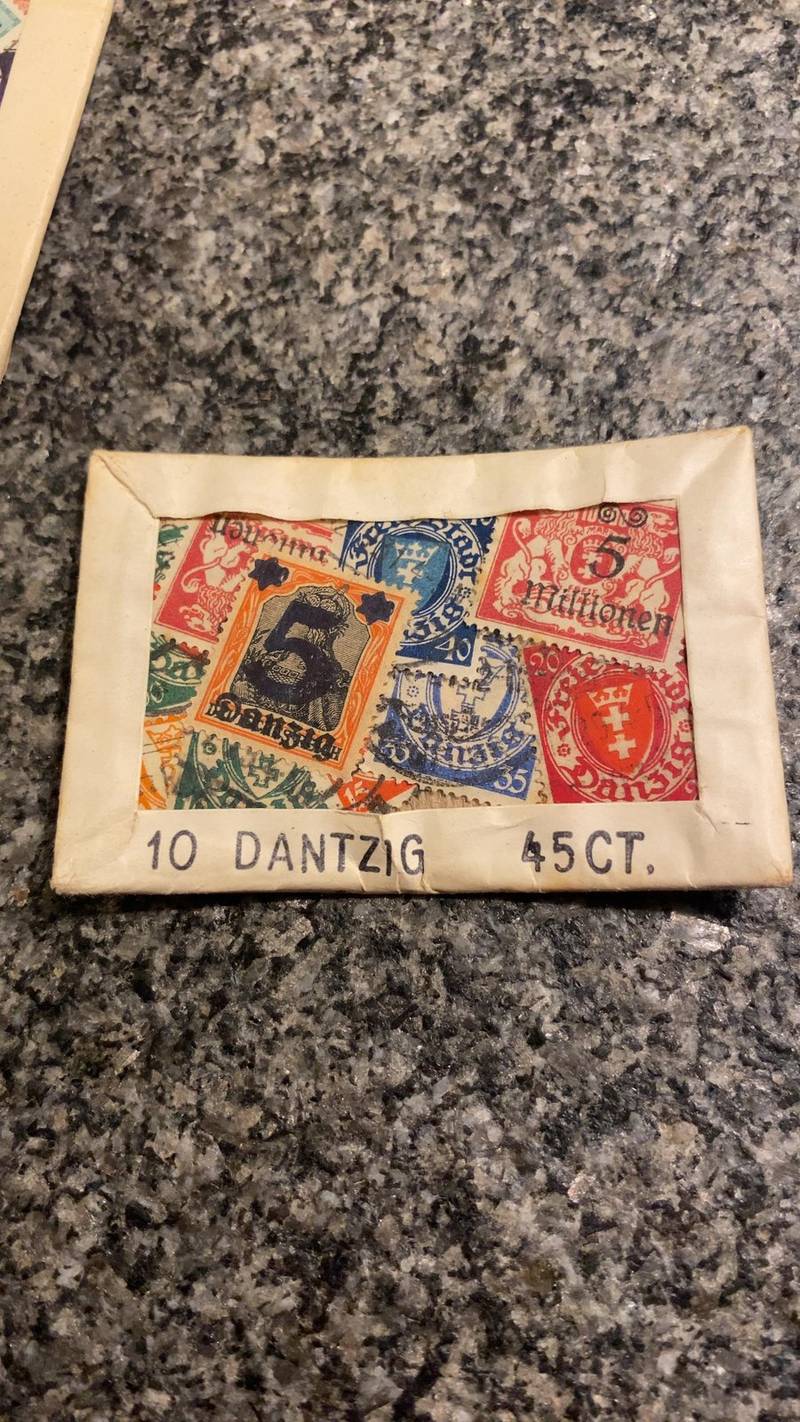
Danzig Hyperinflation Stamp Approval Packet (1920-1923)
Authenticity
DANZIG HYPERINFLATION STAMP APPROVAL PACKET (1920-1923): IDENTIFICATION
A glassine or paper-framed retail approval packet containing 10 assorted stamps issued by the Free City of Danzig (Freie Stadt Danzig) during the hyperinflation period of the early 1920s. The assortment includes definitive issues with the '5' and '5 Millionen' overprints, featuring the municipal coat of arms with two crosses and a crown. Visible stamps include Scott #171 (5 million m on 50pf red) and various high-denomination surcharges produced to keep pace with the collapsing German Mark.
CROSS-CULTURAL PARALLELS
Where This Object Echoes
Mirroring the German hyperinflationary surcharge practices of the 'Innerer Dienst' era
Ritual & Ceremonial Use
- •Mid-20th century philatelic collecting, where 'approval' packets were mailed to young collectors to choose items for purchase.
Meaning Through Time
The stamps represented the total loss of purchasing power and daily economic chaos.
These became educational curiosities representing the fragility of fiat currency.
POSTAL HERITAGE
PHILATELIC NOTES
During the peak of hyperinflation in late 1923, Danzig issued stamps with denominations as high as 10 billion marks to cover the cost of a single domestic letter.
The 5 million mark overprint visible in this packet was issued in October 1923, just weeks before the currency was entirely replaced by the Danzig Gulden in 1924.
SCARCITY
Standard antiques commonly found at estate sales and flea markets. Plentiful supply meets modest demand.
Typical Characteristics
- Moderate production runs
- Common at estate sales
- Entry-level collectibles
Confidence Factors
- Commonly circulated hyperinflation issues with low individual value
- Period-correct retail packaging suggesting an mid-20th century hobbyist acquisition
PHILATELIST'S VERDICT
Philatelist
The stamps are visually identifiable by denomination and overprint; the packaging is a diagnostic indicator of mid-century retail philately.
KEY EVIDENCE
- 1Danzig coat of arms visible on red and blue definitives (1920-1923 type)
- 2Bilingual 'Millionen' overprints correspond to the October 1923 hyperinflation peak
- 3Outer packaging typeface and 45-cent pricing consistent with 1940s-50s US stamp dealer inventory
- 4Serrated perforations appear correct (Gauge 14) for the 'Kleine Schild' type issues
UNCERTAINTIES
- •Possible condition issues (thins or gum damage) hidden by the crowded overlapping in the packet
WHAT WOULD IMPROVE CERTAINTY
- →Safely remove stamps from the packet to check for 'Hinged' vs 'Never Hinged' status
- →Check for Danzig 'SO' (Self-Government) overprint variations under a magnifying loupe
- →Examine reverse for watermark 1 (Waffle) or 2 (Network)
CONDITION & GRADE
Grading breakdown
Stamps show standard commercial centering for the period; the outer packaging is 'Good' at best due to structural creasing and paper foxing.
Condition
The packet shows significant age-related wear, including creasing and soil on the outer paper frame. The visible stamps appear used or with hinge marks, and centering is generally 'Fine' as typical for the mass-overprinted issues of this turbulent era.
PHILATELIC VALUATION
Updated: May 11, 2026
Similar 'approval' packets from Danzig frequently sell on eBay missions for $8-$12 depending on the number of 'Million' or 'Milliarden' surcharges included.
Who buys this
Entry-level philatelists or history teachers looking for tangible artifacts of the Weimar-era inflation crisis.
What increases value
- •Integrity of the original retail packet
- •Presence of specific high-denomination varieties (e.g., 500 million or billion mark values)
What lowers value
- •Heavy creasing to the stamps themselves inside the tight framing
- •Common nature of these specific denominations limits ceiling
What makes top-tier examples
- •Postally used with clear, dated Danzig circular date stamps (CDS)
- •Unused examples with original, undisturbed gum (MNH)
Grade & condition
Centering of the overprint relative to the original stamp design and perforation integrity.
Rarity & demand
For informational purposes only, not a formal appraisal.
ABOUT STAMPS
Rare stamps, postal history, first day covers, and philatelic treasures.
Stamps value and rarity guideSHARE THIS CURIOSITY
Have your own curiosities to discover?
Scan Your Curiosity
COMMENTS