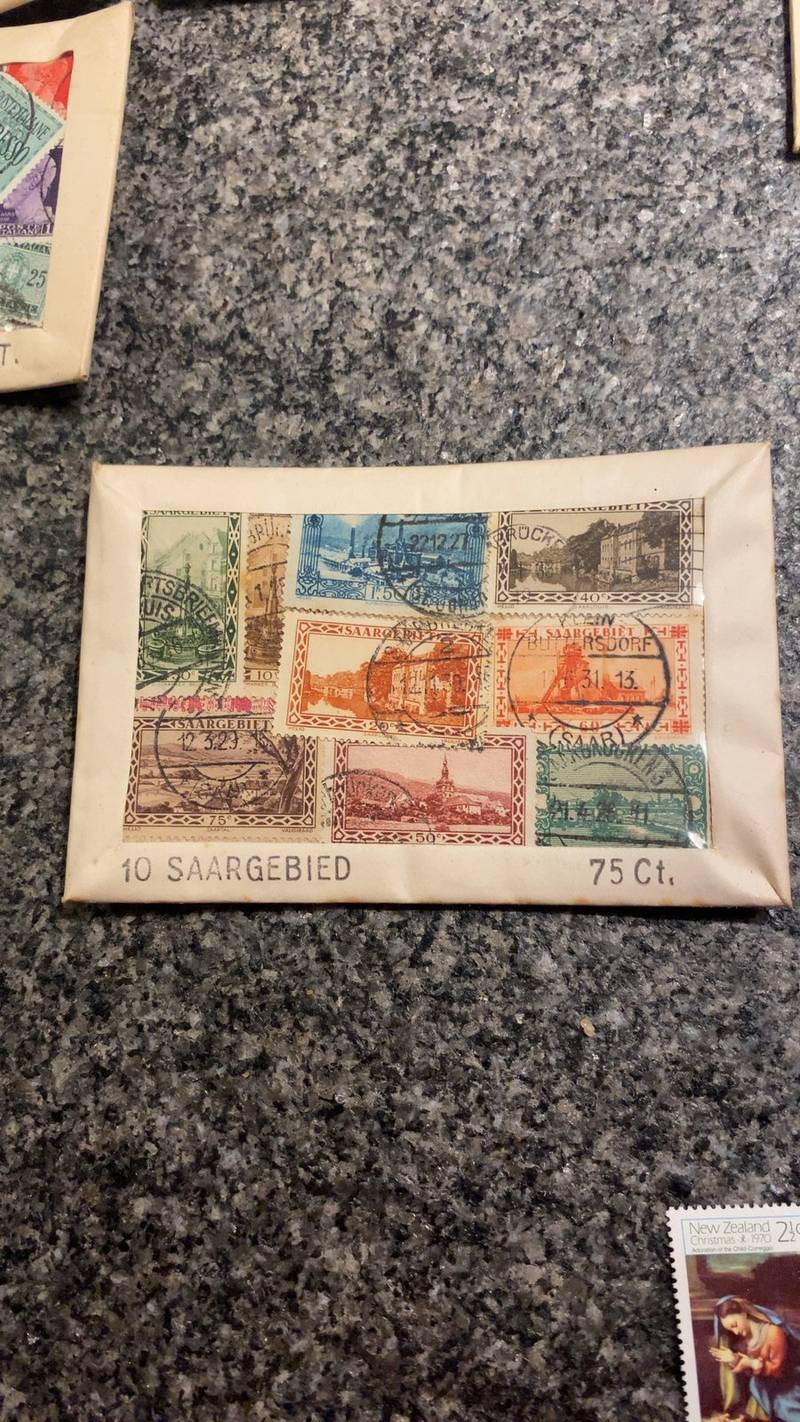
Saar Basin (Saargebiet) Definitives Selection (Scott #68-98 series)
Estimated value
$10 - $35Rarity
Ordinary(3/10)Category
StampsBrand
League of Nations AdministrationEra
1921-1932Origin
GermanyAuthenticity
SAAR BASIN (SAARGEBIET) DEFINITIVES SELECTION (SCOTT #68-98 SERIES): IDENTIFICATION
A philatelic souvenir card or window mount containing nine used postage stamps from the Saar Basin territory. The assembly features pictoral definitives from the early 1920s League of Nations administration period. Visible values include the 40pf grey-black, 50pf red-brown, 60pf orange-red, and various high values in Centimes/Francs overprints. The stamps are canceled-to-order (CTO) or postally used, featuring various town cancels including a legible 'BUTTERSDORF' circular date stamp from 1931 and another date stamp from 1923.
CROSS-CULTURAL PARALLELS
Where This Object Echoes
The use of 'Plebiscite' and 'Mandate' stamps was a common political tool used by the League of Nations to establish administrative legitimacy in disputed border regions like Upper Silesia and Danzig.
Ritual & Ceremonial Use
- •Souvenir mounting: The practice of creating small 'pocket' selections for tourists or beginning collectors was a staple of European philatelic shops in the 1950s-70s.
Meaning Through Time
Evidence of local autonomy and League of Nations administrative oversight.
Historical artifacts representing the complex geopolitical restructuring of Europe after World War I.
POSTAL HERITAGE
PHILATELIC NOTES
The 1921 Saar landscape series was the first definitive set issued specifically for the territory rather than using overprinted German stocks.
The currency changed mid-issue from Marks to Francs in 1921, leading to the surcharge overprints visible on several stamps in this group.
SCARCITY
Standard antiques commonly found at estate sales and flea markets. Plentiful supply meets modest demand.
Typical Characteristics
- Moderate production runs
- Common at estate sales
- Entry-level collectibles
Confidence Factors
- Commonly available philatelic material with consistent 1920s printing characteristics
- Cancellation dates (1923, 1931) align perfectly with the postal history of the Saar Basin territory
- Paper toning and mount style are consistent with mid-20th century collector sets
PHILATELIST'S VERDICT
Philatelist
High confidence in identification of the issues and era due to clear inscriptions and readable cancel dates, though secondary evaluation is needed for individual stamp faults behind the plastic film.
KEY EVIDENCE
- 1Identification of 'SAARGEBIED' (Saar Territory) inscriptions on all specimens.
- 2Presence of surcharged overprints in Centimes/Francs which occurred after the 1921 currency reform.
- 3Readable town cancels from Buttersdorf and 1923/1931 date stamps.
- 4Industrial and landscape motifs (collieries, bridges) characteristic of the 1921-1927 Saar definitives.
UNCERTAINTIES
- •Toning/staining on the mount indicates poor storage conditions which may have caused migration of acids to the stamp paper (foxing).
WHAT WOULD IMPROVE CERTAINTY
- →Remove from the non-archival mount to inspect for hinges or thins on the reverse.
- →Verify the 75 centime surcharges against Scott #85-91 for specific plate varieties.
- →Check for watermarks (typically a mesh pattern) to confirm issue dates.
CONDITION & GRADE
Grading breakdown
The stamps themselves show typical commercial centering for the period. Toning is visible on the paper mount which likely affects the reverse gum condition of any 'unused' appearing specimens. Most cancels are standard town strikes.
Condition
Stamps appear used with circular date stamps. Centering varies from fine to very fine. The mounting card shows significant edge wear, toning, and foxing consistent with long-term storage in a non-archival environment.
PHILATELIC VALUATION
Updated: May 11, 2026
Similar interwar territory sets typically sell for $1-$3 per stamp in standard used condition at specialized auctions like David Feldman or through eBay sold listings for German Area collections (2024).
Who buys this
Specialist collectors of German Area philately and League of Nations postal history.
What increases value
- •Clarity of the Buttersdorf cancel
- •High-value surcharge varieties within the landscape series
- •Presence of the Franc-denominated airmail or express stamps if identified upon removal
What lowers value
- •Staining or toning on the stamp paper significantly reduces value
- •Hidden thins or creases caused by the mounting process
What makes top-tier examples
- •Full original gum (MNH) for unused copies
- •Rare town cancellations for used copies
- •Perfect centering (Superb 95+)
Grade & condition
Centering, freshness of color, integrity of perforations, and clarity of the cancel strike.
Rarity & demand
For informational purposes only, not a formal appraisal.
ABOUT STAMPS
Rare stamps, postal history, first day covers, and philatelic treasures.
Stamps value and rarity guideSHARE THIS CURIOSITY
Have your own curiosities to discover?
Scan Your Curiosity
COMMENTS