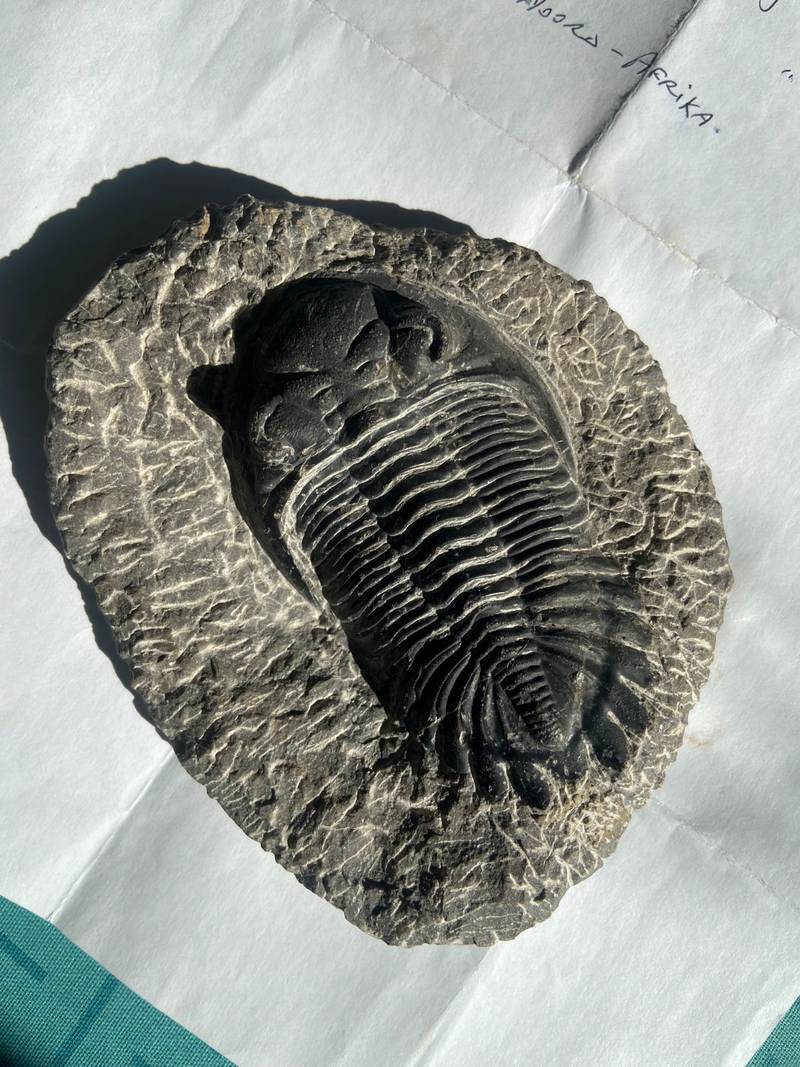
Composite/Reproduction Moroccan Trilobite (Phacopid style)

Estimated value
$15 - $40Rarity
Common(2/10)Category
FossilsEra
Contemporary (Modern reproduction based on Devonian ~380 Ma specimens)Origin
🇲🇦 MoroccoAuthenticity
COMPOSITE/REPRODUCTION MOROCCAN TRILOBITE (PHACOPID STYLE): ORIGINS & SIGNIFICANCE
While modeled to represent a large Devonian Phacopid trilobite (resembling a Drotops or similar genus), visual evidence strongly suggests this is a piece produced for the tourist and decorative market. The specimen exhibits several classic hallmarks of Moroccan artisan composites or casts. The most immediate tell is the matrix: the deep, aggressive, and highly uniform radial scratch marks framing the specimen are a stylized technique used to simulate preparation, rather than the varied, precise marks left by air scribes removing authentic host rock. The trilobite itself features a highly uniform, matte-black surface with soft, slightly melted-looking details on the pleurae (segments), lacking the crisp calcite preservation expected of genuine specimens. Furthermore, the prominent eyes lack the distinct, individual schizochroal lenses characteristic of this order. The reverse of the matrix shows a suspicious patch of yellowish, translucent residue—highly indicative of the epoxy or resin used to merge casts with host rock or stabilize artificial matrix mixtures.
LIFE ACROSS EONS
Where This Object Echoes
The creation of sophisticated imitation antiquities and fossils is a recognized artisanal craft in North Africa, originally meant to supplement incomes between authentic paleontological finds.
Ritual & Ceremonial Use
- •Purchased heavily in tourist markets and rock shops as novelty educational gifts or decorative objects.
Meaning Through Time
Shifted from being a biological record of ancient life to a manufactured souvenir representing the aesthetic idea of paleontology.
DEEP-TIME CHRONICLE
PREHISTORIC SURPRISES
Real Phacopid trilobites had incredibly advanced 'schizochroal' eyes made of exceptionally pure calcite crystals, allowing them to see almost 360 degrees in the murky Devonian seas.
The Moroccan fossil preparation industry is so prolific that distinguishing artisan composites from authentic specimens has become a necessary rite of passage for every amateur paleontologist.
HOW SCARCE IS IT?
Older mass-produced items still widely available. Easy to find on eBay, antique malls, and estate sales in large quantities.
Typical Characteristics
- Mass produced historically
- High survival rate
- Readily available everywhere
Confidence Factors
- Lack of defined schizochroal lenses in the compound eyes, which should be highly visible on a Phacopid this size.
- Stylized, deeply gouged 'sunburst' radial tool marks on the matrix, a known signature of Moroccan tourist composites.
- Soft, 'melted' appearance of the pleural segments, characteristic of resin or plaster casts rather than crisp natural calcite preservation.
- Visible translucent, yellowish epoxy/resin smear on the reverse cracking.
Expert review recommended. Consider consulting a specialist before making purchasing decisions.
PALEONTOLOGIST'S TAKE
Paleontology Specialist
The visual hallmarks of Moroccan tourist composites are very well-documented in paleontological circles. The specific style of matrix scratching combined with the blunt anatomical features and visible glue strongly confirm this classification.
KEY EVIDENCE
- 1Anatomical failure: Eyes lack the distinct individual calcite lenses (schizochroal structure) required for this genus.
- 2Matrix preparation technique: The radial sunburst scratching is decorative, not functional for removing host rock.
- 3Surface texture: Lacks natural exoskeleton fractures, showing instead the slightly rounded, soft edges typical of molded materials.
- 4Material presence: A conspicuous patch of hardened resin/epoxy is caught in a fracture on the reverse side of the matrix.
UNCERTAINTIES
- •The uniform black color is often achieved with black shoe polish or paint over plaster in these specific Moroccan types.
- •The seam where the 'fossil' meets the 'matrix' lacks the authentic undercut or natural parting line of stone.
WHAT WOULD IMPROVE CERTAINTY
- →Apply a hot needle to an inconspicuous area of the black trilobite surface; if it smells of burning plastic or shoe polish, it confirms a resin cast/paint.
- →Examine the specimen under a UV light; resins and modern glues will fluoresce starkly different from natural rock.
- →Examine the eyes closely under a jeweler's loupe to confirm the complete absence of crystalline lens structures.
CONDITION & GRADE
Condition
Visually 'mint' as a decorative object, but paleontologically non-viable as it presents as a heavily manufactured composite or complete cast. A yellowish resin/glue smear is visible on the reverse side.
Surface
The subject exhibits a uniform, matte black finish lacking the natural sheen or varied mineralization of genuine exoskeleton. The surrounding matrix features deep, repetitive, artificial-looking radial gouges designed to mimic pneumatic preparation tools.
Weight & feel
Would likely feel slightly lighter or 'warmer' to the touch than solid, dense natural limestone, especially if significant resin was used in the core matrix.
SPECIMEN MARKET VALUE
Updated: Mar 31, 2026
Who buys this
General public, tourists, and novice collectors looking for decorative or novelty rock/fossil specimens rather than scientifically rigorous collectors.
What increases value
- •Size and dramatic presentation on the display matrix
- •Overall visual completeness (even if artificial)
What lowers value
- •Identification as a cast or fake, which drops the value from hundreds of dollars to the cost of a tourist souvenir.
- •Flaking or chipping of the paint/polish revealing the plaster beneath.
What makes top-tier examples
- •For authentic pieces (which this is not): 100% natural exoskeleton, free-standing preparation (matrix removed from underneath), visible crystalline eye facets.
Grade & condition
Aesthetic appeal as a decorative item rather than scientific preservation quality.
Rarity & demand
For informational purposes only, not a formal appraisal.
CONTEXT ANALYSIS
How your provided context compares with Curiosa.com scanner findings.
What Aligned
- Origin/Language: 'Afrika' aligns perfectly with the piece's likely origin in the Moroccan tourist fossil trade.
- Notes: 'Triboliet' correctly identifies the organism this object is modeled after.
What Conflicted
- Condition/Authenticity: User believes it is 'Original/Authentic' and 'Mint'. Visual evidence heavily indicates it is a modern artisan cast or heavily composited reproduction, rather than a mint-condition authentic fossil.
SIMILAR CURIOSITIES
Megalodon Tooth (Carcharocles megalodon)
Fossilized Vertebrate Bone Fragments in Matrix (Likely Ribs/Limb Shafts)
Fossil Megalodon Shark Tooth (Otodus megalodon)
Ammonite Fossil - Mortoniceras cf. inflatum
Petrified Wood (Silicified)
Fossilized Vertebra/Bone Fragment (Possibly Cetacean or other large mammal)
ABOUT FOSSILS
Prehistoric specimens, dinosaur fossils, amber inclusions, and ancient life forms.
Fossils value and rarity guideSHARE THIS CURIOSITY
Have your own curiosities to discover?
Scan Your Curiosity
COMMENTS
No comments yet. Be the first to share your thoughts!
Sign in to leave a comment