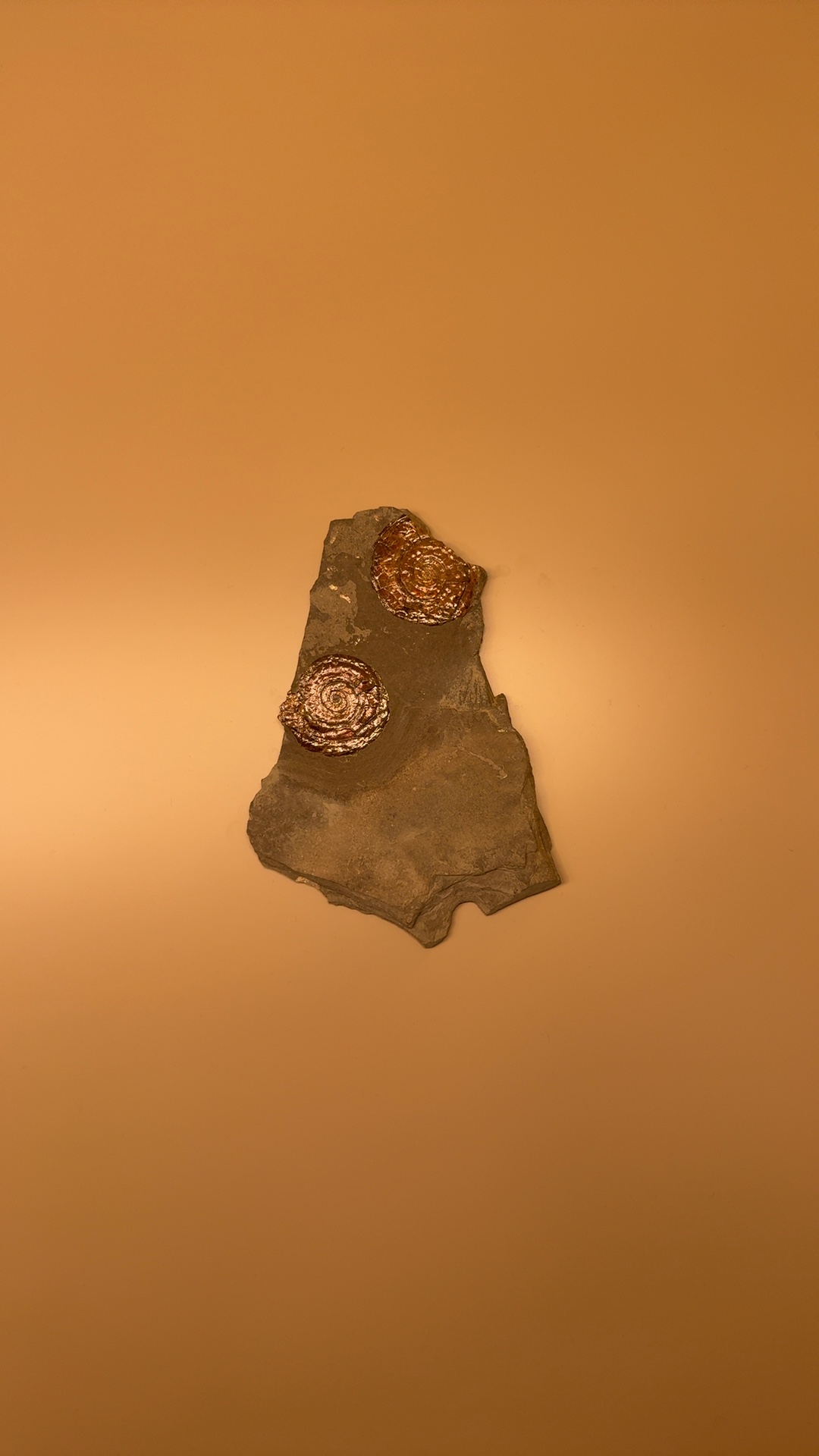
Pyritized Ammonite Fossils on Shale Matrix
QUICK FACTS
Categories
Era
Mesozoic Era (Jurassic-Cretaceous Period likely)
Origin
🌍 International
Rarity
Average (4/10)
Discovered
Jan 11, 2026
1 months ago
DESCRIPTION
This specimen presents two pyritized ammonite fossils embedded within a dark shale matrix. The ammonites display a characteristic spiral coiling, with their shells replaced by pyrite, exhibiting a metallic, brassy luster. Both specimens appear to be partial, possibly sectioned or broken, highlighting their internal structures and coiling. The matrix is a roughly triangular piece of dark grey shale, suggesting a natural presentation rather than a highly refined one.
CULTURAL ECHOES
Where This Object Echoes
Ammonite fossils were sometimes associated with the god Ammon due to their horned, coiled shape, leading to the name 'ammonite'.
Ritual & Ceremonial Use
- •Fossils, including ammonites, have historically been collected as curiosities, talismans, and objects of scientific study, representing deep time and ancient life.
Meaning Through Time
Often interpreted as petrified snakes or magical objects, believed to have healing or protective properties.
Became key evidence in the emerging field of paleontology, supporting theories of evolution and Earth's immense age.
HISTORICAL STORY
DID YOU KNOW?
Ammonites are more closely related to modern-day octopuses and squid than to true nautilus, despite superficial shell similarities.
The intricate suture patterns (lines marking the divisions between the internal shell chambers) on an ammonite's inner shell are so unique, paleontologists can often identify the genus or even species from these patterns alone.
MATERIAL & CONDITION
Surface
The ammonites feature a segmented, spiraling surface with a distinct metallic sheen, indicating pyritization. The shale matrix is rough and uneven, exhibiting natural fractures and a somewhat planar cleavage typical of sedimentary rock. There's a subtle dull luster from the matrix, contrasting with the bright metallic shine of the fossils.
Weight & Feel
Given the size of the shale matrix and the presence of two pyritized fossils, the piece would likely feel moderately heavy for its size due to the density of the shale and the iron sulfide in the fossils.
Condition
The ammonite fossils appear to be incomplete specimens, either naturally fragmented or partially revealed through preparation. The pyritization seems generally stable, though some minor flaking or surface abrasion might be present, particularly at edges. The shale matrix shows natural breaks and weathering consistent with its origin.
RARITY ANALYSIS
Typical antique shop fare. Requires some searching but regularly available. This is where most genuine antiques fall.
Typical Characteristics
- Standard antique shop items
- Regularly available
- Moderate collector interest
EXPERT ANALYSIS
Paleontology Specialist
The visual evidence strongly points to pyritized ammonite fossils on a shale matrix, a common and recognizable fossil type. My confidence primarily hinges on these clear morphological and taphonomic indicators, despite the inability to ascertain species or precise locality from the photos.
KEY EVIDENCE
- 1Clear spiral morphology indicative of ammonoid cephalopods.
- 2Distinct metallic, brassy color and texture, characteristic of pyrite mineralization (pyritization).
- 3Fossils presented on a natural shale matrix, a common occurrence for marine invertebrates.
- 4The overall appearance is consistent with commercially prepared ammonite specimens.
UNCERTAINTIES
- •Exact species identification is not possible without closer examination of suture patterns or other diagnostic features.
- •The completeness of the specimens within the matrix is not fully apparent from these images.
WHAT WOULD IMPROVE CERTAINTY
- →Provide clearer, higher-resolution images from multiple angles, including close-ups of the ammonite surface for detailed morphology.
- →Examine the reverse side of the shale matrix for any signs of artificial adhesion or other composite work.
- →If possible, measure the largest diameter of each ammonite to aid in potential taxonomic identification and market comparison.
ESTIMATED VALUE
Updated: Feb 26, 2026
- Market comparables from auctions & retail
- Condition, completeness & craftsmanship
- Current collector demand & trends
- Low = quick sale, high = patient seller
For informational purposes only, not a formal appraisal.

ABOUT FOSSILS
Prehistoric specimens, dinosaur fossils, amber inclusions, and ancient life forms.
Browse all FossilsSHARE THIS CURIOSITY
Have your own curiosities to discover?
Scan Your Curiosity
COMMENTS
No comments yet. Be the first to share your thoughts!
Sign in to leave a comment