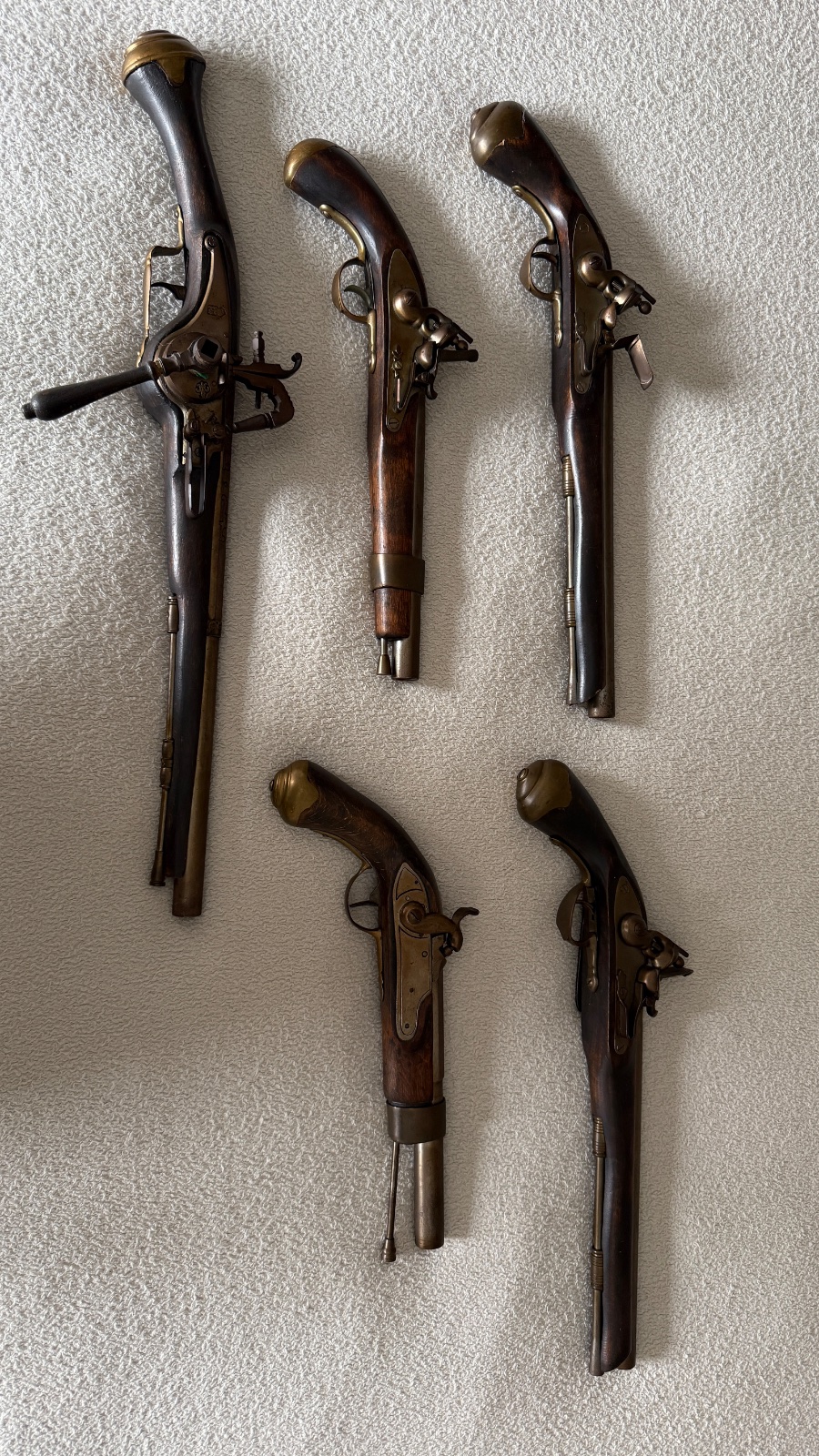
Collection of Five Flintlock Pistols
QUICK FACTS
Categories
Era
Post-1950
Origin
🌍 International
Rarity
Common (2/10)
Discovered
Feb 20, 2026
1 weeks ago
DESCRIPTION
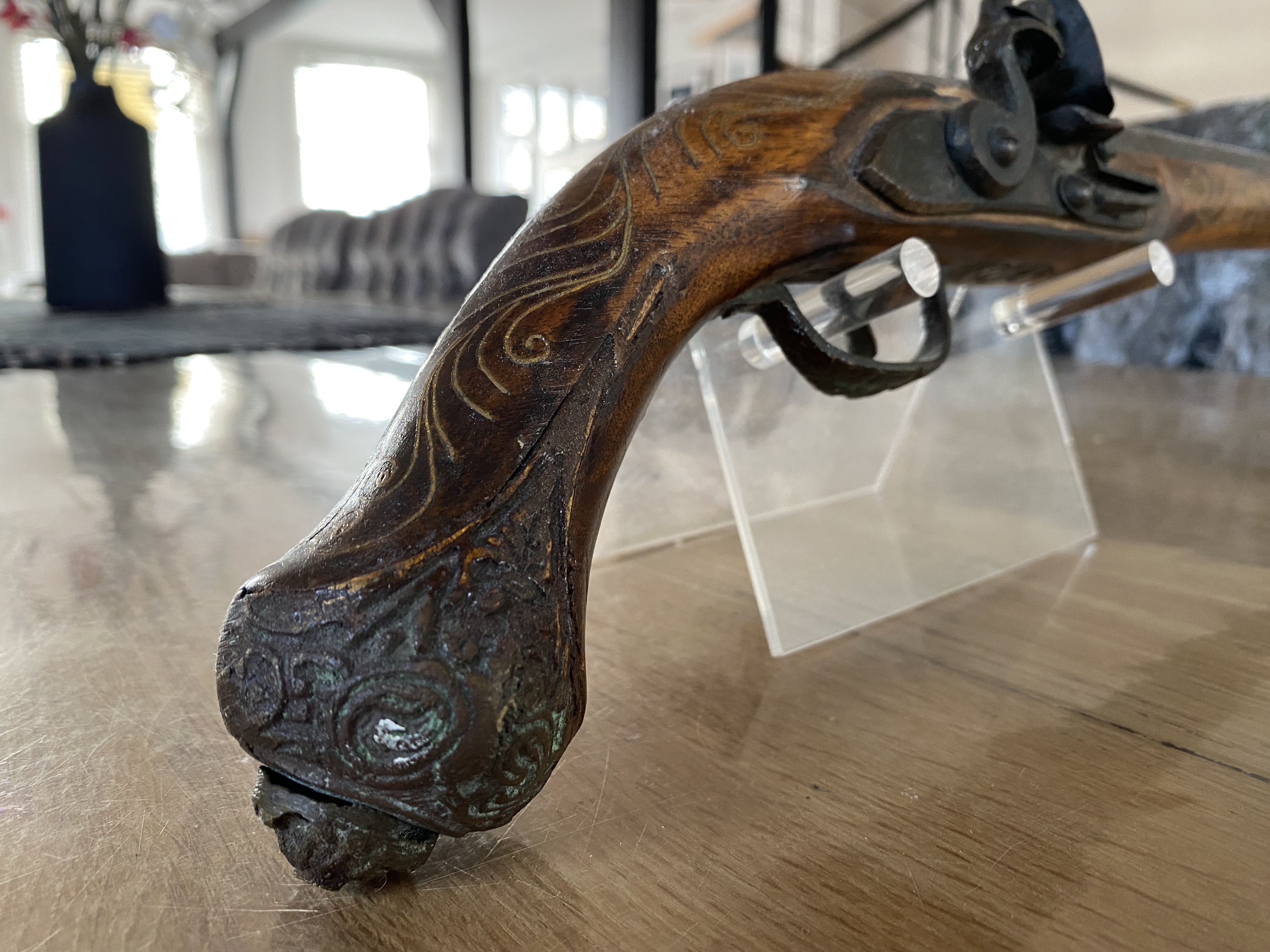
This collection features five flintlock pistols, primarily of relatively uniform design, suggesting they are decorative replicas rather than genuine period firearms. The construction appears to be a combination of dark stained wood for the stocks and brass-toned metal components for the lock plates, hammers, frizzens, and trigger guards. One pistol at the top left stands out with a distinct 'cocking lever' mechanism, differentiating it slightly from the others. These firearms are characterized by a smoothbore barrel, and the lock mechanisms are clearly visible, indicating their function as muzzle-loading weapons reliant on a flint ignition system.
CULTURAL ECHOES
Where This Object Echoes
The general form and flintlock mechanism are typical of 18th-century European military and civilian pistols. The design of the lock plates and trigger guards are broadly inspired by common patterns from countries such as France or Great Britain.
Similar pistol types were widely used during the American Revolutionary War, often imported from Europe or produced by colonial gunsmiths based on European designs.
Ritual & Ceremonial Use
- •Dueling: Flintlock pistols were famously used in formal duels to settle matters of honor, usually with specific rules and protocols.
- •Military Parade/Ceremonial Use: Officers and cavalry often carried these types of pistols as sidearms, serving a functional as well as ceremonial role.
- •Self-Defense: Given the single-shot nature and reloading time, these weapons were primarily for close-quarters self-defense in an age before reliable multi-shot firearms.
Meaning Through Time
Primarily a functional tool for warfare, self-defense, or hunting, also a symbol of status and wealth for gentry and military officers.
Predominantly a collectible historical artifact, a decorative item, or a prop for re-enactments and media, due to their obsolescence as functional weaponry.
HISTORICAL STORY
DID YOU KNOW?
Flintlock pistols were notoriously unreliable in damp conditions, as moisture could prevent the gunpowder in the pan from igniting.
Many flintlock pistols from the 18th century were sold in matching pairs, often ornately decorated, for dueling or as status symbols.
MATERIAL & CONDITION
Surface
The wood stocks display a dark, uniform stain with minimal signs of genuine age or deep patination. The metal parts, likely cast, show a brass-like finish with some artificial patination, giving them an aged appearance. The surfaces are generally smooth but lack the intricate hand-finishing often seen on genuine antique firearms.
Weight & Feel
Based on the appearance of the metal components and wood, these would likely feel moderately weighty for their size, though perhaps lighter than genuine antique firearms which often featured heavier steel barrels and dense hardwoods.
Condition
The pistols appear to be in generally good, albeit decorative, condition. There are no obvious signs of significant damage or malfunction. The simulated aging is consistent across the pieces, suggesting they have been handled primarily as display items.
RARITY ANALYSIS
Older mass-produced items still widely available. Easy to find on eBay, antique malls, and estate sales in large quantities.
Typical Characteristics
- Mass produced historically
- High survival rate
- Readily available everywhere
EXPERT ANALYSIS
Militaria Historian
My confidence is high that these are modern decorative replicas rather than genuine antique flintlock pistols, based on the highly uniform appearance, lack of expected period markings, and characteristics consistent with known reproductions.
KEY EVIDENCE
- 1Absence of legible proof marks or arsenal stamps typical of genuine antique firearms.
- 2The brass-toned metal and uniform 'aged' appearance common on modern decorative replicas.
- 3Relatively crude fit and finish compared to period-made functional firearms.
- 4The presence of multiple identical or very similar items in the same grouping, which is common for decorative sets.
- 5The specific 'cocking lever' design on the top-left pistol suggests an anachronistic addition or a design element adapted for non-firing functionality.
UNCERTAINTIES
- •No visible proof marks, serial numbers, or maker's marks which are critical identification features for period firearms.
- •The overall 'too good to be true' uniformity of condition for a group of purported antique weapons.
- •The anachronistic 'cocking lever' on one pistol, which doesn't align with standard flintlock mechanisms and suggests a modern simplified or decorative function.
WHAT WOULD IMPROVE CERTAINTY
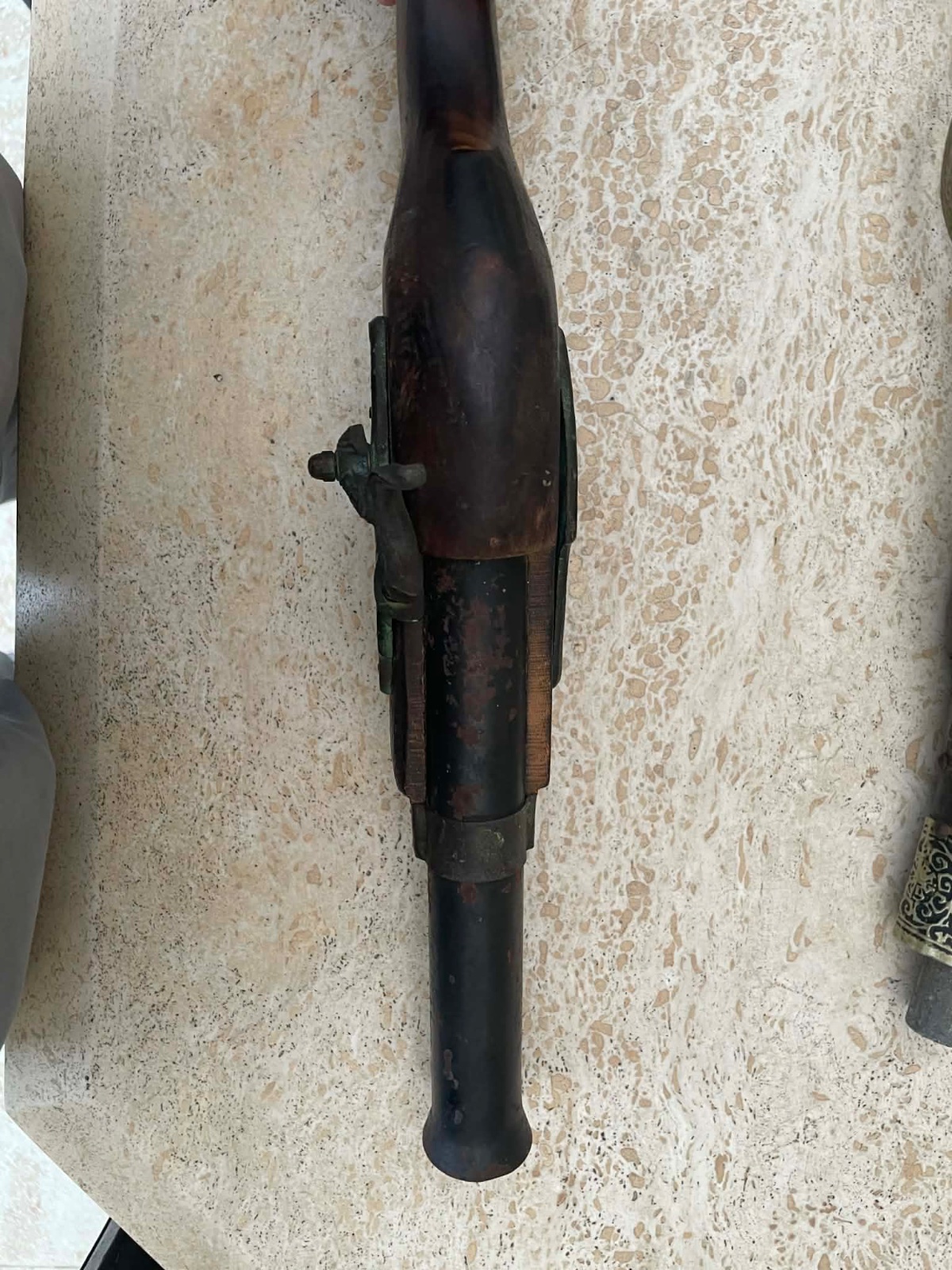
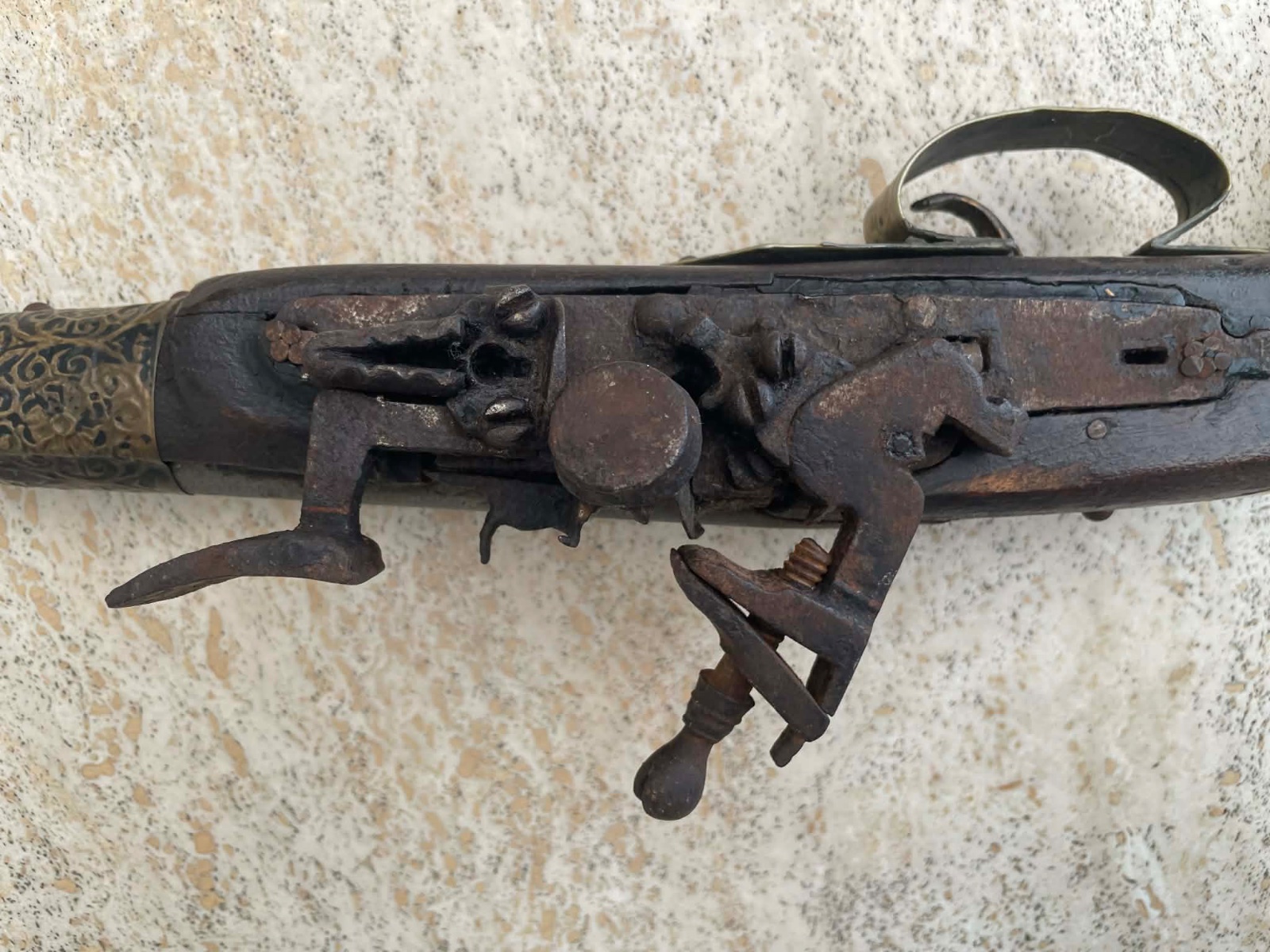
- →Examine all metal components closely for any faint inscriptions, proof marks, or serial numbers, especially on the lock plate, barrel, and tang.
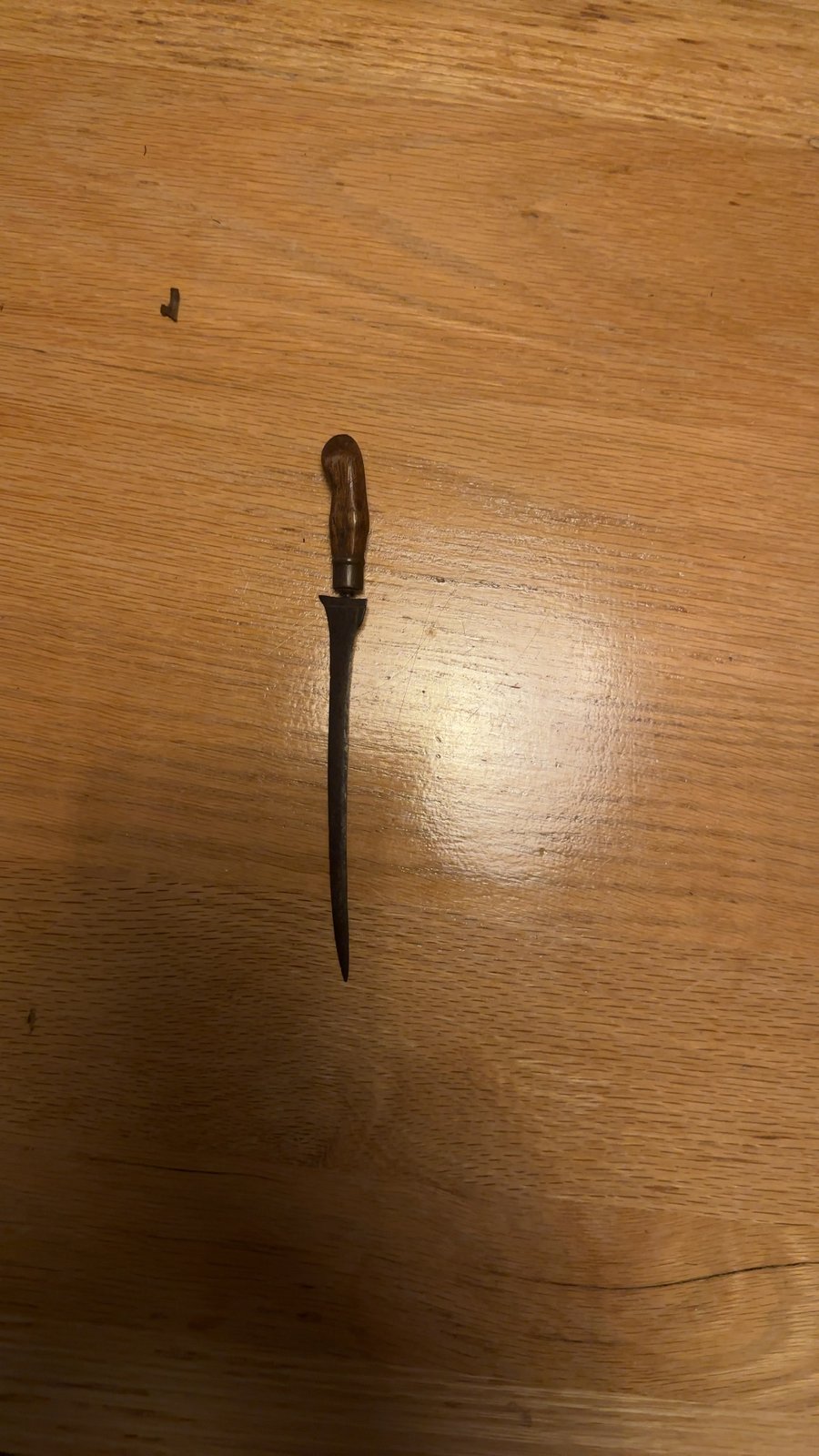
- →Inspect the interiors of the barrels and the lock mechanisms for signs of firing or actual wear consistent with a functional firearm, not just decorative use.
- →Provide clear, high-resolution close-ups of the lock mechanisms and any suspected marks.
- →Consult a specialist in antique firearms directly for hands-on examination, as visual inspection from images alone cannot definitively prove or disprove functionality or authenticity.
ESTIMATED VALUE
Updated: Feb 27, 2026
- Market comparables from auctions & retail
- Condition, completeness & craftsmanship
- Current collector demand & trends
- Low = quick sale, high = patient seller
For informational purposes only, not a formal appraisal.
ABOUT MILITARIA
Military uniforms, weapons, medals, equipment, and war memorabilia.
Browse all MilitariaSHARE THIS CURIOSITY
Have your own curiosities to discover?
Scan Your Curiosity
COMMENTS
No comments yet. Be the first to share your thoughts!
Sign in to leave a comment