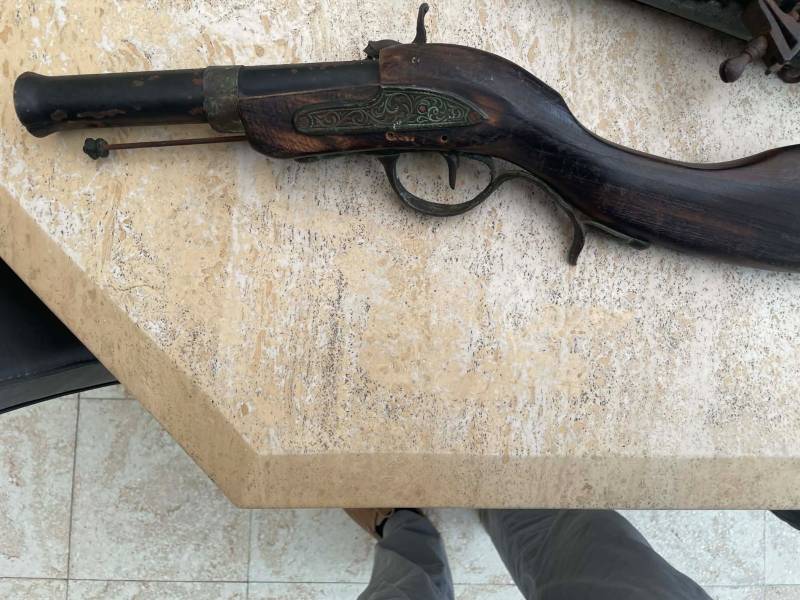
Middle Eastern Style Percussion Blunderbuss Pistol
Authenticity
MIDDLE EASTERN STYLE PERCUSSION BLUNDERBUSS PISTOL: IDENTIFICATION
This is a smoothbore muzzle-loading blunderbuss-style pistol, often referred to as a 'Dag' or 'Traveler's Companion' in Mediterranean or Middle Eastern contexts. The piece features a prominently flared iron barrel designed to facilitate rapid loading and wide shot dispersion. It operates on a percussion ignition system, suggesting a mid-19th century design or a later functional assembly using older components. The wooden stock is dark-stained with a pronounced curved grip, and the brass or copper-alloy sideplates, trigger guard, and barrel band feature cast scrolling foliate patterns often associated with Ottoman or Balkan decorative traditions. The ramrod is retained by a simple hole in the fore-stock.
ISSUE & SERVICE HISTORY
SCARCITY
Typical antique shop fare. Requires some searching but regularly available. This is where most genuine antiques fall.
Typical Characteristics
- Standard antique shop items
- Regularly available
- Moderate collector interest
Confidence Factors
- Construction techniques in the wood-to-metal fit suggest a later 'bazaar' piece rather than a military-issue weapon.
- The verdigris on the brass is consistent with age, but the lack of a maker's mark is common in non-functional decorative reproductions from the early 20th century.
- The hammer and percussion nipple appear to be simplified castings.
Expert review recommended. Consider consulting a specialist before making purchasing decisions.
MILITARY HISTORIAN'S TAKE
Militaria Historian
The identification of the style and origin is high, but the distinction between a functional mid-19th century regional firearm and an early 20th-century decorative piece cannot be finalized without a physical inspection of the breech and lock internals.
KEY EVIDENCE
- 1Flared 'bell' muzzle characteristic of scattershot weaponry.
- 2Percussion ignition system (cap lock) used post-1830.
- 3Cast brass furniture with scrolling foliate motifs points to East Mediterranean or North African origin.
- 4Simple thin iron ramrod retained in the stock body.
- 5Lack of proof marks on the visible top of the barrel indicates local artisanal or non-military production.
UNCERTAINTIES
- •Simplified hammer design lacks the refined beveling of 19th-century European mechanical locks.
- •Crude wood-to-metal fitting around the side-plate is often indicative of pieces made for the traveler market rather than combat use.
WHAT WOULD IMPROVE CERTAINTY
- →Check the underside of the barrel and the lock-plate interior for hidden proof marks or initials.
- →Perform a Bore Light inspection to determine if the breech is actually drilled (functional) or solid (decorative).
- →Compare brass scroll patterns against catalogs from the St. Etienne or Liege export markets for the Ottoman trade.
CONDITION & GRADE
Grading breakdown
Assessed as 'Good' for late-period ethnographic militaria; shows honest age-related wear and oxidation without significant modern mechanical alterations.
Condition
Visible verdigris on the side plates and trigger guard; the percussion nipple appears original but potentially worn down. The wood stock shows surface drying and minor longitudinal cracks near the barrel tang but remains structurally intact.
Weight & feel
Estimated weight of approximately 0.8–1.2 kg, characterized by a front-heavy balance due to the thick-walled iron flared barrel.
MILITARIA VALUATION
Updated: May 11, 2026
Similar North African 'Dag' pistols have achieved $200-$400 at regional militaria auctions like Rock Island or Morphy's specialty sales.
Who buys this
Collectors of ethnographic weapons, North African/Ottoman militaria, or interior designers seeking 'Old World' character pieces.
What increases value
- •Originality of the percussion lock components
- •Integrity of the wooden stock near the stress points of the barrel
- •Presence of any verifiable regional arsenal markings
What lowers value
- •Categorized by some as 'non-firing decor,' which caps value at curiosity levels
- •Significant rust-pitting on the barrel would decrease the value toward the minimum range
What makes top-tier examples
- •Silver-wire inlay in the stock
- •Damascus-steel barrel patterns
- •European export proof marks (e.g., Liege 'ELG')
Grade & condition
Condition of the lock spring tension, degree of metal oxidation, and presence/absence of wood rot or repairs.
Rarity & demand
For informational purposes only, not a formal appraisal.
ABOUT MILITARIA
Military uniforms, weapons, medals, equipment, and war memorabilia.
Militaria value and rarity guideSHARE THIS CURIOSITY
Have your own curiosities to discover?
Scan Your Curiosity
COMMENTS