Ottoman Miquelet-Lock Pistol
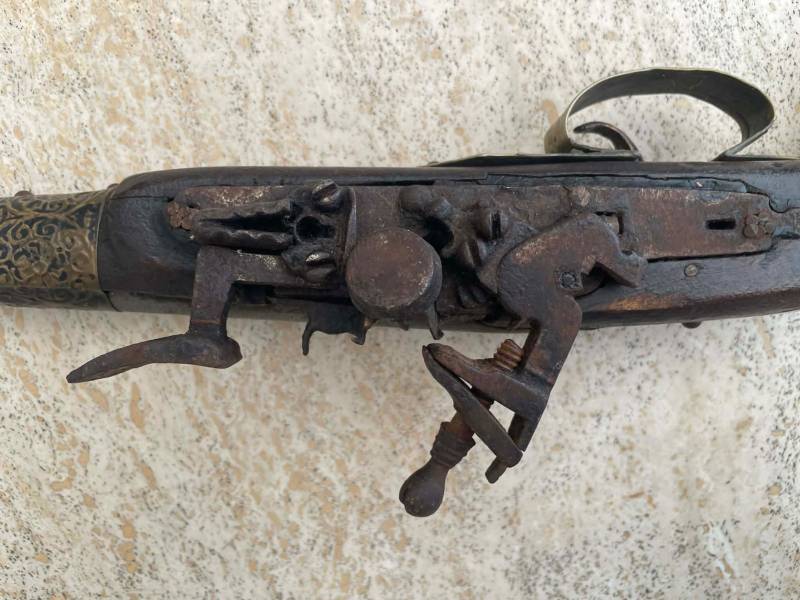
Estimated value
$450 - $1,200Rarity
Uncommon(5/10)Category
MilitariaEra
Circa 1780-1840Origin
InternationalAuthenticity
OTTOMAN MIQUELET-LOCK PISTOL: IDENTIFICATION
A Balkan or Ottoman-style smoothbore pistol featuring a characteristic steel miquelet lock mechanism. The stock is constructed from a dark hardwood, likely walnut, heavily decorated with bone or ivory inlays in geometric 'circle-dot' patterns and secured with numerous decorative brass tacks. The trigger guard and grip cap are formed from engraved brass plate, with the grip terminating in a large, rounded brass 'lemon' pommel common to 18th and early 19th-century regional sidearms.
CROSS-CULTURAL PARALLELS
Where This Object Echoes
The miquelet lock was actually a Spanish innovation, highlighting the 17th-century technological exchange between Mediterranean powers.
Ritual & Ceremonial Use
- •Often used as part of 'Klephtic' or Balkan irregular military bridegroom gifts during the Ottoman period.
Meaning Through Time
Primarily a weapon of war and social rank.
An object of regional heritage and an example of pre-industrial mechanical folk art.
SCARCITY
Genuine antiques with fewer examples on the market. Named makers, documented provenance, or early production examples.
Typical Characteristics
- Limited production
- Named makers
- Growing collector demand
Confidence Factors
- High volume of 'tourist-grade' replicas produced in Mediterranean regions since the mid-20th century
- Pitting on the lock plate appears inconsistent with the relatively sharp edges of the brass engraving
- Modern screws or fasteners sometimes hide beneath traditional-looking tacks
MILITARY HISTORIAN'S TAKE
Militaria Historian
High confidence in the type and regional origin (Balkan/Ottoman), but moderate confidence on the exact date due to the persistence of this style over two centuries and the potential for later assembly.
KEY EVIDENCE
- 1Distinctive external mainspring and frizzen assembly diagnostic of a miquelet lock.
- 2Balkan 'circle-dot' bone inlay style and brass tack patterns consistent with 18th-century regional aesthetics.
- 3Chased brass pommel cap and trigger guard suggest production in an urban center like Sarajevo or Shkodër.
- 4Wear patterns on the stock indicate natural handling and aging rather than artificial distressing.
UNCERTAINTIES
- •The lack of visible maker's marks on the barrel or lock plate is common but complicates precise dating.
- •The condition of the wood vs the metal suggests parts may have been married during a much later restoration.
WHAT WOULD IMPROVE CERTAINTY
- →Check for proof marks or maker's cartouches on the top of the barrel near the breech.
- →Attempt to gently cycle the lock (if safe) to check for a strong primary and secondary sear click.
- →Inspect the bore with a light to determine if it was used with corrosive salts.
CONDITION & GRADE
Grading breakdown
The rating is based on the completeness of the brass and bone ornamentation contrasted against the heavy corrosion on the primary firing mechanism and wood stability issues.
Condition
Significant active corrosion is visible on the miquelet frizzen and cock. The wood stock shows several stress cracks near the lock plate and top tang, and at least one bone inlay appears to be a later replacement. The miquelet spring appears intact, but the mechanical functionality of the sear is unverified.
Weight & feel
Estimated at 0.9 to 1.1 kg, this pistol would feel significantly muzzle-heavy due to the iron barrel length and the dense brass pommel assembly.
MILITARIA VALUATION
Updated: May 10, 2026
Similar Balkan miquelet pistols sold at Czerny's International Auction House for between €500 and €1,100 in 2023.
Who buys this
Specialist collectors of Ottoman Turkish weapons and Balkan military history enthusiasts.
What increases value
- •Operational miquelet lock with a strong spring
- •Retention of original bone inlays without modern putty fillers
- •Presence of an original iron barrel with decorative gold or silver damascening (need clear barrel photos)
What lowers value
- •Seized mechanical parts reducing it to a non-functional decorative piece
- •Evidence of modern glue or epoxy used in wood repairs
What makes top-tier examples
- •Matching silver rather than brass furniture
- •Signed barrel by a known Ottoman smith such as those from the Constantinople workshops
Grade & condition
Rust depth on lock, wood integrity, completeness of inlays, and mechanical soundness.
Rarity & demand
For informational purposes only, not a formal appraisal.
ABOUT MILITARIA
Military uniforms, weapons, medals, equipment, and war memorabilia.
Militaria value and rarity guideSHARE THIS CURIOSITY
Have your own curiosities to discover?
Scan Your Curiosity
COMMENTS