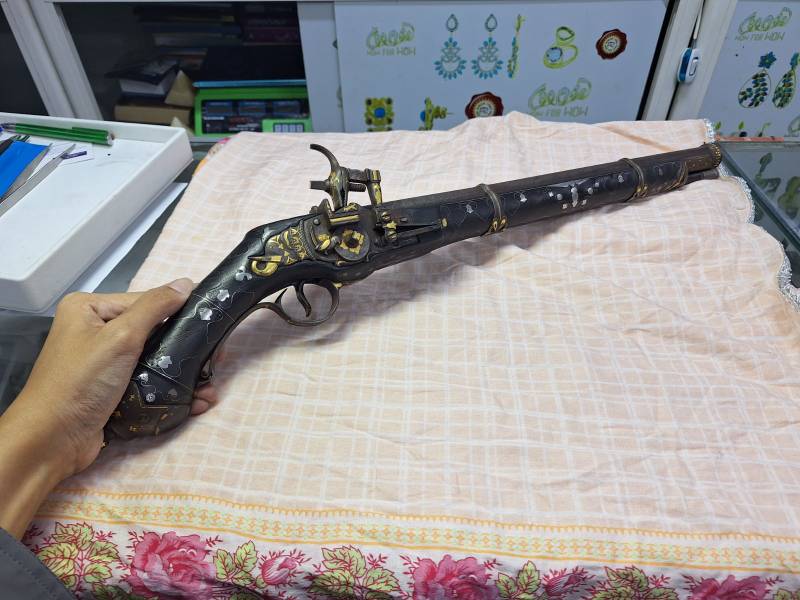
Ottoman Style Miquelet-Lock Pistol
Authenticity
OTTOMAN STYLE MIQUELET-LOCK PISTOL: IDENTIFICATION
A long-barreled flintlock pistol featuring a miquelet ignition system with an external mainspring. The wooden stock is finished in a dark lacquer or stain and decorated with silver-toned wire or foil inlays in floral and geometric patterns. Brass or gold-washed hardware covers the lock plate, trigger guard, and barrel bands. The grip terminates in a bulbous pommel with a metallic cap, characteristic of coastal Mediterranean and Ottoman firearms production from the 18th and 19th centuries.
CROSS-CULTURAL PARALLELS
Where This Object Echoes
The miquelet lock was the standard military ignition system for Spanish forces until the mid-19th century.
Ritual & Ceremonial Use
- •Displaying ornate firearms in 'Salamlik' or reception rooms to signify the host's wealth and military prowess.
Meaning Through Time
An essential defensive weapon for travelers and officials in Ottoman territories.
Highly decorative objects valued for their Islamic geometric art and craftsmanship rather than ballistic utility.
SCARCITY
Genuine antiques with fewer examples on the market. Named makers, documented provenance, or early production examples.
Typical Characteristics
- Limited production
- Named makers
- Growing collector demand
Confidence Factors
- High prevalence of 20th-century 'tourist trade' reproductions using genuine style but non-functional materials
- Pristine appearance of some brass overlays relative to the steel oxidation suggests possible later marriage of parts
- The screw heads and internal spring tensioner show characteristics often seen in mid-20th century decorative copies
Expert review recommended. Consider consulting a specialist before making purchasing decisions.
MILITARY HISTORIAN'S TAKE
Militaria Historian
The object matches the visual profile of 19th-century Ottoman firearms, but the high volume of decorative reproductions from the mid-20th century requires physical inspection of the lock's internal hardness to confirm function over form.
KEY EVIDENCE
- 1External mainspring and vertical sear typical of Mediterranean miquelet locks
- 2Floral wire inlay technique consistent with Balkan or North African 'tufek' workshops
- 3Bulbous pommel design characteristic of 19th-century Ottoman handgun aesthetics
- 4Absence of serial numbers or assembly marks suggests artisan/cottage industry production
UNCERTAINTIES
- •Inlays appear unusually bright compared to the heavy pitting on the barrel
- •Potential non-functional 'wall hanger' status if the internal sear is cast rather than forged
- •Lack of visible proof marks on the barrel breech
WHAT WOULD IMPROVE CERTAINTY
- →Check for a 'touch-hole' (a small hole connecting the pan to the barrel interior) to determine if it was intended for firing.
- →Use a magnet on the brass elements to ensure they are solid non-ferrous metal and not plated steel.
- →Examine the lock mechanism's underside for any maker's stamps or Turkish 'tugra' marks.
CONDITION & GRADE
Condition
Visible oxidation on the steel barrel and lock plate; several sections of the wire inlay appear missing or lifting. The wood displays minor surface abrasions near the lock and grip typical of age and handling.
Weight & feel
Approximately 1.0 to 1.3 kg; the front-heavy balance is typical for long-barreled pistols designed without a shoulder stock.
MILITARIA VALUATION
Updated: May 10, 2026
Similar 19th-century Ottoman pistols sold at Hermann Historica and Rock Island Auction between $800 and $2,400 depending on provenance and barrel quality.
Who buys this
Islamic arts collectors, antique arms specialists, and interior decorators seeking ethnographic display pieces.
What increases value
- •Integrity of the silver wire inlays
- •Operational status of the miquelet lock mechanism
- •Verification of age versus 20th-century decorative copies
What lowers value
- •Missing hardware or broken springs
- •Evidence of being a non-functional 'tourist' piece
- •Heavy rust causing structural failure of the barrel
What makes top-tier examples
- •Hand-forged Damascus steel barrel
- •Clearly identifiable maker's marks or tugra stamps
- •High-grade silver (rather than alloy) inlays
Grade & condition
Completeness of decoration, mechanical functionality, and preservation of the wood-to-metal fit.
Rarity & demand
For informational purposes only, not a formal appraisal.
ABOUT MILITARIA
Military uniforms, weapons, medals, equipment, and war memorabilia.
Militaria value and rarity guideSHARE THIS CURIOSITY
Have your own curiosities to discover?
Scan Your Curiosity
COMMENTS