Delft Tin-Glazed Earthenware Tile
Estimated value
$150 - $350Rarity
Uncommon(5/10)Category
Ceramics & PotteryBrand
DelftEra
Mid-17th Century (c. 1640-1660)Origin
NetherlandsArtist / Creator
DelftAuthenticity
DELFT TIN-GLAZED EARTHENWARE TILE: IDENTIFICATION
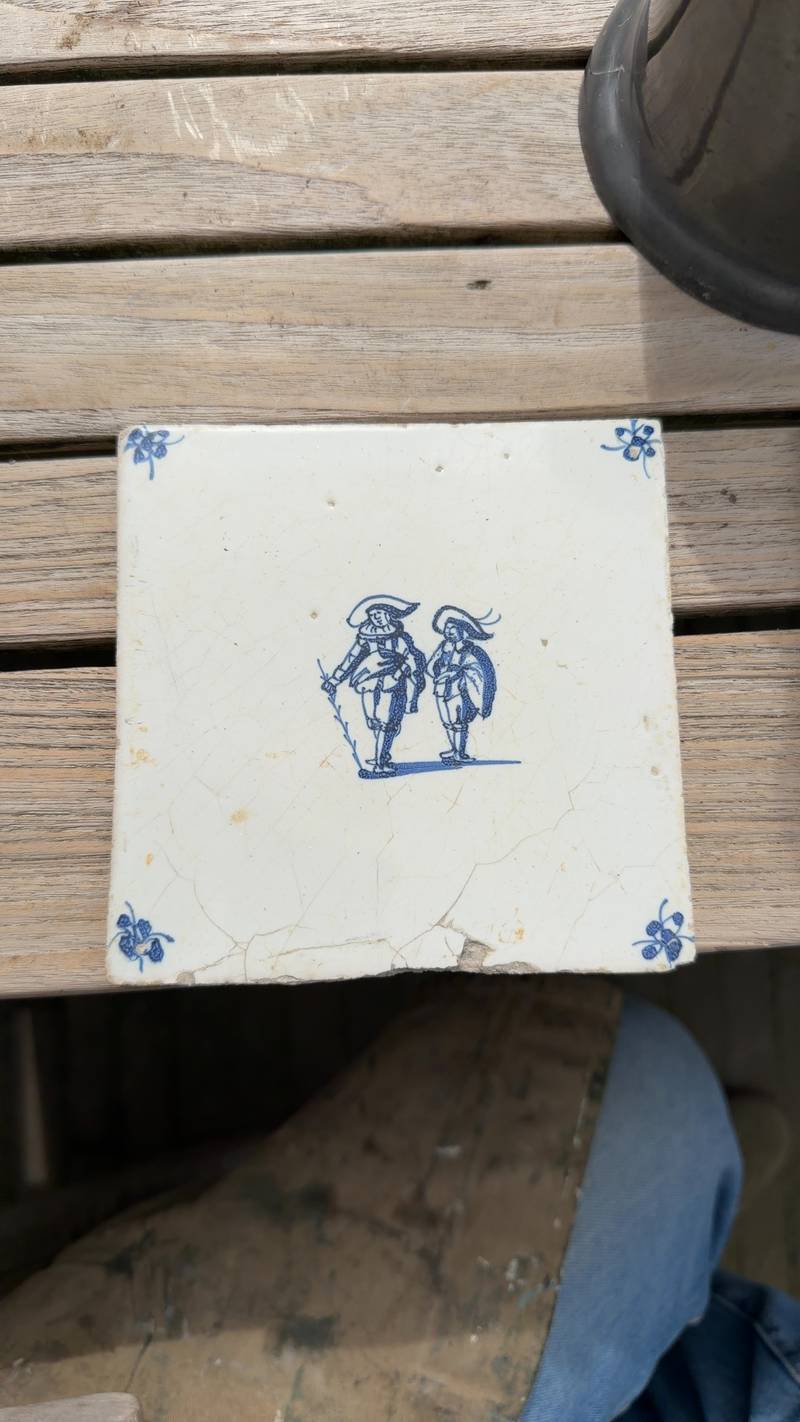
A square tin-glazed earthenware wall tile featuring a hand-painted central motif of two male figures in 17th-century 'Cavalier' attire. The figures are rendered in cobalt blue against a milky white background, flanked by 'ox-head' (ossekop) corner motifs. The reverse reveals a pinkish-buff, coarse earthenware body with remnants of lime mortar, characteristic of tiles removed from a masonry wall.
PRODUCTION & FIRING
COLLECTOR NOTES
Typical Dutch tiles from this period measure approximately 13 x 13 cm and were about 8–10 mm thick to fit standard chimney and baseboard alignments.
SCARCITY
Genuine antiques with fewer examples on the market. Named makers, documented provenance, or early production examples.
Typical Characteristics
- Limited production
- Named makers
- Growing collector demand
Confidence Factors
- Presence of authentic kiln nail marks in glaze
- Mortar residue and porous earthenware body consistent with 17th-century manufacture
- Spontaneous brushwork in cobalt blue matches period examples
CERAMICIST'S ASSESSMENT
Ceramics Historian & Kiln Specialist
High confidence due to clear visual evidence of manufacturing techniques (nail holes, paste type, and ossekop corners) that are difficult to accurately replicate in modern fakes.
KEY EVIDENCE
- 1Ox-head corner motifs are diagnostic markers for mid-17th century production.
- 2The presence of three pin-sized holes near the corners indicates the use of traditional wooden pinning boards during decoration.
- 3The coarse, yellowish-pink paste exposed at the chips is a classic 'Delffse plate-backers' recipe.
- 4Cobalt blue pigment has 'bled' slightly into the lead-tin glaze, creating a soft halo characteristic of genuine period firing.
UNCERTAINTIES
- •The significant chip at the bottom reduces the value by approximately 40-50% compared to a pristine example.
- •Rust-colored stains suggest the tile was exposed to moisture or iron-rich mortar for a long period.
WHAT WOULD IMPROVE CERTAINTY
- →Measure exact dimensions; 13.0cm to 13.4cm is the standard for this era.
- →Check for any modern epoxy restorations under UV light, particularly around the damaged edge.
CONDITION & GRADE
Condition
Significant loss to the lower edge affecting the base of the scene; widespread crazing and minor iron staining (rust spots) on the glaze surface; heavy mortar residue on the reverse.
Weight & feel
Substantial and dense for its 13cm size, weighing approximately 250–300g, consistent with hand-pressed low-fire clay.
CERAMICS MARKET VALUE
Updated: May 11, 2026
Similar 17th-century figure tiles have sold at specialist auctions like Bubb Kuyper or Christie's Amsterdam for €200–€400 depending on subject rarity.
Who buys this
Specialist antique tile collectors and interior designers seeking authentic Dutch Golden Age architectural fragments.
What increases value
- •Rarity of the 'Two Cavalier' motif compared to common single-figure or floral types
- •Clarity of the cobalt blue brushwork
- •Authenticity of the 17th-century earthenware body
What lowers value
- •Large loss at the bottom edge significantly impacts display quality
- •Widespread iron staining on the white field
What makes top-tier examples
- •Pristine edges without nibbling or chips
- •Strong historical scenes like 'Soldiers' or 'Children at Play' command highest prices
Grade & condition
Condition of the four corners and the integrity of the central motif glaze surface.
Rarity & demand
For informational purposes only, not a formal appraisal.
ABOUT CERAMICS & POTTERY
Pottery, porcelain, stoneware, earthenware, and kiln-fired objects.
Ceramics & Pottery value and rarity guideSHARE THIS CURIOSITY
Have your own curiosities to discover?
Scan Your Curiosity
COMMENTS