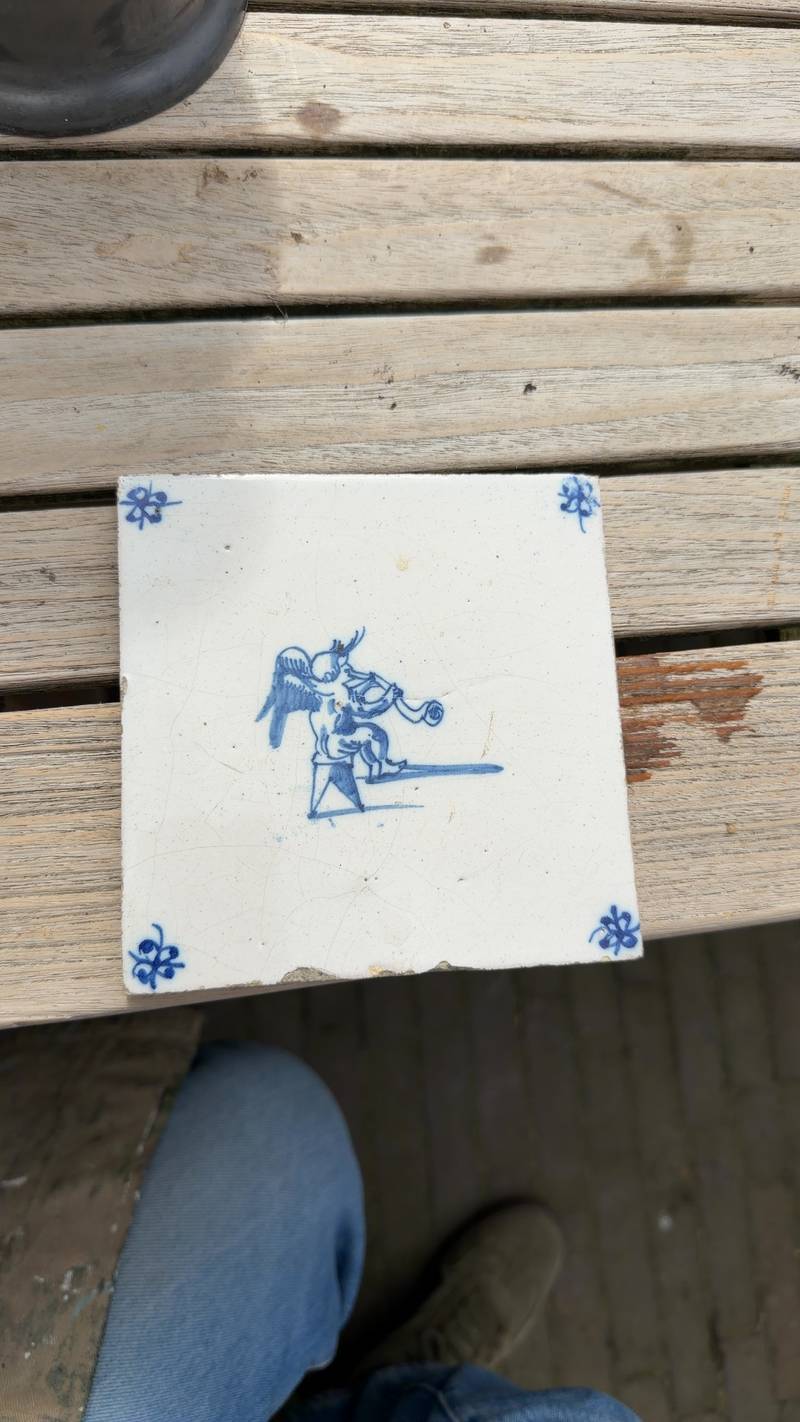
Delft Blue Tin-Glazed Earthenware Tile with Putto
Estimated value
$85 - $175Rarity
Average(4/10)Category
Ceramics & PotteryBrand
DelftEra
Circa 1680-1750Origin
NetherlandsAuthenticity
DELFT BLUE TIN-GLAZED EARTHENWARE TILE WITH PUTTO: IDENTIFICATION
Hand-painted tin-glazed earthenware (Delftware) wall tile featuring a central blue monochrome putto playing a horn. The figure is flanked by traditional 'ox-head' or 'spider' corner motifs. The reverse reveals a coarse, buff-colored earthenware body consistent with 17th or 18th-century Dutch fabrication, approximately 13 cm by 13 cm in size with a thickness of roughly 8-10 mm.
PRODUCTION & FIRING
COLLECTOR NOTES
The 13 cm square format became the industry standard in the 1600s because it maximized kiln space efficiency for standard wood-fired ovens.
SCARCITY
Typical antique shop fare. Requires some searching but regularly available. This is where most genuine antiques fall.
Typical Characteristics
- Standard antique shop items
- Regularly available
- Moderate collector interest
Confidence Factors
- Visible pin-holes from production templates consistent with period technique
- Body paste color and thickness align with 17th/18th century Dutch clay sources
- Wear patterns on the edges show natural oxidation of the earthenware
CERAMICIST'S ASSESSMENT
Ceramics Historian & Kiln Specialist
The evidence of the coarse earthenware body, specific corner motifs, and glaze crazing provides a high degree of certainty for a Southern Netherlands origin in the late 17th or early 18th century.
KEY EVIDENCE
- 1Presence of pin-holes in the tin-glaze surface
- 2Buff-colored, porous earthenware 'biscuit' visible at chipped edges
- 3Stylized 'spider' corner motifs consistent with 18th-century production
- 4Standardized 13cm dimensions
WHAT WOULD IMPROVE CERTAINTY
- →Measure thickness accurately: 8mm-10mm supports an older date; thinner tiles are often 19th-century reproductions.
- →Examine edges for mortar remains, which confirms it was once installed in a period interior.
- →Check for a 'tap' sound; a high-pitched ring suggests a denser, later body, while a dull 'thud' confirms soft earthenware.
CONDITION & GRADE
Grading breakdown
Frequent edge losses and minor surface pitting are standard for excavated or salvaged tiles; the absence of through-cracks maintains its structural value.
Condition
Significant edge chipping (fritting) reveals the underlying buff earthenware body. Surface showcases authentic age-related crazing and scattered staining, though the central figure remains 90% intact.
CERAMICS MARKET VALUE
Updated: May 11, 2026
Similar 18th-century figural tiles regularly achieve between $100 and $200 at specialist auctions like Christie's Amsterdam or via Dutch specialty dealers.
Who buys this
Specialist Dutch Delftware collectors and interior designers seeking authentic period accents for historical restoration projects.
What increases value
- •Clarity and charm of the central figural motif
- •Rarity of specific character types (soldiers or musicians often command a 20% premium over landscapes)
- •General structural integrity and lack of professional restoration
What lowers value
- •Heavy staining from proximity to old soot if used in a fireplace
- •Over-cleaning which can strip the soft tin-glaze surface
What makes top-tier examples
- •Rare polychrome (multi-color) decoration from the early 17th century
- •Attribution to a specific factory like 'De Grieksche A'
Grade & condition
Condition of the central figure, degree of edge chipping, and presence of original 'nail holes'.
Rarity & demand
For informational purposes only, not a formal appraisal.
ABOUT CERAMICS & POTTERY
Pottery, porcelain, stoneware, earthenware, and kiln-fired objects.
Ceramics & Pottery value and rarity guideSHARE THIS CURIOSITY
Have your own curiosities to discover?
Scan Your Curiosity
COMMENTS