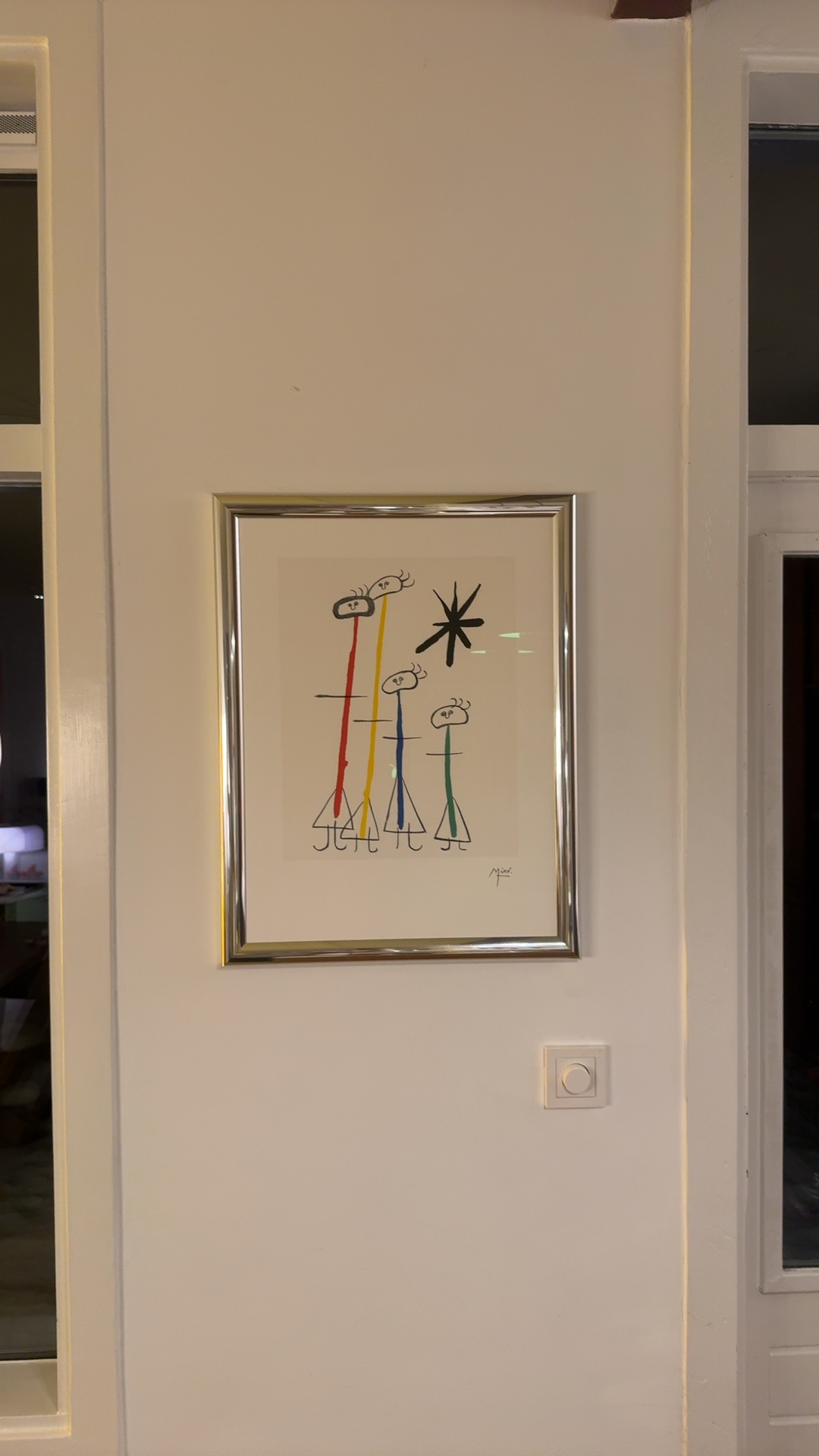
Joan Miró, 'L'enfance d'Ubu' (Ubu's Childhood) series print
QUICK FACTS
Categories
Era
1960s-1970s
Origin
🇪🇸 Spain
Artist/Maker
Joan Miró
Rarity
Uncommon (5/10)
Discovered
Jan 6, 2026
1 months ago
DESCRIPTION
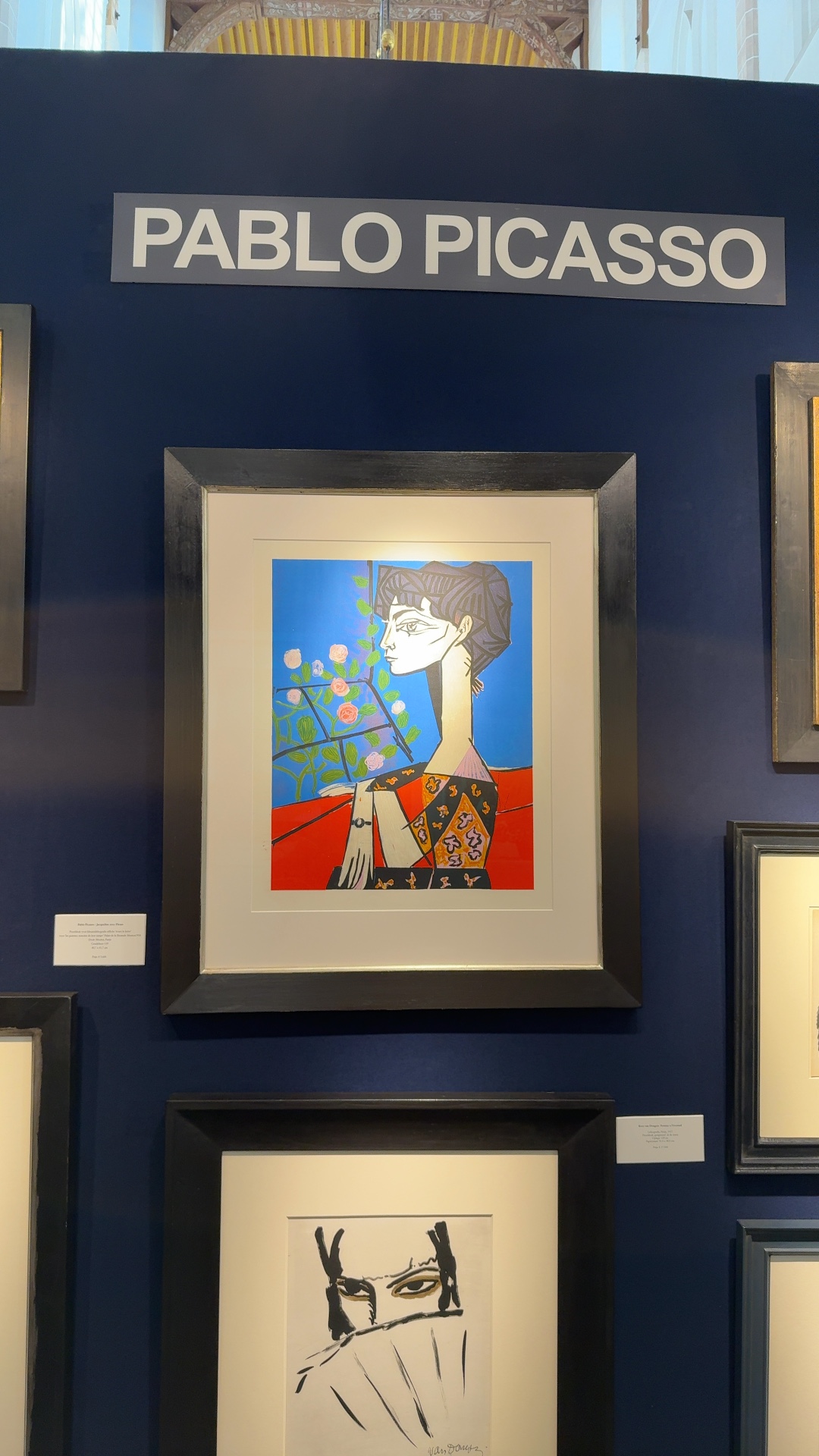
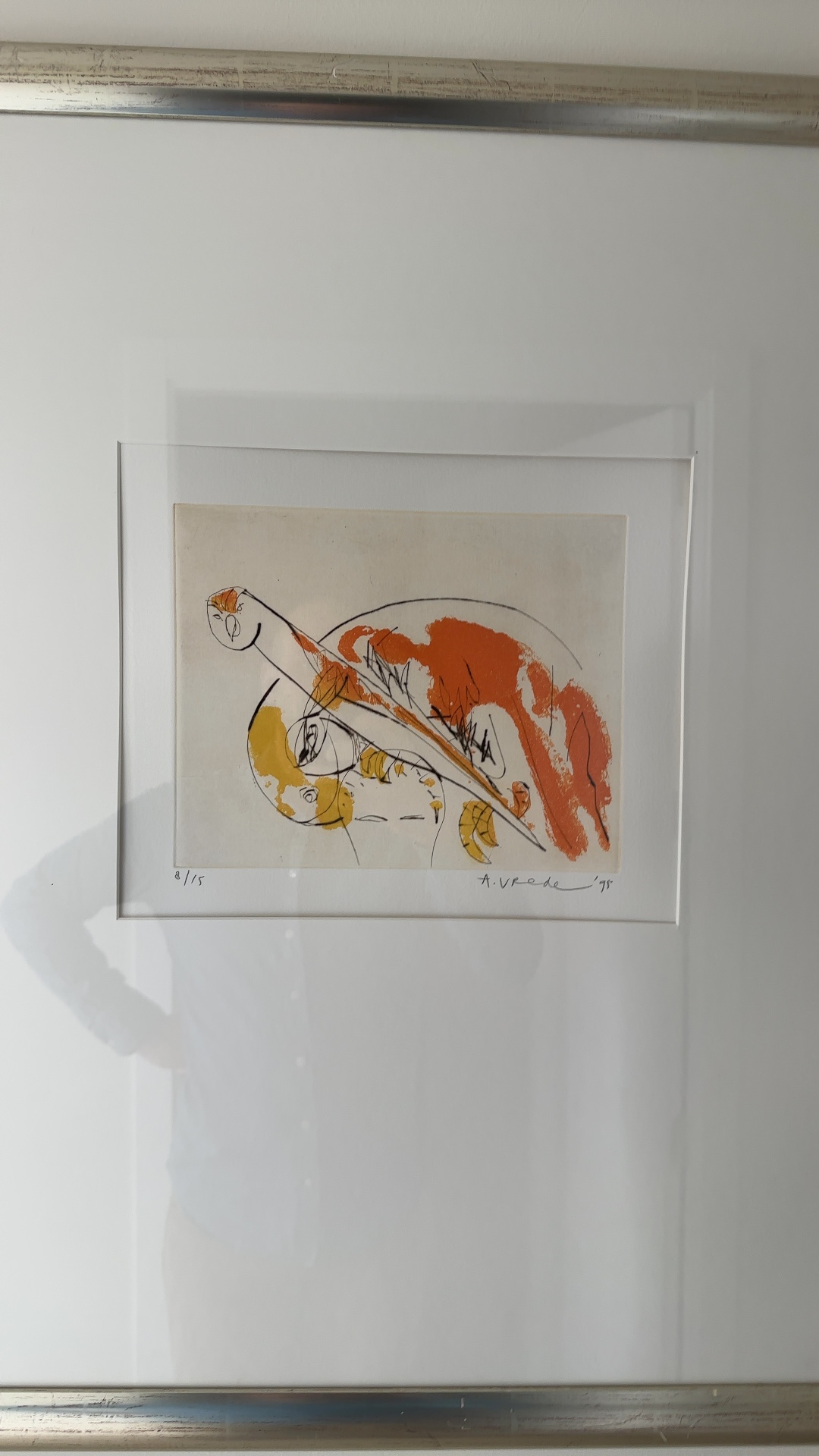
This appears to be a framed print, likely a lithograph, from the renowned Spanish artist Joan Miró, specifically from his 'L'enfance d'Ubu' series. The work features characteristic Miró abstract figures composed of simplified lines and shapes, with primary colors and a distinct calligraphic signature. The composition, depicting several vertical figures with simplified heads and bodies, alongside an abstract star-like form, is highly emblematic of his later graphic work.
CULTURAL ECHOES
Where This Object Echoes
Miró's early association with Surrealism influenced his exploration of the subconscious and dream imagery, evident in the playful, fantastical quality of his figures.
While not an Abstract Expressionist, Miró's emphasis on spontaneous gestures and simplified forms had a significant impact on later movements, influencing artists who prioritized emotional expression over strict representation.
Ritual & Ceremonial Use
- •The ritual of collecting and displaying modern master prints as a means of personal expression and cultural engagement in domestic and public spaces.
- •The academic and curatorial ritual of cataloging, archiving, and authenticating graphic works for scholarly and market purposes.
Meaning Through Time
Miró's work was seen as a radical departure from traditional representation, embodying the avant-garde's challenge to artistic conventions and logic, often associated with revolutionary political and social ideas.
His art became increasingly recognized for its unique 'Miróesque' style, achieving widespread popular appeal and becoming a symbol of modern art's playful, yet profound, capacity for universal communication beyond cultural barriers.
HISTORICAL STORY
DID YOU KNOW?
Miró's 'Ubu' series was inspired by Alfred Jarry's 1896 play 'Ubu Roi,' a seminal work in the theater of the absurd that satirized power and greed through the character of Père Ubu, a tyrannical, gluttonous, and foolish monarch.
Despite his association with Surrealism, Miró often emphasized his connection to his Catalan roots and landscape, frequently incorporating elements inspired by traditional Catalan art and the rugged terrain of Mont-roig into his abstract lexicon.
MATERIAL & CONDITION
Surface
The print appears to be on a relatively smooth, off-white wove paper, common for Miró's lithographs. The colors are bold and flat, suggesting a lithographic process where distinct color layers are applied. No apparent texture or brushwork is visible on the surface, which is consistent with a print rather than an original painting.
Weight & Feel
Given the framing, this piece would likely feel moderately heavy, with the weight primarily coming from the glass and frame materials. The paper itself would contribute minimal weight.
Condition
The print itself appears to be in very good condition, with no obvious signs of foxing, fading, or creasing visible through the low-resolution images. The metallic frame shows some minor surface scuffs or reflections, typical of handling and age, but nothing that detracts significantly from the presentation.
RARITY ANALYSIS
Genuine antiques with fewer examples on the market. Named makers, documented provenance, or early production examples.
Typical Characteristics
- Limited production
- Named makers
- Growing collector demand
EXPERT ANALYSIS
Museum-Trained Art Historian
Confidence is good regarding the attribution to Miró based on the highly identifiable style and signature. However, the exact medium (e.g., original lithograph vs. reproduction) and authenticity cannot be definitively confirmed without closer inspection of the print's physical characteristics, such as edition numbering and paper type, which are not visible in the provided images.
KEY EVIDENCE
- 1The imagery is highly characteristic of Joan Miró's distinct curvilinear style and biomorphic forms, particularly from his later periods and graphic works.
- 2The inclusion of primary colors (red, yellow, blue) applied in flat washes is common in his printmaking oeuvre.
- 3The signature 'Miró' is consistent with known examples of the artist's cursive signature.
- 4The composition resembles known prints from his significant 'L'enfance d'Ubu' series, indicative of its period and thematic content.
UNCERTAINTIES
- •Lack of visible edition number or additional pencil signature below the image, which is common for artist-signed limited edition prints.
- •The image quality does not allow for close examination of paper type, watermarks, or the presence of a platemark, which are crucial for authenticating print mediums.
- •The framing obscures the edges of the print, potentially hiding important marks or inscriptions.
WHAT WOULD IMPROVE CERTAINTY
- →Remove the print from the frame and photograph the entire sheet, front and back, including any pencil markings, edition numbers, or stamps.
- →Examine the paper closely for watermarks or distinguishing characteristics consistent with prints of the period.
- →Consult a Miró prints catalogue raisonné to compare the image and details with documented works, paying attention to specific prints from the 'L'enfance d'Ubu' series.
- →Seek an opinion from an expert specializing in 20th-century prints or Miró's graphic work.
ESTIMATED VALUE
Updated: Feb 26, 2026
- Market comparables from auctions & retail
- Condition, completeness & craftsmanship
- Current collector demand & trends
- Low = quick sale, high = patient seller
For informational purposes only, not a formal appraisal.
ABOUT PRINTS & POSTERS
Vintage prints, posters, advertising signs, and graphic art.
Browse all Prints & PostersSHARE THIS CURIOSITY
Have your own curiosities to discover?
Scan Your Curiosity
COMMENTS
No comments yet. Be the first to share your thoughts!
Sign in to leave a comment