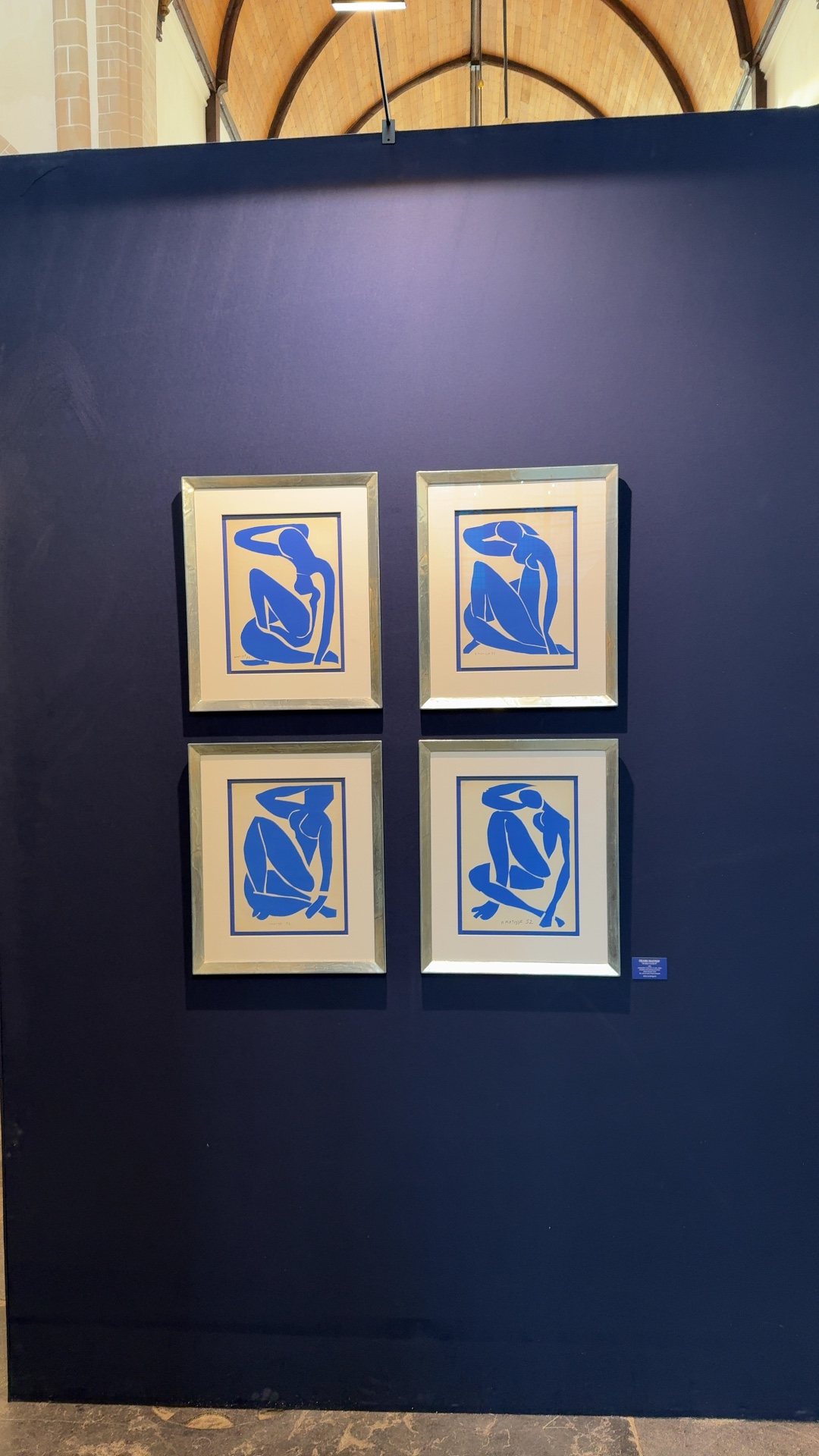
Set of Four Prints after Henri Matisse's "Blue Nudes" (Nus Bleus I-IV)
QUICK FACTS
Type
Museum Object
Categories
Era
Original design 1952; prints could be 1958 or modern reproductions
Origin
🇫🇷 France
Artist/Maker
Henri Matisse (after)
Rarity
Rare (7/10)
Discovered
Jan 25, 2026
1 months ago
DESCRIPTION
A professionally framed set of four prints reproducing Henri Matisse's seminal 1952 paper cut-outs, the Nus Bleus. The series exemplifies the artist's late-career 'carving into color' method, a powerful synthesis of drawing and collage. The signature and date, 'H. MATISSE 52,' are printed as part of the image, which is consistent with both the original lithographs and subsequent reproductions. It is crucial to determine if these are the original 1958 lithographs published in the journal Verve, which are highly valuable ($15,000+), or later decorative prints of modest worth. Based on the images alone, the latter is more probable, but only physical inspection can confirm.
CULTURAL ECHOES
Where This Object Echoes
The simplified, essential forms of the Blue Nudes echo the abstract power of Cycladic figurines from the Aegean Bronze Age, which also reduced the human body to fundamental geometric shapes.
Matisse was influenced by Japanese prints, and the use of flat planes of color, strong outlines, and dynamic poses in his cut-outs shares a lineage with the compositional innovations of artists like Hokusai and Utamaro.
Ritual & Ceremonial Use
- •Collecting blue-chip modern art prints as a form of cultural and financial investment.
- •The display of iconic artworks in domestic settings to signify cultural literacy and sophisticated taste.
Meaning Through Time
Viewed as a radical, late-career triumph; a distillation of a lifetime's work into a new, vibrant medium by a master of Modernism.
Became symbols of post-war European culture and artistic freedom, widely disseminated through posters and books, entering mainstream visual culture.
Universally recognized cultural icons, with the distinction between original print and mass-market poster being critical for value but often lost on the general public.
HISTORICAL STORY
DID YOU KNOW?
Matisse referred to his cut-out process as "drawing with scissors," feeling it was a more direct and instantaneous union of line and color than painting.
The specific vibrant ultramarine blue was a custom gouache mix prepared for Matisse. It predates the famed International Klein Blue (IKB) by several years, making Matisse a pioneer in the use of such a bold, signature color.
MATERIAL & CONDITION
Surface
The image is composed of a flat, unmodulated ultramarine blue printed on a warm, off-white paper stock. The printing appears sharp and clean, with crisp edges defining the figure, characteristic of lithography or high-quality screenprinting.
Weight & Feel
As prints on paper, the works themselves are lightweight. The frames, appearing to be silvered wood or aluminum with glazing, contribute the majority of the weight and have a modern, clean presence.
Condition
From a distance, the prints appear to be in excellent condition, with no visible fading, foxing, or acid damage. This pristine state could argue for either careful archival storage or for the works being modern reproductions. The frames are modern and appear undamaged.
RARITY ANALYSIS
Exceptional items that serious collectors actively seek. Only a handful appear at major auctions each year.
Typical Characteristics
- Few examples at auction yearly
- Specialist dealer networks
- Strong collector competition
EXPERT ANALYSIS
Museum-Trained Art Historian
Confidence is high in identifying the subject matter and artist, as the 'Blue Nudes' are among Matisse's most famous works. Confidence in the specific edition (and thus value) is low, as the photographs do not permit the necessary examination of the paper, printing method, or potential printers' marks.
KEY EVIDENCE
- 1The works are identifiable as reproductions of Henri Matisse's four *Nu Bleu* (Blue Nude) paper cut-outs from 1952.
- 2The signature and date, 'H. MATISSE 52', are part of the print, which is correct for the original 1958 lithographic edition and subsequent reproductions.
- 3The style is the artist's seminal late-career 'cut-out' technique, representing a fusion of drawing and color.
- 4The prints are presented as a complete series in uniform, modern frames, suggesting a deliberate curatorial or decorative choice.
- 5The gallery-style hanging on a dark blue wall implies the works are considered significant.
UNCERTAINTIES
- •The primary red flag is the inability to distinguish between a highly valuable 1958 *Verve* lithograph and a modern decorative poster without physical examination.
- •The lack of a visible central fold, characteristic of the *Verve* edition, raises the probability that these are later prints.
WHAT WOULD IMPROVE CERTAINTY
- →Carefully de-frame one of the prints (or have a professional do so) to examine the full sheet of paper.
- →Look for a central vertical crease, which would be strong evidence for a 1958 *Verve* edition.
- →Photograph the reverse of the sheet to check for any text or printer's marks (e.g., 'Mourlot Frères').
- →Examine the print surface with a magnifying glass or loupe to identify the printing technique (e.g., the dot pattern of lithography vs. a flat screenprint or digital print).
- →Consult the Matisse catalogue raisonné for prints, prepared by the Duthuit family, to compare against known editions.
ESTIMATED VALUE
Updated: Feb 27, 2026
- Market comparables from auctions & retail
- Condition, completeness & craftsmanship
- Current collector demand & trends
- Low = quick sale, high = patient seller
For informational purposes only, not a formal appraisal.

ABOUT PRINTS & POSTERS
Vintage prints, posters, advertising signs, and graphic art.
Browse all Prints & PostersSHARE THIS CURIOSITY
Have your own curiosities to discover?
Scan Your Curiosity
COMMENTS
No comments yet. Be the first to share your thoughts!
Sign in to leave a comment