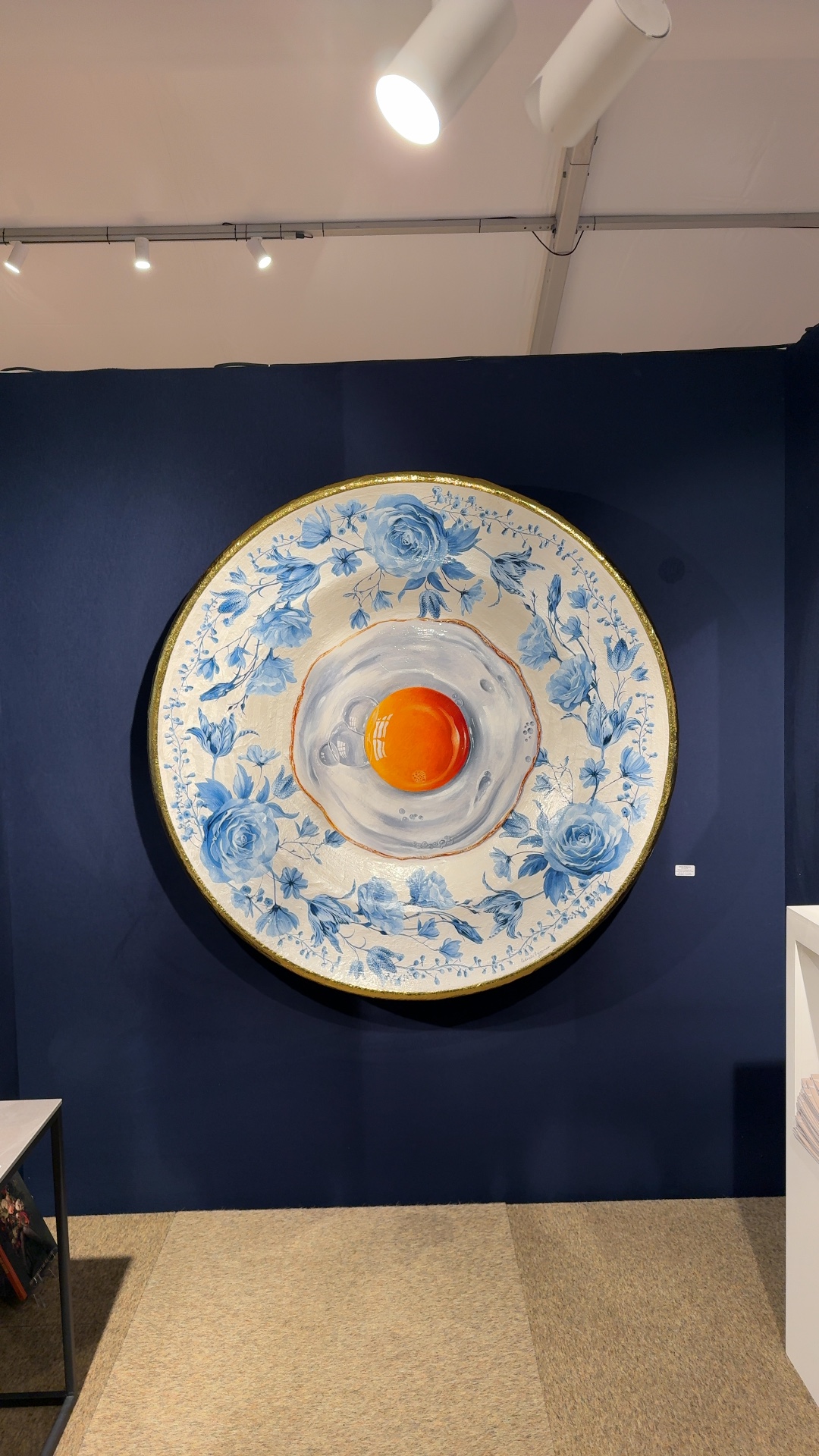
Katinka Krijgsman Frying Pan with Egg Painting
QUICK FACTS
Categories
Era
21st Century
Origin
🇳🇱 Netherlands
Artist/Maker
Katinka KrijgsmanRarity
Scarce (6/10)
Discovered
Jan 25, 2026
1 months ago
DESCRIPTION
This appears to be a large-scale, trompe l'œil painting depicting a fried egg set within an elaborately decorated blue-and-white 'plate' or 'frying pan'. The execution is highly realistic, particularly the rendering of the egg yolk and the viscous quality of the egg white, complete with illusory reflections. The 'plate' itself features a decorative border of blue floral motifs, reminiscent of Delftware or transferware patterns, alongside a gilded rim. The signature 'Katinka Krijgsman' is visible along the lower edge of the blue floral band.
CULTURAL ECHOES
Where This Object Echoes
The tradition of still life painting and trompe l'œil, often featuring domestic objects and food, which this contemporary piece playfully references.
The elevation of everyday, mundane objects, such as food, to the status of fine art, challenging traditional hierarchies of subject matter.
The blue and white floral patterns on the 'plate' directly echo the style and color palette of traditional Dutch ceramic decorations.
Ritual & Ceremonial Use
- •The domestic ritual of meal preparation and consumption, elevated and aestheticized through large-scale artistic representation.
- •The act of viewing and decoding trompe l'œil works, engaging the viewer in a playful deception and a deeper appreciation of artistic skill.
Meaning Through Time
Trompe l'œil was used to create convincing illusions, often for architectural enhancement or to denote abundance and luxury.
Everyday objects, like a fried egg, became symbols of consumer culture and artistic commentary on the ordinary.
Reinterpretation of historical techniques and motifs, blending realism with decorative arts, often to explore themes of illusion, representation, and the artistic process itself.
HISTORICAL STORY
DID YOU KNOW?
Trompe l'œil art was often used in ancient Roman murals to create architectural illusions, making rooms appear larger or more ornate.
The iconic 'fried egg' motif has been a recurring subject in art history, notably by artists like Salvador Dalí, often symbolizing concepts of life, creation, or fragility.
MATERIAL & CONDITION
Surface
The painting surface exhibits a smooth, yet slightly textured quality, particularly visible in the 'white' areas, suggesting a canvas or panel ground. The impasto in the egg yolk and white creates a convincing three-dimensional illusion, capturing light and sheen with exceptional skill. The gilded rim appears to be an application of metallic paint, adding a decorative flourish.
Weight & Feel
Given its scale, this piece would likely be substantial but manageable for wall mounting, possibly painted on a stretched canvas or a lightweight panel, rendering it moderately weighty.
Condition
Visually, the painting appears to be in excellent condition, with no apparent damage, abrasions, or loss of paint. The colors retain their vibrancy, and the surface appears clean, suggesting careful display and handling.
RARITY ANALYSIS
Genuinely harder to find. Perhaps only dozens come to market annually. Collectors actively watch for these pieces.
Typical Characteristics
- Dozens per year at market
- Documented provenance valued
- Active collector pursuit
EXPERT ANALYSIS
Museum-Trained Art Historian
The clear signature and distinctive style, coupled with basic online verification of the artist's known works, provide a strong basis for identification with high confidence.
KEY EVIDENCE
- 1The prominent and clearly legible signature 'Katinka Krijgsman'.
- 2The distinctive trompe l'œil style and subject matter (fried egg on decorative plate) align with contemporary artistic practices, notably those of Katinka Krijgsman.
- 3The scale and execution suggest a fine art piece intended for gallery display rather than a decorative object.
WHAT WOULD IMPROVE CERTAINTY
- →Consult the artist's official website or gallery representation for catalog raisonné or verified exhibition records.
- →Examine the reverse of the artwork for any exhibition labels, artist's notes, or framing details.
- →Request further information on the medium and support used, such as canvas type or panel material.
ESTIMATED VALUE
Updated: Feb 27, 2026
- Market comparables from auctions & retail
- Condition, completeness & craftsmanship
- Current collector demand & trends
- Low = quick sale, high = patient seller
For informational purposes only, not a formal appraisal.

SHARE THIS CURIOSITY
Have your own curiosities to discover?
Scan Your Curiosity
COMMENTS
No comments yet. Be the first to share your thoughts!
Sign in to leave a comment