Aletai Iron Meteorite Slice, III E-an - Om
QUICK FACTS
Categories
Era
Found 1898
Origin
🇨🇳 China
Rarity
Rare (7/10)
Discovered
Jan 11, 2026
1 months ago
DESCRIPTION
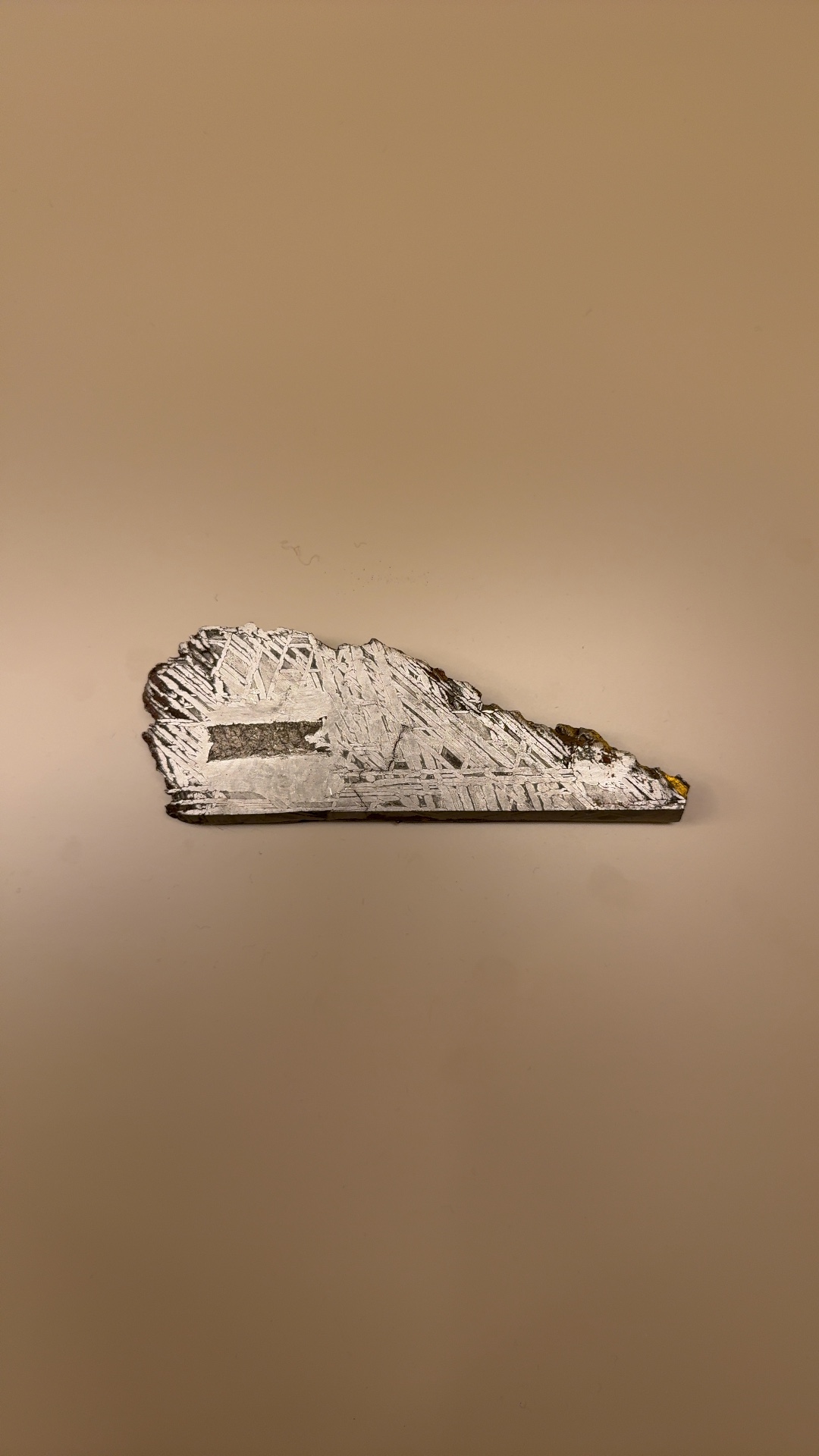
This appears to be a polished and etched slice from an Aletai iron meteorite, classified as a III E-an - Om type. The distinctive Widmanstätten patterns are prominently visible, indicating its extraterrestrial origin and specific metallurgical structure formed by slow cooling in space. The accompanying label provides key recovery information, including its origin in Xinjiang, China, and a find date of 1898, with an estimated total known weight (TKW) exceeding 50 tons for the entire meteorite mass.
CULTURAL ECHOES
Where This Object Echoes
Ancient cultures sometimes utilized meteoritic iron for tools and ceremonial objects due to its unique properties and celestial origin, predating terrestrial iron smelting.
The display of such specimens, often with detailed labels, aligns with traditions of natural history museums and private collections aiming to educate and preserve scientific artifacts.
Ritual & Ceremonial Use
- •Collectors sometimes participate in a ritual of 'cutting and etching' that reveals the internal beauty of an iron meteorite, turning a rough find into a scientific and aesthetic display item.
Meaning Through Time
Meteorites were often seen as gifts from the gods, omens, or sacred objects due to their mysterious arrival from the sky.
With scientific advancement, meteorites transitioned from supernatural phenomena to objects of intense scientific study, providing direct evidence of extraterrestrial material and solar system formation.
HISTORICAL STORY
DID YOU KNOW?
The Widmanstätten patterns visible on etched iron meteorite slices cannot be replicated on Earth, serving as a powerful indicator of their extraterrestrial origin.
The term 'Aletai' refers to a strewn field, meaning the original meteorite broke up upon atmospheric entry, scattering fragments across a wide area.
MATERIAL & CONDITION
Surface
The surface is characterized by a polished, silvery metallic sheen, revealing intricate, geometric Widmanstätten patterns. These patterns are etched to highlight the kamacite and taenite crystals, giving a textured aesthetic despite the smooth, polished cut. Some areas may show slight discoloration or oxidation near the edges.
Weight & Feel
Given its iron-nickel composition, the slice would feel considerably dense and heavy for its size, typical of metallic specimens.
Condition
The specimen appears to be in excellent condition, with a well-preserved polished and etched surface. The Widmanstätten patterns are clear and distinct, without significant scratches, corrosion, or pitting that would detract from its aesthetic and scientific value.
RARITY ANALYSIS
Exceptional items that serious collectors actively seek. Only a handful appear at major auctions each year.
Typical Characteristics
- Few examples at auction yearly
- Specialist dealer networks
- Strong collector competition
EXPERT ANALYSIS
Natural History Curator & Specimen Preparator
The visible Widmanstätten patterns are a definitive marker of iron meteorites, and the provided label information aligns perfectly with established data for the Aletai meteorite. The overall presentation is consistent with authenticated specimens.
KEY EVIDENCE
- 1Distinctive Widmanstätten patterns clearly visible on the etched surface, characteristic of iron-nickel meteorites.
- 2Informational label providing classification (III E-an - Om), locality (Xinjiang, China), and find date (1898), which corresponds to known Aletai meteorite data.
- 3Polished metallic luster consistent with prepared iron meteorite slices.
- 4Irregular, organic shape typical of cut meteorite fragments.
WHAT WOULD IMPROVE CERTAINTY
- →Review provided documentation if available (e.g., certificate of authenticity, purchase records).
- →Examine the edges and cut surfaces under magnification to confirm consistency in material and absence of terrestrial smelting slag.
- →Verify the mass of the slice to compare with typical weights for reported dimensions of Aletai fragments.
ESTIMATED VALUE
Updated: Feb 26, 2026
- Market comparables from auctions & retail
- Condition, completeness & craftsmanship
- Current collector demand & trends
- Low = quick sale, high = patient seller
For informational purposes only, not a formal appraisal.

ABOUT SCIENCE & CURIOSITIES
Scientific instruments, laboratory equipment, and curious objects.
Browse all Science & CuriositiesSHARE THIS CURIOSITY
Have your own curiosities to discover?
Scan Your Curiosity
COMMENTS
No comments yet. Be the first to share your thoughts!
Sign in to leave a comment