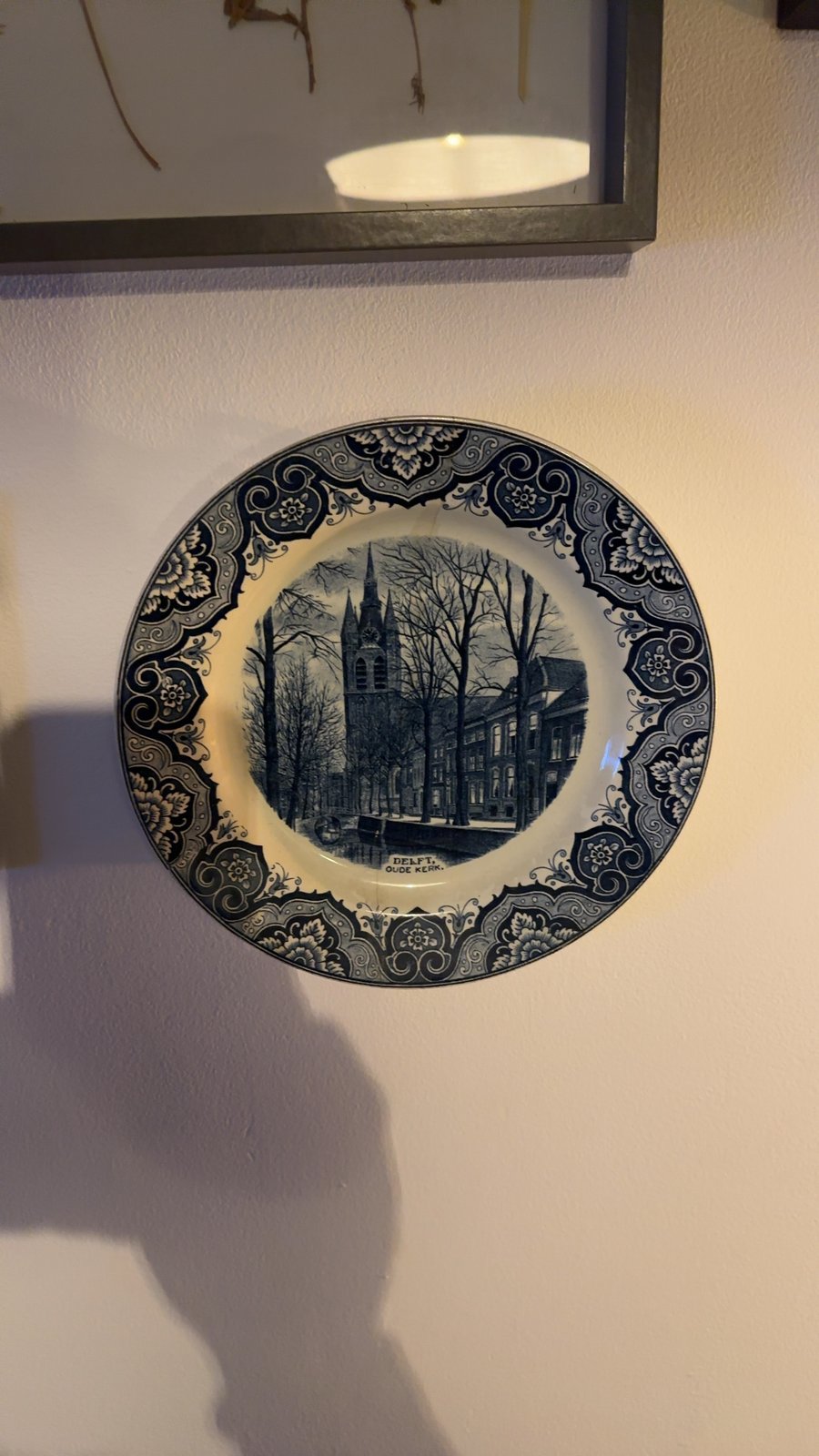
Dutch Blue and White Transferware Plate - 'Delft, Oude Kerk'
QUICK FACTS
Categories
Era
Mid-20th Century (c. 1950s-1970s)
Origin
🇳🇱 Netherlands
Brand
Royal Schwabap (Based on mark 'Royal Goedewaagen' which now owns Schwabap)
Artist/Maker
Delft blauw
Rarity
Ordinary (3/10)
Discovered
Jan 14, 2026
1 months ago
DESCRIPTION
This appears to be a decorative ceramic plate, likely earthenware, featuring a transfer-printed scenic decoration in cobalt blue on a white ground. The central image depicts the 'Oude Kerk' (Old Church) in Delft, Netherlands, a common motif for Dutch souvenirs and decorative ceramics. The border is adorned with intricate floral and scrollwork patterns, typical of traditional European blue and white ceramic styles, often inspired by earlier Chinese porcelain.
CULTURAL ECHOES
Where This Object Echoes
The 'blue and white' ceramic tradition originated in China during the Tang and Yuan dynasties, inspiring European makers for centuries.
Dutch artisans in Delft famously replicated Chinese blue and white porcelain, developing a distinctive tin-glazed earthenware style that became iconic.
The popularity of transfer printing in 19th-century Britain made decorative pottery with complex scenes affordable, much like this plate's technique.
Ritual & Ceremonial Use
- •Decorative display: Such plates were often hung on walls or placed in display cabinets as ornamental pieces, showcasing travel memories or regional pride.
- •Gift-giving: Souvenir plates like this often served as gifts or mementos from trips to tourist destinations.
Meaning Through Time
Blue and white ceramics symbolized exoticism and luxury, due to their Chinese origins and high cost.
With industrialization and transfer printing, decorative plates became accessible, representing nostalgia, local pride, or travel souvenirs.
HISTORICAL STORY
DID YOU KNOW?
The 'Oude Kerk' in Delft, depicted on the plate, is famous for being the burial place of notable figures such as naval hero Piet Hein and the painter Johannes Vermeer.
Transfer printing, the technique likely used here, revolutionized ceramic production by allowing intricate designs to be rapidly applied to pottery, making decorative pieces more accessible to a broader market.
MATERIAL & CONDITION
Surface
The plate exhibits a smooth, glossy glaze over a white earthenware body. The blue decoration is applied via transfer print, evidenced by its crisp, uniform lines and slight pixelation or faint seams that can sometimes be observed with this technique. The reverse is also glazed, with a recessed footrim typical of decorative plates.
Weight & Feel
Based on its size and the likely earthenware composition, the plate would feel moderately weighted, substantial but not overly heavy, indicating a solid ceramic body.
Condition
The plate appears to be in good overall condition, with no obvious chips, cracks, or significant glaze loss visible. There's a string attached for hanging, which suggests it was used decoratively rather than for serving, reducing wear. Minor surface scratches or crazing typical of age might be present but are not clearly visible in the provided images.
RARITY ANALYSIS
Standard antiques commonly found at estate sales and flea markets. Plentiful supply meets modest demand.
Typical Characteristics
- Moderate production runs
- Common at estate sales
- Entry-level collectibles
EXPERT ANALYSIS
Decorative Arts Specialist
High confidence is given due to the clear visual evidence of the specific landmark, the consistent stylistic elements of Dutch souvenir ceramics, and the visible—though slightly obscured—maker's mark indicating Dutch origin.
KEY EVIDENCE
- 1The central image ('Delft, Oude Kerk') identifies a specific Dutch landmark.
- 2The blue and white palette and scenic decoration are characteristic of Delft-style souvenir ware.
- 3The visible mark 'MADE IN HOLLAND' and 'Mooi Nederland' on the reverse clearly indicate Dutch manufacture.
- 4The mark includes a crown and a shield-like emblem with 'Royal Goedewaagen' or 'Schwabap' elements, pointing to a probable Dutch manufacturer known for such wares.
WHAT WOULD IMPROVE CERTAINTY
- →A clearer, high-resolution image of the maker's mark on the reverse to precisely identify the manufacturer and any potential date codes.
- →A close-up inspection of the transfer print under magnification to confirm the technique and lack of hand-painting.
- →UV light examination to check for any hidden repairs or restorations to the glaze or body.
ESTIMATED VALUE
Updated: Feb 26, 2026
- Market comparables from auctions & retail
- Condition, completeness & craftsmanship
- Current collector demand & trends
- Low = quick sale, high = patient seller
For informational purposes only, not a formal appraisal.
ABOUT DECORATIVE OBJECTS
Ceramics, silver, porcelain, glassware, and decorative arts.
Browse all Decorative ObjectsSHARE THIS CURIOSITY
Have your own curiosities to discover?
Scan Your Curiosity
COMMENTS
No comments yet. Be the first to share your thoughts!
Sign in to leave a comment