Japanese Arita Blue and White 'Long Eliza' Lidded Cup and Saucer
QUICK FACTS
Categories
Era
Meiji Period (c. 1880-1910)
Origin
🇯🇵 Japan
Brand
Arita Ware
Rarity
Average (4/10)
Discovered
Feb 27, 2026
2 days ago
DESCRIPTION
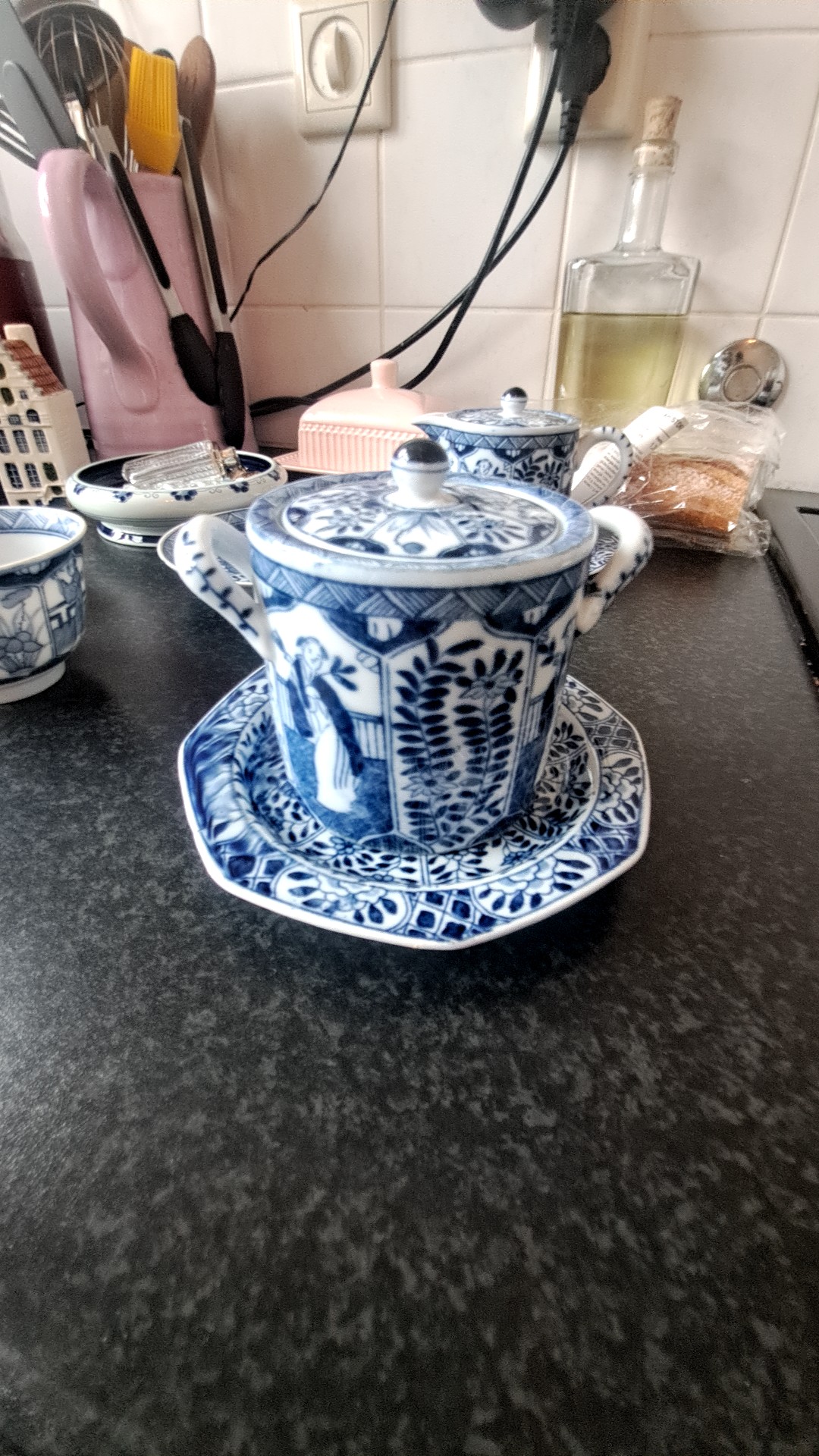
This is a fine example of Japanese Arita ware, specifically a two-handled lidded cup and its matching octagonal saucer. The underglaze blue decoration is a clear emulation of popular Chinese Kangxi-period export patterns, featuring a standing female figure—often called a 'Long Eliza' or *Lange Lijs* by Dutch traders—within a garden cartouche. The surrounding dense floral and diaper patterns, along with the lobed shape of the saucer, are all characteristic of wares produced for the European market. The form itself, a lidded broth or chocolate cup, is distinctly Western.
CULTURAL ECHOES
Where This Object Echoes
The design directly mimics the popular 'blue and white' export wares from Jingdezhen, China, featuring 'Long Eliza' figures and paneled floral motifs that were highly prized in Europe.
Dutch potters in the 17th and 18th centuries created their own tin-glazed earthenware versions of Chinese porcelain, often using very similar blue and white decorative schemes.
Ritual & Ceremonial Use
- •In 18th and 19th-century Europe, such cups were used in the domestic ritual of serving and drinking hot chocolate, broth, or posset, often while receiving guests.
Meaning Through Time
Symbolized the exoticism and wealth of the owner, who could afford luxurious imported goods from the Far East.
Represented Japan's industrial and artistic prowess, successfully competing in Western markets by adapting traditional aesthetics for mass export.
Valued as an accessible antique decorative item, appreciated for its historical 'chinoiserie'-style charm and craftsmanship.
HISTORICAL STORY
DID YOU KNOW?
The female figures depicted are called 'Lange Lijzen' or 'Long Elizas,' a Dutch nickname for the slender ladies often painted on Chinese Kangxi porcelain.
This cup shape, with two handles and a lid, was popular in 18th-century Europe for serving hot chocolate, then a luxurious and fashionable beverage.
MATERIAL & CONDITION
Surface
The piece has a glossy, slightly uneven glaze over a transfer-printed underglaze cobalt blue. The blue shows some characteristic minor 'bleeding' into the white porcelain body, and the finial has a dark, almost black glaze.
Weight & Feel
Likely feels delicate but solid, typical of well-made hard-paste porcelain. Not overly heavy or clunky.
Condition
The set appears to be in very good antique condition, consistent with the user's description of 'minor wear.' The footrim shows slight shelf wear, but I see no obvious chips, cracks, or repairs in the images provided.
RARITY ANALYSIS
Typical antique shop fare. Requires some searching but regularly available. This is where most genuine antiques fall.
Typical Characteristics
- Standard antique shop items
- Regularly available
- Moderate collector interest
EXPERT ANALYSIS
Asian Art Specialist
Confidence is high because the form, transfer-printed decoration, 'Long Eliza' motif, and the 'yama' mark on the base are all classic, converging indicators of Japanese export porcelain made during the Meiji period for the Western market.
KEY EVIDENCE
- 1The porcelain body, glaze, and character of the underglaze blue are typical of Japanese Arita ware.
- 2The mark on the base is a stylized Japanese 'yama' (mountain) symbol, a known kiln mark from the Arita region.
- 3The decoration is transfer-printed, a mass-production technique widely used in the Meiji period.
- 4The design is a pastiche of Chinese Kangxi 'Long Eliza' patterns, a common practice for Japanese export wares targeting the European market.
- 5The form, a two-handled lidded cup and saucer, is a European shape intended for serving hot chocolate or broth.
UNCERTAINTIES
- •The images show multiple pieces; the value depends heavily on the size and completeness of the entire set, which is not fully visible.
WHAT WOULD IMPROVE CERTAINTY
- →Catalog all pieces in the set to determine its completeness (e.g., number of cups, saucers, teapot, creamer, sugar bowl).
- →Examine each piece carefully under bright light for any hairline cracks, chips, or repairs, especially around handles and rims.
- →Compare the mark to known examples of 'yama' marks from Arita to potentially narrow down the kiln or period.
ESTIMATED VALUE
Updated: Feb 27, 2026
- Market comparables from auctions & retail
- Condition, completeness & craftsmanship
- Current collector demand & trends
- Low = quick sale, high = patient seller
For informational purposes only, not a formal appraisal.
CONTEXT ANALYSIS
How your provided context compares with Curiosa.com scanner findings.
What Aligned
- The user's assessment of 'Original/Authentic' and 'Minor wear' aligns with the visual evidence of a well-preserved, genuine antique from the late 19th to early 20th century.
SHARE THIS CURIOSITY
Have your own curiosities to discover?
Scan Your Curiosity
COMMENTS
No comments yet. Be the first to share your thoughts!
Sign in to leave a comment