Chinese 'Nine Dragons' Porcelain Vase with Apocryphal Qianlong Mark
QUICK FACTS
Categories
Era
c. 1880
Origin
🇨🇳 China
Artist/Maker
Chinese vaas
Rarity
Average (4/10)
Discovered
Mar 2, 2026
1 day ago
DESCRIPTION
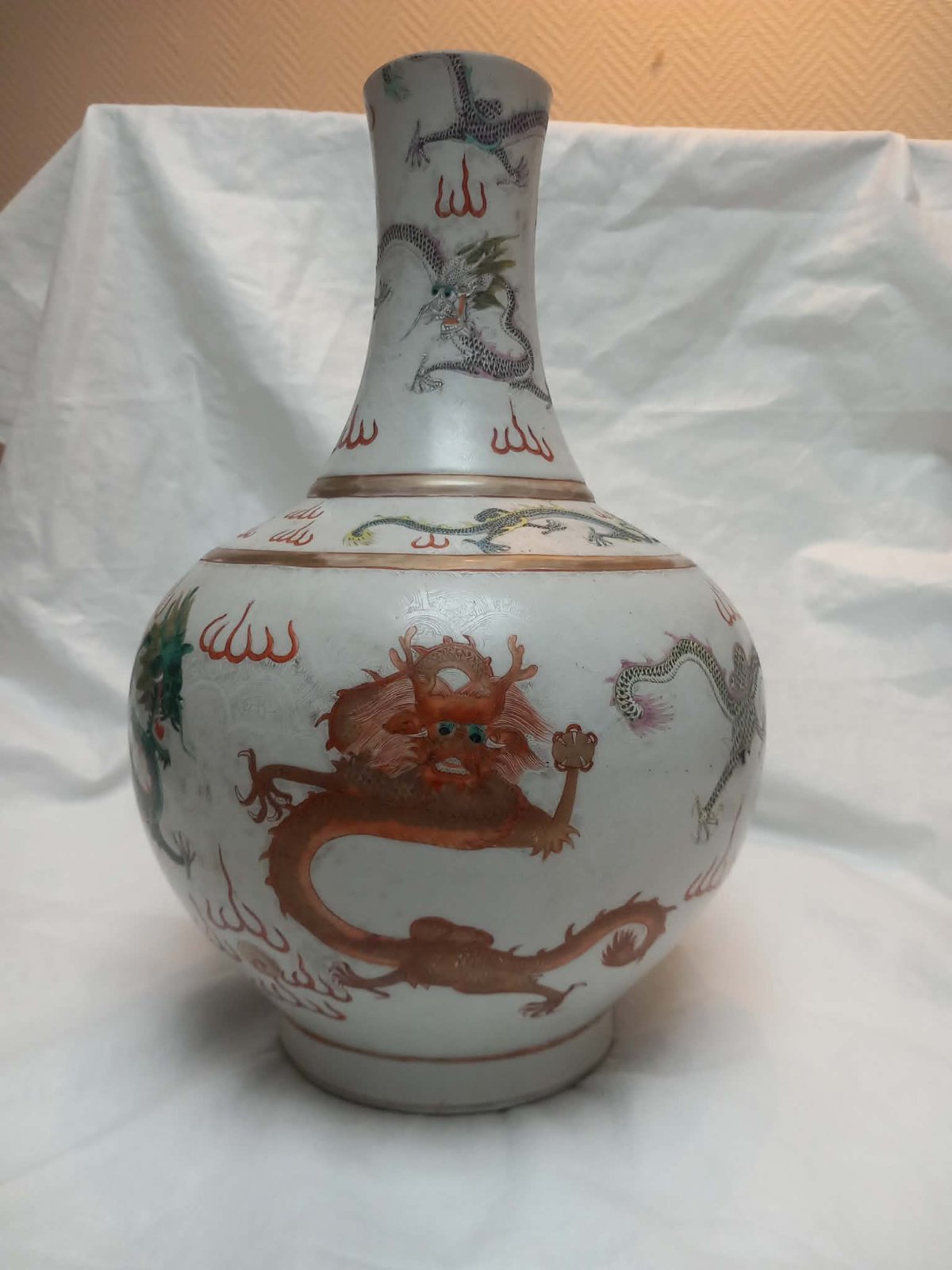
This is a Chinese porcelain vase of the type known as a *tianqiuping*, or 'celestial sphere vase'. The body is densely decorated with nine dragons, a highly auspicious number, executed in a mix of iron-red and polychrome overglaze enamels from the *famille rose* palette. A prominent five-clawed dragon in iron-red dominates the main body, while smaller dragons in various colors writhe around the shoulder and neck. The white ground itself possesses a subtle molded or incised wave pattern. The style of painting is energetic and expressive, characteristic of its period, though it lacks the fastidious precision of earlier, imperial works. The gilding on the bands has been worn with time, a common sign of age.
CULTURAL ECHOES
Where This Object Echoes
This vase is a classic example of the revivalist trend in the late 19th century, where artisans emulated the forms and marks of the celebrated 18th-century 'High Qing' period to evoke a past era of greatness.
Ritual & Ceremonial Use
- •As a large, impressive object, this vase would have been a significant decorative piece within an affluent household, used to display wealth, taste, and cultural sophistication.
Meaning Through Time
The five-clawed dragon was a symbol strictly reserved for the emperor and the imperial court.
Following the decline of imperial power, the dragon motif became a more generalized symbol of Chinese nationality and cultural heritage, appearing on a wider range of export and decorative wares.
HISTORICAL STORY
DID YOU KNOW?
Vases decorated with nine dragons are particularly prized, as nine is a powerfully auspicious number in Chinese culture, strongly associated with the Emperor and celestial power.
The use of an earlier emperor's reign mark, like the Qianlong mark seen here, is called 'apocryphal.' In the late 19th century, this was typically a sign of respect for past mastery, not an attempt to create a fake.
MATERIAL & CONDITION
Surface
The surface presents a worn but honest glaze, with a fine craze pattern visible under close inspection. The overglaze enamels, particularly the iron-red and pinks, show noticeable rubbing and some small losses. The gilt bands are significantly worn down to the underlying porcelain body in places.
Weight & Feel
Based on the thick walls typical of a tianqiuping form, this vase would feel substantial and heavy, conveying a sense of stability and presence.
Condition
The vase exhibits considerable signs of age and handling, consistent with the user's note that it 'needs restoration'. There is significant rubbing and loss to the painted enamels and giltwork. A fine network of crazing is present, which may be inherent to the glaze or a result of age.
RARITY ANALYSIS
Typical antique shop fare. Requires some searching but regularly available. This is where most genuine antiques fall.
Typical Characteristics
- Standard antique shop items
- Regularly available
- Moderate collector interest
EXPERT ANALYSIS
Asian Art Specialist
The style of painting, the enamel palette, and the specific execution of the apocryphal Qianlong mark are all highly characteristic of late Qing Dynasty porcelain, aligning well with the user's suggested date. Confidence is not higher as a hands-on inspection is required to definitively assess the paste and glaze.
KEY EVIDENCE
- 1The vase form is a 'tianqiuping' (celestial sphere vase), a classic Chinese shape.
- 2The decoration employs a mix of iron-red and 'famille rose' enamels, a palette common in the 18th and 19th centuries.
- 3The base shows an apocryphal six-character iron-red 'Zhuanshu' (seal script) mark of Qianlong, framed by two dragons.
- 4The execution of the mark and the painting style are characteristic of the late 19th century (e.g., Guangxu period), not the 18th-century Qianlong period.
- 5Significant wear to the overglaze enamels and gilt supports its antiquity and aligns with a late 19th-century dating.
UNCERTAINTIES
- •The Qianlong mark is apocryphal and must not be interpreted as an 18th-century production date.
- •The significant wear to the surface decoration, while evidence of age, substantially impacts the vase's aesthetic condition and market value.
WHAT WOULD IMPROVE CERTAINTY
- →Provide clear, well-lit photos of the footrim, showing where the unglazed porcelain meets a surface.
- →Take a picture looking down into the interior of the vase.
- →An in-person evaluation by a specialist in Chinese ceramics could confirm the period and assess the extent of wear more accurately.
- →Examine the surface under UV light to check for any modern restoration or repairs that are not visible to the naked eye.
ESTIMATED VALUE
Updated: Mar 2, 2026
- Market comparables from auctions & retail
- Condition, completeness & craftsmanship
- Current collector demand & trends
- Low = quick sale, high = patient seller
For informational purposes only, not a formal appraisal.
CONTEXT ANALYSIS
How your provided context compares with Curiosa.com scanner findings.
What Aligned
- User's specified origin of 'china' is correct, as all stylistic elements are unequivocally Chinese.
- User's time period of '1880' (late Qing Dynasty) is entirely plausible and aligns with the artistic style, enamel palette, and the use of an apocryphal mark.
- User's assessment that it 'needs restoration' is supported by the visible wear, rubbing on the enamels, and gilt loss.
- User's claim of 'Original/Authentic' seems correct in the sense that it is an authentic antique from the late 19th century, rather than a modern reproduction.
SHARE THIS CURIOSITY
Have your own curiosities to discover?
Scan Your Curiosity
COMMENTS
No comments yet. Be the first to share your thoughts!
Sign in to leave a comment