Chinese Lapis Lazuli Snuff Bottle with Carved Relief
QUICK FACTS
Categories
Era
1900
Origin
🇨🇳 China
Rarity
Uncommon (5/10)
Discovered
Mar 2, 2026
1 day ago
DESCRIPTION
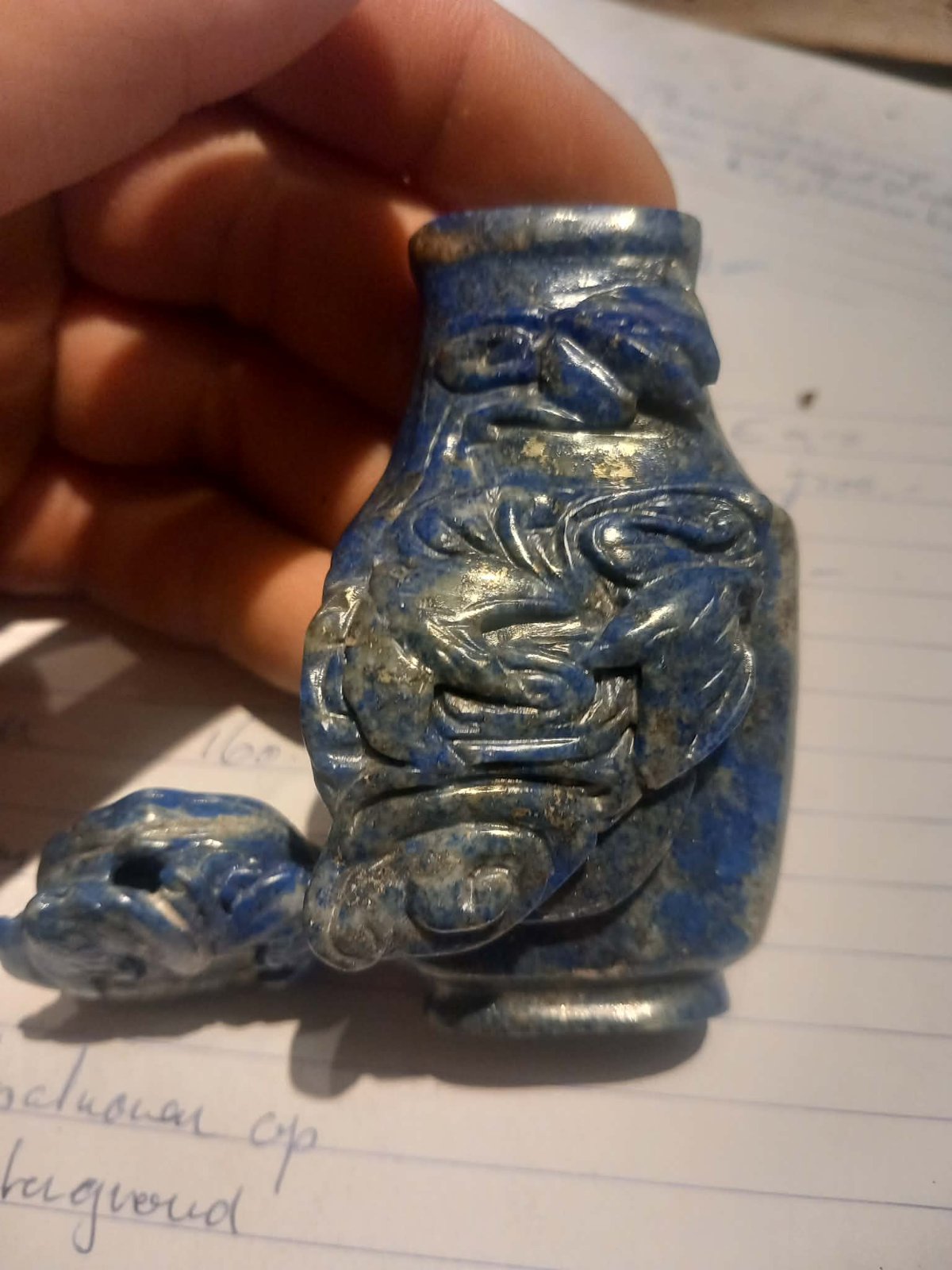
This appears to be a Chinese snuff bottle, meticulously carved from lapis lazuli. The bottle features intricate high-relief carvings depicting what seem to be mythological creatures, possibly dragons, amidst cloud motifs. The deep blue of the lapis is accented by natural pyrite inclusions, giving it a speckled, almost golden sheen in some areas. The stopper, also carved from lapis lazuli, matches the main body's carving style, suggesting it is original to the bottle. The overall form is a classic flattened ovoid or rectangular shape, common for snuff bottles, with a slightly flared lip.
CULTURAL ECHOES
Where This Object Echoes
The art of snuff bottle collecting flourished, with imperial patronage leading to exquisite craftsmanship across diverse materials.
The dragon, a powerful symbol of imperial authority, heavenly power, and good fortune, was a prevalent motif in Chinese art, particularly on items intended for the elite.
Ritual & Ceremonial Use
- •The ritualistic sharing and consumption of snuff, initially introduced from the West, became a highly refined social practice in China, necessitating elaborate and beautiful containers.
- •Snuff bottles were often exchanged as gifts, signifying respect and fostering social connections among the educated and wealthy classes.
Meaning Through Time
Primarily functional containers for snuff, social status symbols, and objects of artistic connoisseurship.
Transitioned from functional items to highly collectible art objects and antiques, representing Chinese cultural heritage and craftsmanship.
HISTORICAL STORY
DID YOU KNOW?
Originating from the Himalayas and Afghanistan, lapis lazuli was once valued more than gold in some ancient civilizations for its celestial blue color.
Snuff bottles were essentially the 17th- to 19th-century equivalent of modern luxury status symbols, with connoisseurs often carrying multiple bottles to suit different outfits or occasions.
MATERIAL & CONDITION
Surface
The surface exhibits the characteristic rich, deep blue of lapis lazuli, interspersed with patches of grey matrix and metallic flecks of pyrite, which are natural inclusions within the stone. These inclusions are particularly noticeable in the recessed areas of the carving, adding depth and a subtle shimmer. The carving itself is of high-relief, creating a tactile and intricate pattern that feels smooth yet detailed to the touch.
Weight & Feel
Given its material and size (implied by being held in a hand), this snuff bottle would feel substantial and cool to the touch, possessing a satisfying heft that speaks to the density of the carved stone.
Condition
The object appears to be in good condition overall, consistent with 'minor wear'. There is some light surface grime or residue visible, particularly in the crevices of the carvings, which is expected with age and handling. No significant chips, cracks, or repairs are immediately apparent from the provided images.
RARITY ANALYSIS
Genuine antiques with fewer examples on the market. Named makers, documented provenance, or early production examples.
Typical Characteristics
- Limited production
- Named makers
- Growing collector demand
EXPERT ANALYSIS
Cabinet of Curiosities Generalist
Confidence is good as the material and form are highly consistent with Chinese lapis lazuli snuff bottles, aligning well with user-provided context. However, the exact dating and verification of carving origin require closer physical inspection for definitive attribution.
KEY EVIDENCE
- 1The distinctive deep blue hue with visible pyrite (golden flecks) and grey matrix strongly indicates natural lapis lazuli.
- 2The form factor of the bottle and its matching stopper are characteristic of Chinese snuff bottles.
- 3The high-relief carving style, depicting what appear to be dragons and clouds, is a typical decorative motif for Chinese art, particularly on semi-precious stone carvings.
- 4The apparent age and minor wear are consistent with an object from the early 20th century, made for use or collection.
UNCERTAINTIES
- •The quality of the photos, while helpful for general identification, prevents a detailed examination of carving precision and potential tool marks that could further confirm age and artisanry.
- •The exact identification of the creature(s) carved is somewhat ambiguous from the images, needing better resolution.
- •The presence of surface residue might mask finer details or small imperfections that could aid in dating or authenticity.
WHAT WOULD IMPROVE CERTAINTY
- →Obtain clearer, well-lit photographs from multiple angles, particularly close-ups of the carving details and the bottle's base.
- →Examine the interior of the bottle and the stopper's 'spoon' (if present) for carving quality and material consistency.
- →If possible, perform a scratch test in an inconspicuous area (on a Mohs scale 6-7, lapis is relatively soft for a gemstone but harder than many fakes) or a UV light test to check for dyes or treatments.
- →Consult with a specialist in Chinese snuff bottles or carved hardstones for a definitive assessment of authenticity and age.
ESTIMATED VALUE
Updated: Mar 2, 2026
- Market comparables from auctions & retail
- Condition, completeness & craftsmanship
- Current collector demand & trends
- Low = quick sale, high = patient seller
For informational purposes only, not a formal appraisal.
CONTEXT ANALYSIS
How your provided context compares with Curiosa.com scanner findings.
What Aligned
- The user's belief that the item is 'Original/Authentic' is plausible given the visual characteristics of the carving style and apparent material.
- The user's specified material 'lapis lazuli' aligns perfectly with the visual evidence of the deep blue color with natural pyrite and grey matrix inclusions.
- The user's stated origin 'china' is strongly supported by the form and carving motifs, which are highly characteristic of Chinese snuff bottles.
- The '1900' time period aligns with the late Qing Dynasty into early Republican era, a period when such intricately carved snuff bottles from semi-precious stones were still produced.
- The 'minor wear' observation by the user is consistent with the visual assessment showing expected surface accumulation in crevices but no major damage.
SHARE THIS CURIOSITY
Have your own curiosities to discover?
Scan Your Curiosity
COMMENTS
No comments yet. Be the first to share your thoughts!
Sign in to leave a comment