Japanese Imari-Style Porcelain Cabinet Plate
QUICK FACTS
Categories
Era
Early to Mid-20th Century
Origin
🇯🇵 Japan
Rarity
Average (4/10)
Discovered
Jan 31, 2026
4 weeks ago
DESCRIPTION
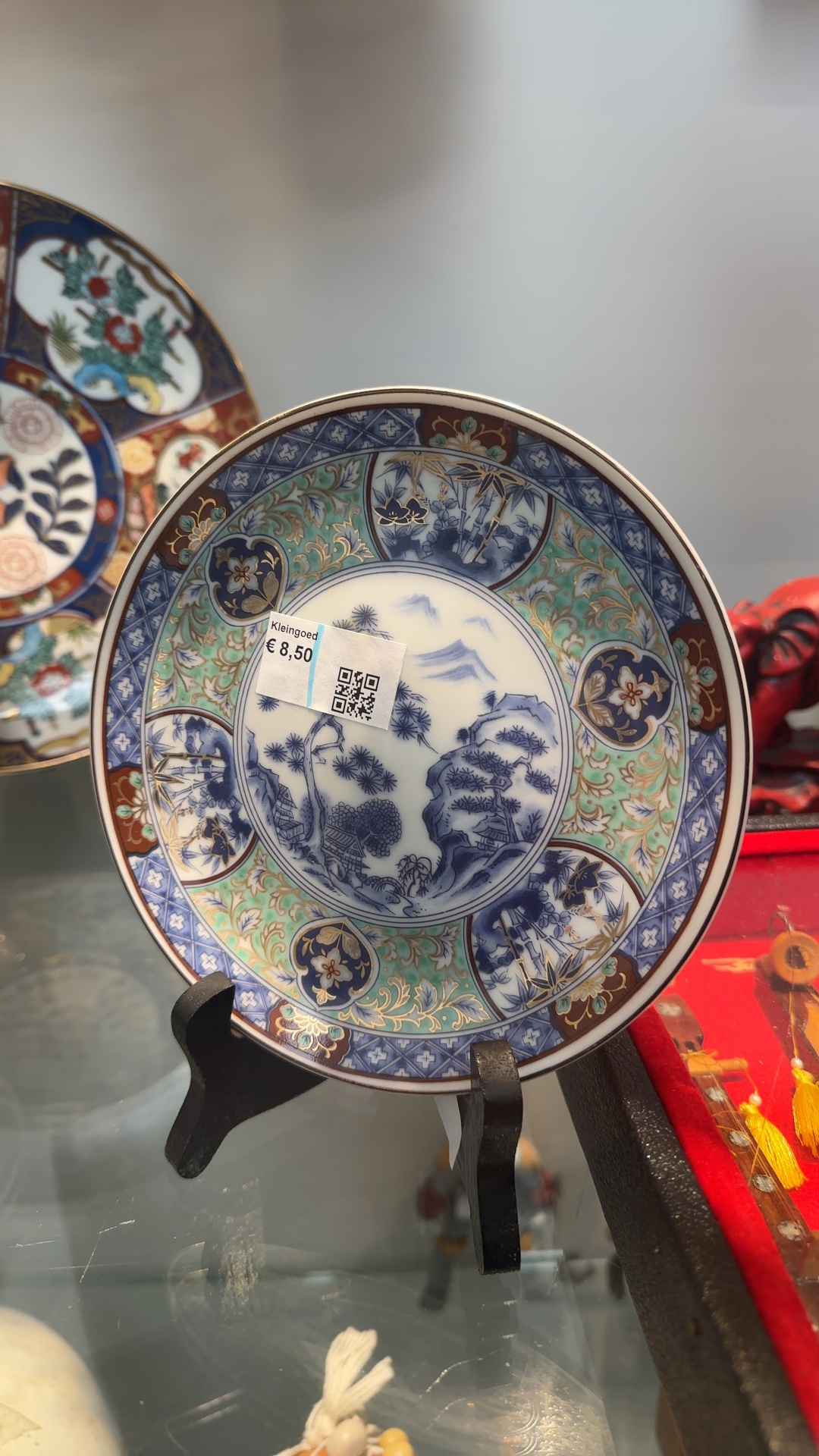
This appears to be a Japanese porcelain cabinet plate or saucedish, decorated in a polychrome Imari style. The central medallion features a classic blue and white landscape scene with mountains and pine trees, executed with a fine brush. This is surrounded by a border incorporating panels with various floral and geometric motifs, typical of the broader Imari aesthetic, which often mixes underglaze blue with overglaze enamels in red, gold, and often a distinctive green or turquoise.
CULTURAL ECHOES
Where This Object Echoes
Early Japanese Imari ware was heavily influenced by Chinese export porcelain, especially Kangxi period blue and white, before developing its unique polychrome style.
The popularity of Imari in Europe led to numerous attempts to replicate the style by European factories, including Delftware in the Netherlands and Meissen in Germany.
Ritual & Ceremonial Use
- •Serving Rituals: Historically, such plates might have been part of formal dining sets for serving small dishes or condiments, reflecting aesthetic value in everyday use.
- •Display Practices: These decorative plates were often prized as cabinet plates, displayed in ornate arrangements in domestic interiors to showcase wealth and taste.
Meaning Through Time
During its peak export period, Imari porcelain symbolized exotic luxury, sophisticated taste, and global trade connections for European elites.
As production continued and proliferated, Imari transitioned from high commodity to a more accessible decorative style, representing traditional Japanese aesthetic (Japonisme) and craftsmanship.
HISTORICAL STORY
DID YOU KNOW?
The distinctive red enamel used in Imari ware was often derived from iron oxides, giving it a rich, opaque hue that contrasts beautifully with underglaze blue and gilding.
True Imari porcelain is fired multiple times: first for the biscuit, then for the underglaze blue, and finally at a lower temperature for the overglaze enamels and gilding.
MATERIAL & CONDITION
Surface
The surface is glossy, suggesting a well-fired glaze. The decoration combines underglaze blue with overglaze enamels, which appear hand-painted given the slight variations and expressive quality, although transfer printing cannot be entirely ruled out without closer inspection. There are visible gold accents.
Weight & Feel
Given its size as a cabinet plate/saucedish and the material (porcelain), it would feel relatively light yet substantial, with a fine and dense paste.
Condition
From the visible images, the plate appears to be in good condition with no obvious chips, cracks, or significant loss to the enamels or gilding. The label obscures part of the central design, but the borders look intact. There is some minor surface wear consistent with age and handling.
RARITY ANALYSIS
Typical antique shop fare. Requires some searching but regularly available. This is where most genuine antiques fall.
Typical Characteristics
- Standard antique shop items
- Regularly available
- Moderate collector interest
EXPERT ANALYSIS
Decorative Arts Specialist
Confidence is high for identifying the style as Japanese Imari or Imari-style porcelain due to the characteristic decorative palette and composition. However, without a view of the base and maker's marks, pinning down a precise production period or specific kiln is challenging, hence the slight reduction from peak confidence.
KEY EVIDENCE
- 1Polychrome decoration in underglaze blue and overglaze enamels, particularly red, green, and gold accents.
- 2Complex composition with a central landscape medallion surrounded by various smaller decorative panels.
- 3Style is consistent with Japanese Imari ware, a long-lasting and widely produced decorative aesthetic.
- 4The ceramic body appears to be fine-grained porcelain, typical of Japanese production for such wares.
UNCERTAINTIES
- •Absence of view of the base (no maker's mark or dating information visible)
- •Small size and commonality of such decorative plates could indicate later mass-produced item.
WHAT WOULD IMPROVE CERTAINTY
- →A clear photograph of the plate's underside (base) to check for any maker's marks, impressed factory names, or date codes.
- →Examine the footrim for wear patterns characteristic of age and use.
- →A close-up inspection of the decoration to discern brushwork quality versus potential transfer decoration.
- →Gently run a finger along the edges and surface to check for any chips, rough spots, or restoration that might not be visible in photos.
ESTIMATED VALUE
Updated: Feb 27, 2026
- Market comparables from auctions & retail
- Condition, completeness & craftsmanship
- Current collector demand & trends
- Low = quick sale, high = patient seller
For informational purposes only, not a formal appraisal.
SHARE THIS CURIOSITY
Have your own curiosities to discover?
Scan Your Curiosity
COMMENTS
No comments yet. Be the first to share your thoughts!
Sign in to leave a comment