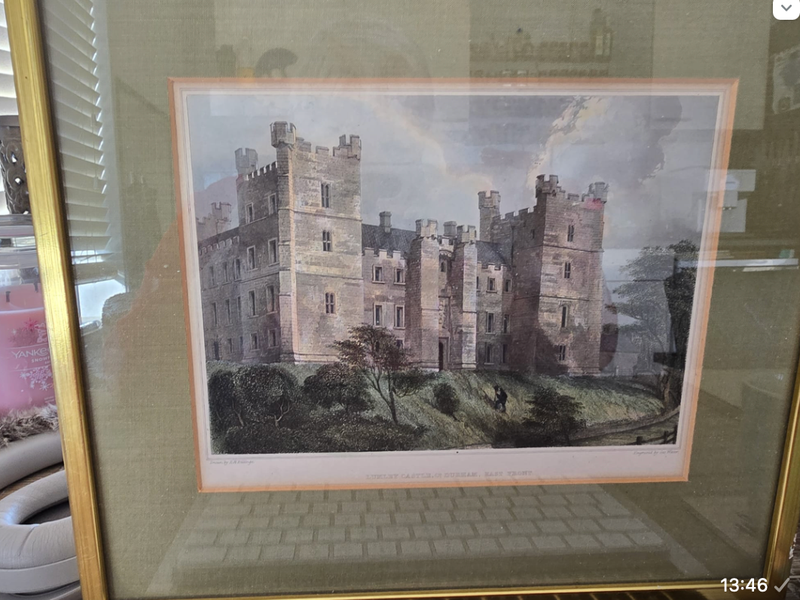
Robert William Billings (British, 1813-1874) - Lumley Castle, Co. Durham, Pair of Steel Engravings, c.1846
Estimated value
$80 - $180Rarity
Average(4/10)Category
Prints & PostersEra
circa 1846Origin
United KingdomArtist / Creator
Robert William BillingsAuthenticity
ROBERT WILLIAM BILLINGS (BRITISH, 1813-1874) - LUMLEY CASTLE, CO. DURHAM, PAIR OF STEEL ENGRAVINGS, C.1846: IDENTIFICATION
A pair of mid-19th-century steel engravings depicting Lumley Castle in County Durham. The first plate shows the 'East Front' and the second a detailed view of the courtyard featuring a rider on horseback. Both plates bear the credit 'Drawn by R.W. Billings' in the lower-left margin. One plate identifies the etcher as J.H. Le Keux. These architectural views are characterized by fine linear cross-hatching and stippled details typical of Victorian topographical illustration. The works are housed in mid-20th-century frames with a Dutch framer's label on the reverse.
CROSS-CULTURAL PARALLELS
Where This Object Echoes
The Gothic Revival movement fueled a massive market for topographical prints documenting 'ancient' Britain.
Ritual & Ceremonial Use
- •Grand Tour collecting: travelers often purchased individual prints of local landmarks as souvenirs of their domestic travels.
Meaning Through Time
Scholarly documentation of national architectural heritage.
Interior decorative accents emphasizing heritage and traditional aesthetic.
PRINT LINEAGE
SCARCITY
Typical antique shop fare. Requires some searching but regularly available. This is where most genuine antiques fall.
Typical Characteristics
- Standard antique shop items
- Regularly available
- Moderate collector interest
Confidence Factors
- Text credits 'Drawn by R.W. Billings' and 'Etched by J.H. Le Keux' match histological publication records for 1846.
- Paper quality and plate marks are consistent with mid-19th-century steel engraving production.
- Presence of a legitimate mid-20th-century Dutch framing label adds contextual history.
PRINT SPECIALIST'S TAKE
Museum-Trained Art Historian
High confidence due to the explicit textual evidence on the plates matching known 1846 publication series by Billings and Le Keux.
KEY EVIDENCE
- 1Attribution to Robert William Billings based on lower-left margin text.
- 2Identification of Lumley Castle, Durham, via title text in the lower center margin.
- 3Steel engraving technique confirmed by the density of fine lines and J.H. Le Keux attribution.
- 4Provenance indicated by the 'Ouderaal b.v.' framer's label from 's-Gravenhage (The Hague).
UNCERTAINTIES
- •Prints are behind glass, preventing a direct examination of the plate mark depth.
- •The hand-coloring, if present, appears to be a later 'wash' rather than original period tinting.
WHAT WOULD IMPROVE CERTAINTY
- →Examine the prints outside of the frame to check for full margins and watermarks.
- →Check for acidic matting which could cause 'mat burn' around the edges of the paper over time.
CONDITION & GRADE
Grading breakdown
Clean plates with sharp impression lines; minor age-related foxing in margins which does not intrude on the central architectural image.
Condition
The paper shows mild uniform toning and minor foxing spots in the margins, consistent with 19th-century rag paper. One image shows circular reflections from the glass; the actual print surface appears stable. The Dutch framer's label indicates a modern archival or professional mounting.
PRINT MARKET VALUATION
Updated: May 11, 2026
Individual Billings prints of Durham subjects typically sell for £30-£60 ($40-$75) at UK regional auctions like Anderson & Garland.
Who buys this
Local historians of Durham, collectors of Victorian architectural prints, and interior designers focusing on English country house style.
What increases value
- •Subject matter (historic English castle)
- •Well-known architectural artist (Billings)
- •Pairing (matched sets usually command a 20% premium over single prints)
What lowers value
- •Severe foxing or water damage
- •Trimmed margins where the text is lost
What makes top-tier examples
- •Hand-colored examples in period-correct rosewood or birds-eye maple frames
- •Pristine margins with the original publisher's line intact
Grade & condition
Paper brightness, absence of foxing, and presence of original plate indentations.
Rarity & demand
For informational purposes only, not a formal appraisal.
ABOUT PRINTS & POSTERS
Vintage prints, posters, advertising signs, and graphic art.
Prints & Posters value and rarity guideSHARE THIS CURIOSITY
Have your own curiosities to discover?
Scan Your Curiosity
COMMENTS