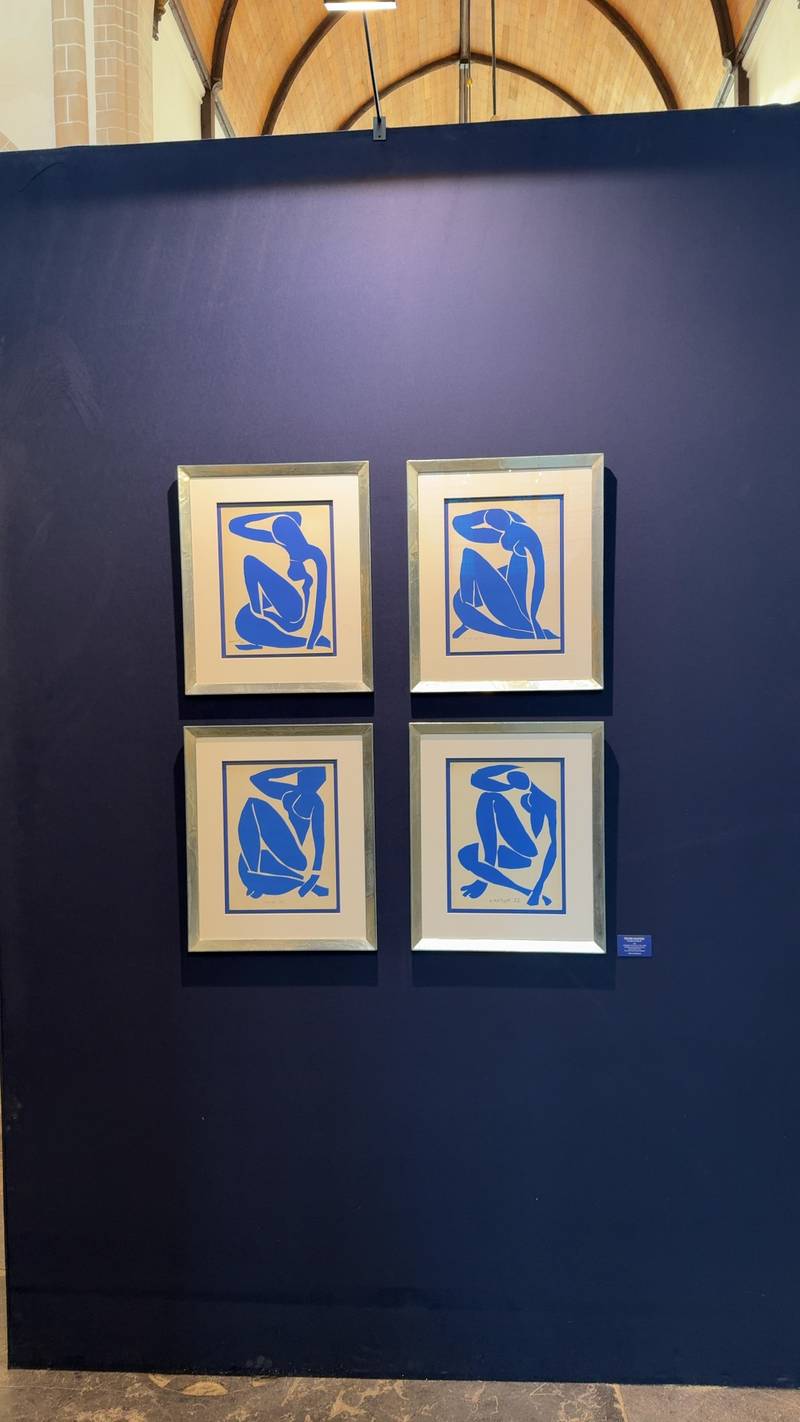
Set of Four Prints after Henri Matisse's "Blue Nudes" (Nus Bleus I-IV)
Estimated value
$300 - $600Rarity
Rare(7/10)Type
Museum ObjectCategory
Prints & PostersEra
Original design 1952; prints could be 1958 or modern reproductionsOrigin
FranceArtist / Creator
Henri Matisse (after)Authenticity
SET OF FOUR PRINTS AFTER HENRI MATISSE'S "BLUE NUDES" (NUS BLEUS I-IV): IDENTIFICATION
A professionally framed set of four prints reproducing Henri Matisse's seminal 1952 paper cut-outs, the Nus Bleus. The series exemplifies the artist's late-career 'carving into color' method, a powerful synthesis of drawing and collage. The signature and date, 'H. MATISSE 52,' are printed as part of the image, which is consistent with both the original lithographs and subsequent reproductions. It is crucial to determine if these are the original 1958 lithographs published in the journal Verve, which are highly valuable ($15,000+), or later decorative prints of modest worth. Based on the images alone, the latter is more probable, but only physical inspection can confirm.
PRINT LINEAGE
SCARCITY
Exceptional items that serious collectors actively seek. Only a handful appear at major auctions each year.
Typical Characteristics
- Few examples at auction yearly
- Specialist dealer networks
- Strong collector competition
Confidence Factors
- These images are among the most frequently reproduced of the 20th century, and modern decorative prints are far more common than original 1958 lithographs.
- The pristine condition and lack of a visible center fold (common to prints from the *Verve* journal) suggest they may be later editions.
- Authentication requires in-person examination of the paper, printing technique, and any publisher's marks, which are not visible in the photos.
Expert review recommended. Consider consulting a specialist before making purchasing decisions.
PRINT SPECIALIST'S TAKE
Museum-Trained Art Historian
Confidence is high in identifying the subject matter and artist, as the 'Blue Nudes' are among Matisse's most famous works. Confidence in the specific edition (and thus value) is low, as the photographs do not permit the necessary examination of the paper, printing method, or potential printers' marks.
KEY EVIDENCE
- 1The works are identifiable as reproductions of Henri Matisse's four *Nu Bleu* (Blue Nude) paper cut-outs from 1952.
- 2The signature and date, 'H. MATISSE 52', are part of the print, which is correct for the original 1958 lithographic edition and subsequent reproductions.
- 3The style is the artist's seminal late-career 'cut-out' technique, representing a fusion of drawing and color.
- 4The prints are presented as a complete series in uniform, modern frames, suggesting a deliberate curatorial or decorative choice.
- 5The gallery-style hanging on a dark blue wall implies the works are considered significant.
UNCERTAINTIES
- •The primary red flag is the inability to distinguish between a highly valuable 1958 *Verve* lithograph and a modern decorative poster without physical examination.
- •The lack of a visible central fold, characteristic of the *Verve* edition, raises the probability that these are later prints.
WHAT WOULD IMPROVE CERTAINTY
- →Carefully de-frame one of the prints (or have a professional do so) to examine the full sheet of paper.
- →Look for a central vertical crease, which would be strong evidence for a 1958 *Verve* edition.
- →Photograph the reverse of the sheet to check for any text or printer's marks (e.g., 'Mourlot Frères').
- →Examine the print surface with a magnifying glass or loupe to identify the printing technique (e.g., the dot pattern of lithography vs. a flat screenprint or digital print).
- →Consult the Matisse catalogue raisonné for prints, prepared by the Duthuit family, to compare against known editions.
CONDITION & GRADE
Condition
From a distance, the prints appear to be in excellent condition, with no visible fading, foxing, or acid damage. This pristine state could argue for either careful archival storage or for the works being modern reproductions. The frames are modern and appear undamaged.
PRINT MARKET VALUATION
Updated: Feb 27, 2026
- Market comparables from auctions & retail
- Condition, completeness & craftsmanship
- Current collector demand & trends
- Low = quick sale, high = patient seller
For informational purposes only, not a formal appraisal.
ABOUT PRINTS & POSTERS
Vintage prints, posters, advertising signs, and graphic art.
Prints & Posters value and rarity guideSHARE THIS CURIOSITY
Have your own curiosities to discover?
Scan Your Curiosity
COMMENTS