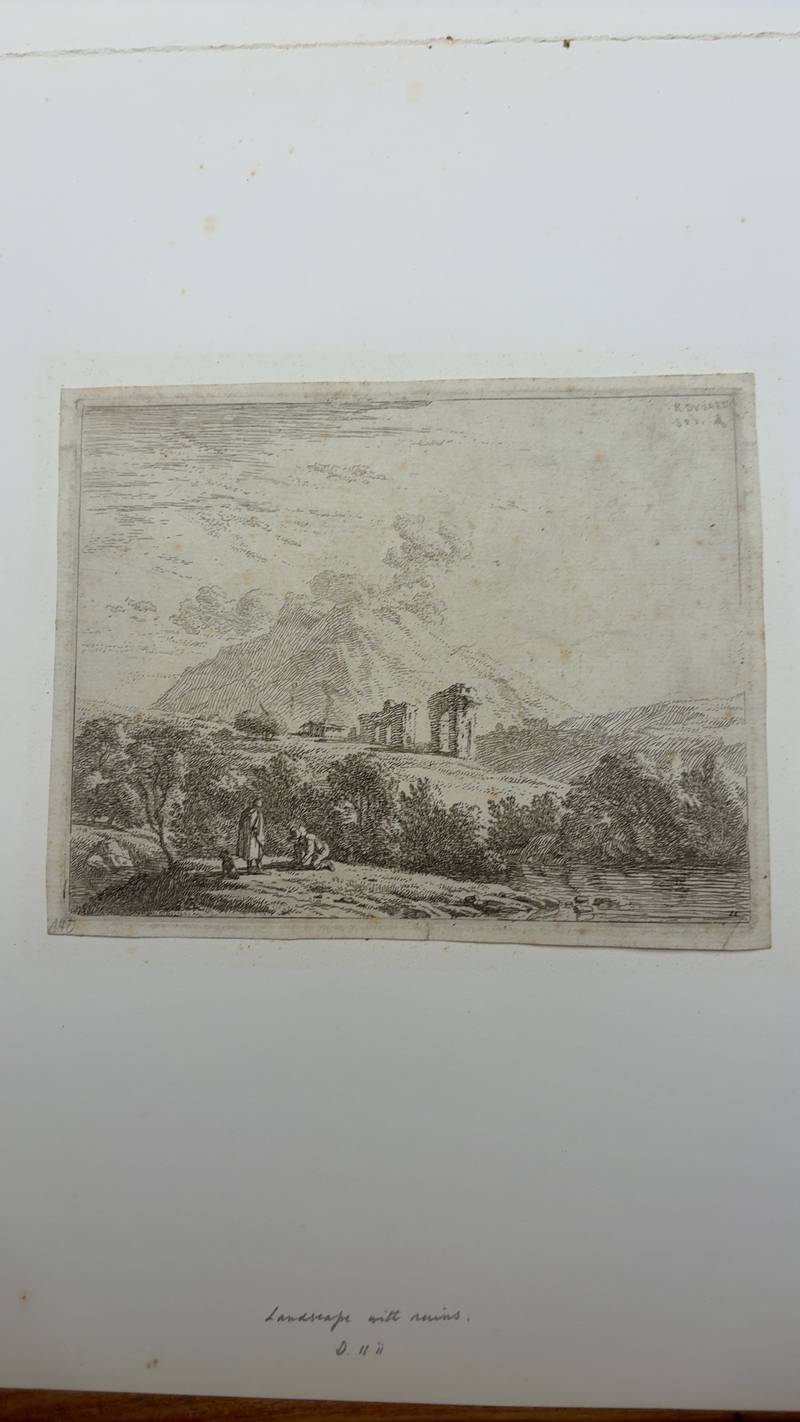
Karel Dujardin, 'Landscape with Ruins' (Etching)
Estimated value
$400 - $1,800Rarity
Uncommon(5/10)Category
Prints & PostersEra
Mid-17th Century (c. 1650-1678)Origin
NetherlandsArtist / Creator
Karel DujardinAuthenticity
KAREL DUJARDIN, 'LANDSCAPE WITH RUINS' (ETCHING): IDENTIFICATION
This appears to be an etching on laid paper, depicting a bucolic landscape interspersed with classical or ancient ruins. The hand-written inscription 'K. DUIARDA' in the upper right corner, along with '875, D' (possibly a catalogue number or an obscure signature variation, but `K. DUJARDIN` is far more common for the artist). This print exhibits characteristics consistent with 17th-century Dutch or Flemish landscape etchings, by delicate line work and a mastery of atmospheric perspective.
PRINT LINEAGE
SCARCITY
Genuine antiques with fewer examples on the market. Named makers, documented provenance, or early production examples.
Typical Characteristics
- Limited production
- Named makers
- Growing collector demand
Confidence Factors
- The signature 'K. DUIARDA' (instead of the standard 'K. Dujardin') raises a slight query, though variations exist.
- While the style is consistent, etchings from this period are sometimes reproduced or copied; a professional examination of watermarks and paper would be crucial.
- Wear and tear visible are consistent with age, but detailed inspection for restoration or alterations would be needed.
PRINT SPECIALIST'S TAKE
Museum-Trained Art Historian
Confidence is high due to the distinctive artistic style strongly indicative of Karel Dujardin, the consistent medium and paper characteristics for the era, and the explicit, albeit slightly variant, signature. Further verification is needed to confirm the precise state and definitively rule out a very early reproductive engraving.
KEY EVIDENCE
- 1The compositional style, featuring classical ruins, pastoral figures, and a distant mountain, is highly characteristic of Karel Dujardin's Italianate landscapes.
- 2The delicate etching technique and fine line work are consistent with 17th-century printmaking, particularly the Dutch Golden Age.
- 3The visible paper characteristics (laid paper with chain/wire lines) are typical of the period.
- 4The inscription 'K. DUIARDA' in the plate, though slightly variant, points directly to the artist Karel Dujardin.
UNCERTAINTIES
- •The inscription 'DUIARDA' instead of 'DUJARDIN' requires verification against known states and signatures of the artist.
- •The exact state of the print (early impression vs. later pull) cannot be determined without closer inspection of plate wear.
- •The possibility of this being a reproductive print after Dujardin's original cannot be entirely ruled out without expert review.
WHAT WOULD IMPROVE CERTAINTY
- →Examine the print out of its mat for watermarks, which can help date the paper and confirm its origin.
- →Consult a catalogue raisonné of Karel Dujardin's prints to identify this specific work and confirm the authenticity of the signature variant.
- →Inspect the reverse for any gallery labels, collector's stamps, or other provenance indicators.
- →A UV light examination could reveal prior repairs or in-painting not visible under normal light.
- →High-resolution close-up images of plate marks and line details would be beneficial.
CONDITION & GRADE
Condition
The print appears to be in good overall condition for its age, with clear impression and tone. Some light toning and foxing are present, especially in the margins, which is common for works of this antiquity. There are no immediately apparent tears or major creases from the visible images, though a full examination out of the mat would be required.
PRINT MARKET VALUATION
Updated: Feb 27, 2026
- Market comparables from auctions & retail
- Condition, completeness & craftsmanship
- Current collector demand & trends
- Low = quick sale, high = patient seller
For informational purposes only, not a formal appraisal.
ABOUT PRINTS & POSTERS
Vintage prints, posters, advertising signs, and graphic art.
Prints & Posters value and rarity guideSHARE THIS CURIOSITY
Have your own curiosities to discover?
Scan Your Curiosity
COMMENTS