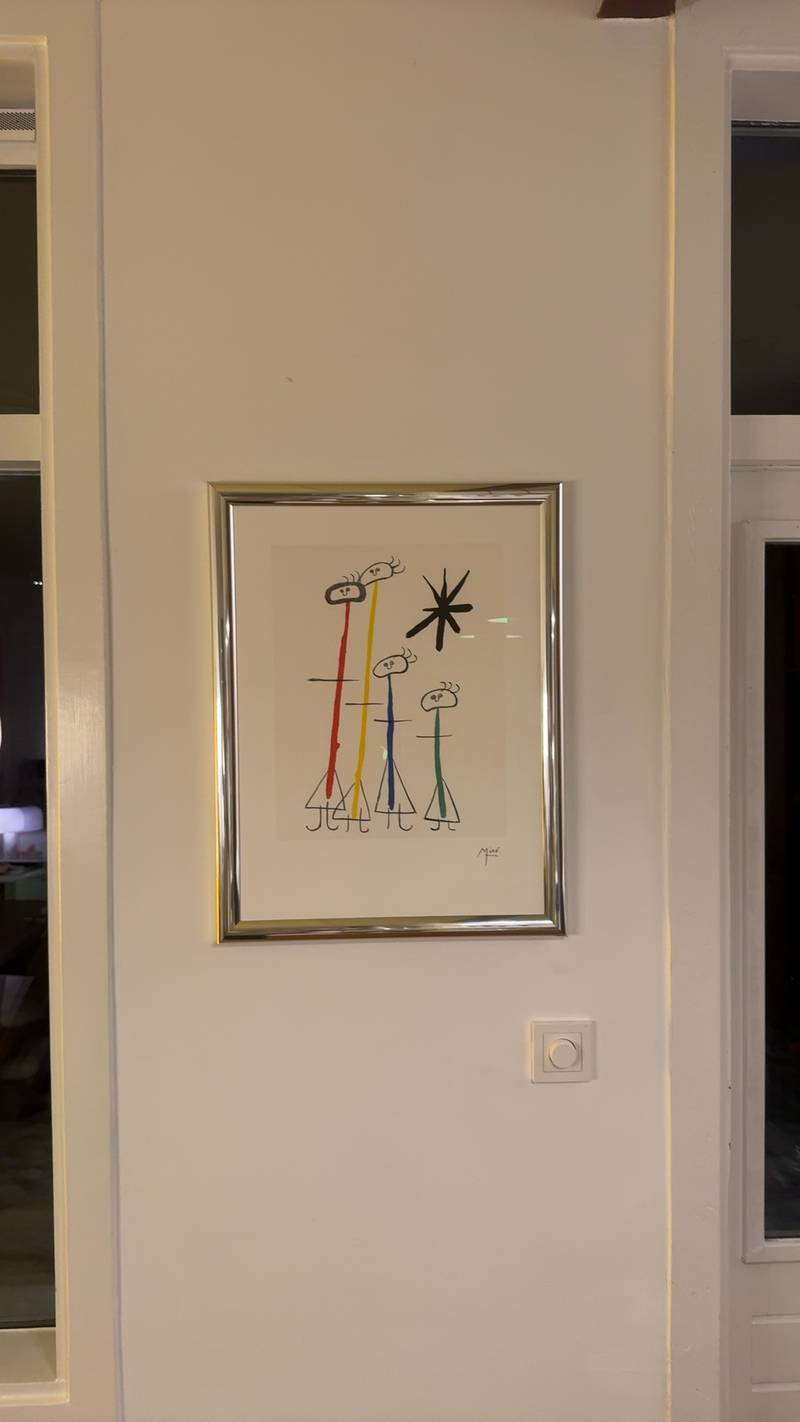
Joan Miró (Spanish, 1893–1983) - Manner of, Lithographic Print, late 20th century
Estimated value
$150 - $450Rarity
Ordinary(3/10)Category
Prints & PostersEra
Circa 1970–1990Origin
SpainArtist / Creator
Joan MiróAuthenticity
JOAN MIRÓ (SPANISH, 1893–1983) - MANNER OF, LITHOGRAPHIC PRINT, LATE 20TH CENTURY: IDENTIFICATION
A color lithograph featuring four anthropomorphic, elongated figures in primary and secondary colors: red, yellow, blue, and green. The figures are rendered in a simplified, child-like calligraphic style characteristic of Surrealism. A black eight-pointed celestial 'asterisk' star occupies the upper right quadrant. The work features a printed 'Miró' signature in the lower right, though it lacks a hand-written pencil signature or edition numbering typically found on original limited-run lithographs.
PRINT LINEAGE
COLLECTOR NOTES
In 1974, Miró produced a massive tapestry for the World Trade Center that survived the impact of the September 11 attacks but was later lost in the building's collapse.
SCARCITY
Standard antiques commonly found at estate sales and flea markets. Plentiful supply meets modest demand.
Typical Characteristics
- Moderate production runs
- Common at estate sales
- Entry-level collectibles
Confidence Factors
- Lack of pencil numbering or hand-signed signature common in original lithographs
- High prevalence of open-edition decorative reproductions of Miró's work
- Modern metallic frame style often associated with 1980s commercial prints
Expert review recommended. Consider consulting a specialist before making purchasing decisions.
PRINT SPECIALIST'S TAKE
Museum-Trained Art Historian
Identification of the artist and style is certain, but the status as a commercial print versus a fine art multiple is based on the visible lack of hand-signing and numbering.
KEY EVIDENCE
- 1Motifs (asterisk star, stick figures) are characteristic of Miró's late-period iconography.
- 2The signature appears to be printed in plate/stone rather than applied by hand in pencil.
- 3No visible edition number (e.g., 25/75) is present in the lower margins.
- 4Paper texture suggests a commercial lithographical process rather than heavy hand-made Arches paper.
- 5The framing hardware visible suggests a late 20th-century retail origin.
UNCERTAINTIES
- •Signature is part of the print matrix, which significantly reduces the value compared to a hand-signed original.
- •Wavy paper indicates the print is likely not acid-free or was improperly mounted.
WHAT WOULD IMPROVE CERTAINTY
- →Remove from frame to inspect the paper edges for a 'Maeght' or 'Arches' watermark.
- →Check the reverse for gallery labels or stock numbers from publishers like Maeght.
- →Examine the inked areas under 10x magnification to confirm lithographic stone texture vs. modern offset dots.
CONDITION & GRADE
Grading breakdown
Paper shows slight rippling, likely due to humidity and non-archival framing; colors appear stable with no significant UV fading visible in the provided light.
Condition
The paper support appears bright with no visible foxing; however, there is a distinct wave in the paper under the glass, suggesting it is not archivally mounted. The printed signature is sharp with no bleeding.
PRINT MARKET VALUATION
Updated: May 11, 2026
Similar open-edition Miró lithographs typically realize between $150 and $400 at regional furniture auctions or on eBay 'Sold' listings (2023-2024).
Who buys this
Entry-level art collectors and interior decorators seeking mid-century modern aesthetic markers.
What increases value
- •Condition of the colors (absence of UV fading)
- •Recognition of the 'Miró' brand by general art buyers
- •Cleanliness of the frame and matting
What lowers value
- •Commonness of this specific 'Manner of' decorative reproduction
- •Lack of provenance or certificate of authenticity
- •Potential acid damage from the current non-archival matting
What makes top-tier examples
- •Presence of a hand-applied pencil signature
- •Low edition number on BFK Rives or Arches paper
- •Provenance from a recognized publisher like Galerie Maeght
Grade & condition
Paper acidity, sun bleaching, and evidence of mounting adhesives.
Rarity & demand
For informational purposes only, not a formal appraisal.
ABOUT PRINTS & POSTERS
Vintage prints, posters, advertising signs, and graphic art.
Prints & Posters value and rarity guideSHARE THIS CURIOSITY
Have your own curiosities to discover?
Scan Your Curiosity
COMMENTS