Manganese Dendrites on Limestone Matrix
Estimated value
$15 - $45Rarity
Ordinary(3/10)Category
Natural HistoryEra
Jurassic period (approx. 150 million years ago); found in modern eraOrigin
GermanyAuthenticity
MANGANESE DENDRITES ON LIMESTONE MATRIX: IDENTIFICATION
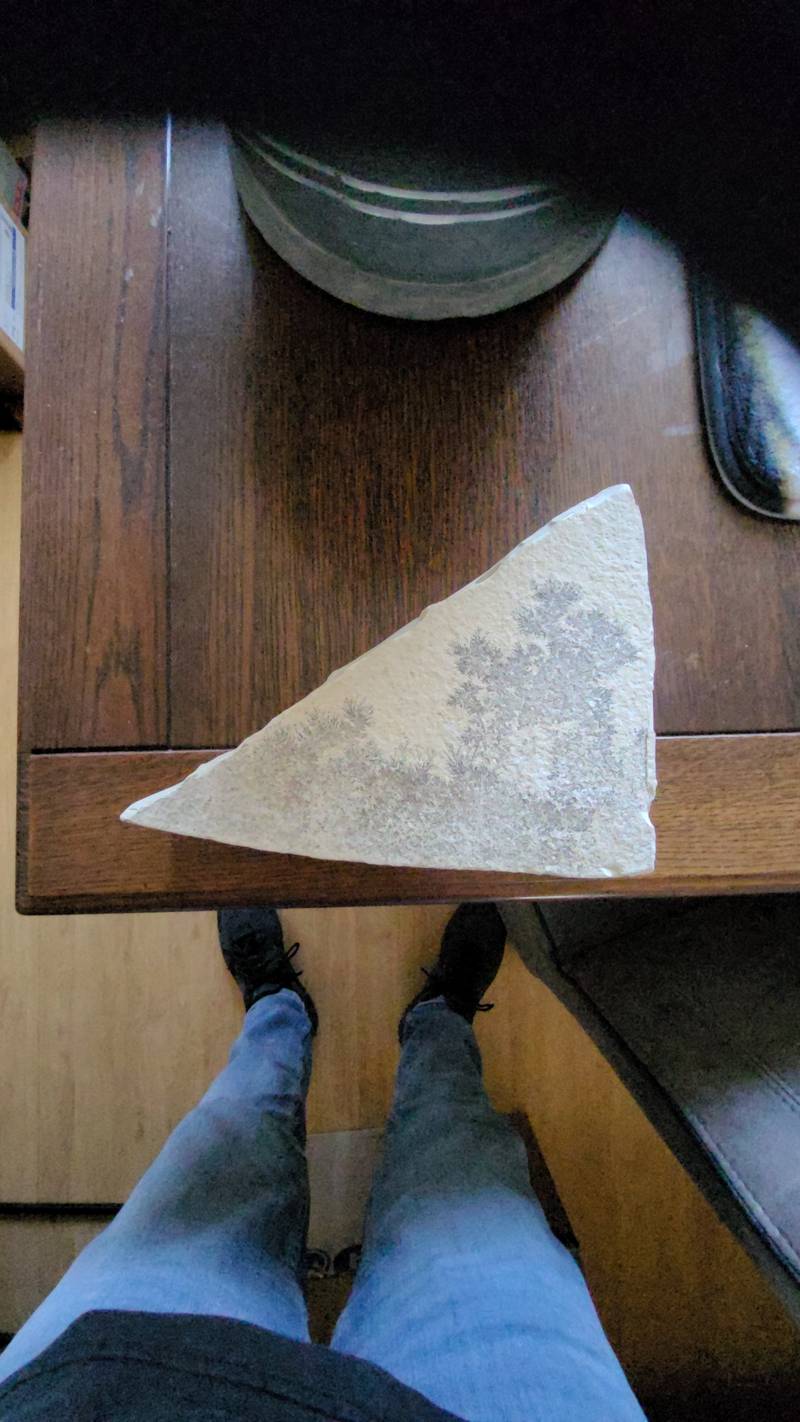
A triangular slab of fine-grained, cream-colored lithographic limestone featuring dark, arborescent (tree-like) mineral growths. These branching structures are manganese oxide dendrites, which formed as mineral-rich water percolated through micro-fissures in the sedimentary rock. The specimen displays a characteristic conchoidal fracture along the edges, typical of dense, homogeneous limestone such as that found in the Solnhofen region of Bavaria.
COLLECTOR NOTES
The Solnhofen limestone used as the matrix for these dendrites was the preferred medium for Alois Senefelder, who invented lithography in 1796.
SCARCITY
Standard antiques commonly found at estate sales and flea markets. Plentiful supply meets modest demand.
Typical Characteristics
- Moderate production runs
- Common at estate sales
- Entry-level collectibles
Confidence Factors
- Naturally occurring geological phenomenon with high availability
- Matrix and fracture patterns are consistent with authentic Solnhofen-type lithographic limestone
NATURALIST'S ASSESSMENT
Natural History Curator & Specimen Preparator
Identification of manganese dendrites on Solnhofen-type limestone is highly certain due to the distinct color, fracture habits, and classic fractal morphology visible in the images.
KEY EVIDENCE
- 1Fractal branching pattern characteristic of manganese oxide precipitation.
- 2Lithographic limestone matrix showing diagnostic cream color and conchoidal fracture.
- 3Specimen thickness and edge-wear typical of quarry-extracted slabs.
- 4Absence of organic cellular structure under visual inspection, confirming pseudofossil status.
WHAT WOULD IMPROVE CERTAINTY
- →Observe the dendrites under 10x magnification; true dendrites will appear as flat mineral stains on the bedding plane, not raised structures.
- →Test a small inconspicuous area with household vinegar; a fizzing reaction will confirm the calcium carbonate (limestone) matrix.
CONDITION & GRADE
Condition
The specimen is an irregular, likely field-trimmed fragment. The dendritic patterns are well-defined and dark, showing high contrast against the light matrix. No significant scuffing or surface contamination is visible on the primary faces.
Weight & feel
The slab appears to be approximately 1.5 to 2.0 cm thick, suggesting a dense, heavy feel for its size, consistent with high-calcium limestone.
SPECIMEN VALUATION
Updated: May 11, 2026
Who buys this
Casual rock and mineral collectors, educators, and interior decorators looking for natural geometric art.
What increases value
- •Clarity and contrast of the dendritic 'trees' against the background
- •Symmetry and aesthetic 'forest' arrangement of the mineral growth
What lowers value
- •Lack of specific locality data (e.g., Solnhofen, Germany)
- •Irregular, non-rectangular shape which can be harder to display
What makes top-tier examples
- •Large, unbroken slabs with 'landscape' compositions
- •Specimens containing both dendrites and true fossils like ammonites
Grade & condition
Matrix integrity, contrast level, and the complexity of the branching structures.
Rarity & demand
For informational purposes only, not a formal appraisal.
ABOUT NATURAL HISTORY
Fossils, minerals, taxidermy, shells, and natural specimens.
Natural History value and rarity guideSHARE THIS CURIOSITY
Have your own curiosities to discover?
Scan Your Curiosity
COMMENTS