Middle Eastern Miquelet Lock Pistol
Authenticity
MIDDLE EASTERN MIQUELET LOCK PISTOL: IDENTIFICATION
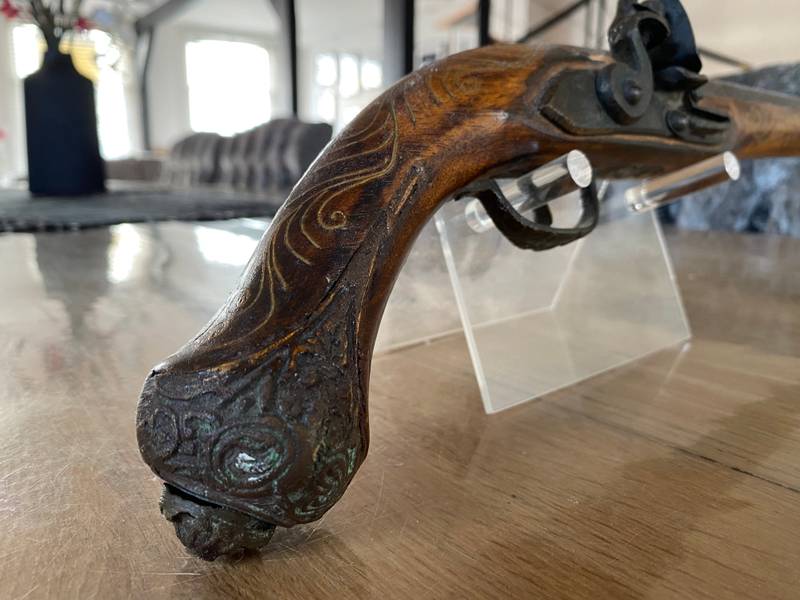
A decorative miquelet-lock smoothbore pistol featuring a wooden stock with brass wire inlay in scroll and wave patterns. The lock mechanism is a characteristic Mediterranean miquelet style with an external mainspring and a heavy, grooved frizzen. The butt is finished with a cast brass or bronze cap featuring relief scrollwork, secured by a protruding steel finial. The barrel is iron, showing significant oxidation and pitted surfaces, held to the stock with a traditional metal band.
CROSS-CULTURAL PARALLELS
Where This Object Echoes
The miquelet was the standard ignition system for Turkish 'Kubur' pistols.
Ritual & Ceremonial Use
- •Often presented as prestige gifts among tribal leaders in North Africa and the Levant.
Meaning Through Time
Transitioned from a primary self-defense weapon to a decorative 'curio' for Western travelers.
SCARCITY
Typical antique shop fare. Requires some searching but regularly available. This is where most genuine antiques fall.
Typical Characteristics
- Standard antique shop items
- Regularly available
- Moderate collector interest
Confidence Factors
- Heavy varnish on wood often hides modern repairs or indicates a 20th-century 'tourist' assembly from older parts.
- The cast detail on the butt-cap lacks the crispness associated with high-tier 18th-century military pieces.
- The wire inlay shows some unevenness consistent with regional artisan production rather than high-end arsenal manufacture.
MILITARY HISTORIAN'S TAKE
Militaria Historian
The visual details clearly identify the lock type and regional style, though the exact date is difficult to pin down without seeing maker marks often obscured by the heavy rust.
KEY EVIDENCE
- 1Presence of external mainspring confirms miquelet lock type.
- 2Brass wire inlay patterns are indicative of Ottoman/Balkan regional styles.
- 3Cast relief butt-cap is a standard feature of 19th-century Eastern Mediterranean pistols.
- 4The use of a metal barrel band suggests a functional rather than purely decorative construction.
UNCERTAINTIES
- •Surface pitting appears very deep, which can sometimes be artificially accelerated to hide modern metalwork.
- •Cracking in the stock near the lock suggests the wood may have dried excessively or was not well-fitted to the metal.
WHAT WOULD IMPROVE CERTAINTY
- →Check the top of the barrel and the lock plate for arsenal marks or 'deep' stamps often found on Turkish barrels.
- →Verify if the mechanism holds at half-cock and full-cock to determine internal spring health.
- →Examine the interior of the barrel with a bore light to check for rifling or smoothbore consistency.
CONDITION & GRADE
Grading breakdown
The item is graded as 'Fair' due to the structural cracks in the stock, missing flint, and the level of pitting on the iron barrel which obscures potential marks.
Condition
Significant splintering and a longitudinal crack are visible in the wooden stock near the lock plate. The metal components show advanced corrosion and lack the 'flint' in the cock's jaws; the screw heads on the lock plate show significant wear from past tool use.
Weight & feel
Estimated at 1.0 to 1.3 kg; its substantial butt-cap and iron barrel suggest a muzzle-heavy balance typical of horse pistols.
MILITARIA VALUATION
Updated: May 11, 2026
Similar Ottoman miquelet pistols have sold at Rock Island Auction and Hermann Historica between $400 and $900 depending on silver content.
Who buys this
Collectors of Ottoman-era weaponry, antique firearms enthusiasts, and interior designers seeking 19th-century ethnographic art.
What increases value
- •Functionality of the lock mechanism
- •Integrity of the brass wire inlay
- •Presence of identifiable maker marks on the barrel
What lowers value
- •Structural cracks in the stock significantly devalue the piece for firearms collectors
- •Excessive rust/pitting that prevents mechanical movement
What makes top-tier examples
- •Silver instead of brass wire inlay
- •Coral or gemstone settings in the stock
- •Gold damascening on the barrel
Grade & condition
Condition of the wood stock, functionality of the lock, and clarity of the decorative inlay.
Rarity & demand
For informational purposes only, not a formal appraisal.
ABOUT MILITARIA
Military uniforms, weapons, medals, equipment, and war memorabilia.
Militaria value and rarity guideSHARE THIS CURIOSITY
Have your own curiosities to discover?
Scan Your Curiosity
COMMENTS