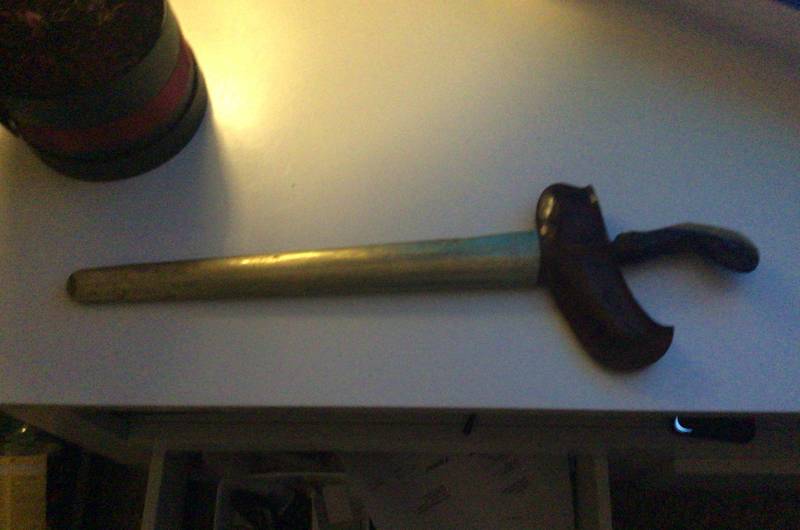
Indonesian Keris (Kris) with Sandang Walikat Style Scabbard
Estimated value
$150 - $450Rarity
Average(4/10)Category
MilitariaEra
Late 19th to early 20th centuryOrigin
IndonesiaAuthenticity
INDONESIAN KERIS (KRIS) WITH SANDANG WALIKAT STYLE SCABBARD: IDENTIFICATION
An Indonesian keris featuring a straight (lurus) blade and a hardwood hilt in the 'jawa demam' or anthropomorphic style. The scabbard is a simple 'sandang walikat' form, often worn for daily utility or concealed carry, typically featuring a brass or white metal 'pendok' sleeve over a wooden 'gandar' core. The blade appears to be forged with 'pamor' (pattern welding), though the specific pattern is obscured by surface oxidation. The cross-piece (wreka) exhibits the characteristic asymmetrical 'ganja' at the base of the blade, a hallmark of traditional Malay and Indonesian smithing.
ISSUE & SERVICE HISTORY
COLLECTOR NOTES
Traditional keris blades are forged using meteoric iron, specifically from the 1749 meteorite fall near the Prambanan temple in Central Java.
SCARCITY
Typical antique shop fare. Requires some searching but regularly available. This is where most genuine antiques fall.
Typical Characteristics
- Standard antique shop items
- Regularly available
- Moderate collector interest
Confidence Factors
- Proliferation of 20th-century tourist reproductions using cast rather than forged blades
- Blurry image quality prevents verification of genuine pamor welding lines
- Generic scabbard fittings lack the specific regional donor marks found on high-end 19th-century examples
MILITARY HISTORIAN'S TAKE
Militaria Historian
The object is clearly an Indonesian keris, and its form matches standard late-colonial era utility styles, but image blur prevents a definitive assessment of the blade's quality or authenticity as a forged antique vs. a modern replica.
KEY EVIDENCE
- 1Asymmetrical 'ganja' at the blade base confirms authentic Indonesian/Malay construction logic.
- 2Sandang Walikat scabbard style is consistent with 1880-1940 utilitarian wear.
- 3Hilt carving follows the standard 'Jawa Demam' (shivering fever) anthropomorphic silhouette.
- 4Blade appears to have a straight profile (lurus) rather than the 'luk' (waved) form.
UNCERTAINTIES
- •Visible heavy rust on the blade suggests poor storage and potential pitting.
- •Lack of detailed close-ups on the blade 'pamor' makes it difficult to distinguish between hand-forged layers and acid-etched imitations.
WHAT WOULD IMPROVE CERTAINTY
- →Provide a high-resolution macro photo of the blade surface to verify forge-welding lines.
- →Remove the hilt (if possible) to inspect the 'pesi' (tang) for maker markings or age-appropriate forging marks.
- →Check for a 'mendak' (small metal ring) between the hilt and the blade, which often carries diagnostic decorative motifs.
CONDITION & GRADE
Grading breakdown
The blade retains its full length and profile, though the lack of recent 'warangan' (arsenic-lime treatment) has allowed oxidation to dull the contrast of the pattern welding.
Condition
Significant surface oxidation is visible on the exposed blade in the third image, which may obscure the pamor lines. The scabbard sleeve shows minor denting near the chape, and the hilt junction appears slightly loose, a common result of wood shrinkage over time.
MILITARIA VALUATION
Updated: May 10, 2026
Similar utilitarian 19th-century keris have achieved between $200 and $400 at dedicated ethnographic sales like Hermann Historica (2023).
Who buys this
Specialist ethnographic arms collectors and Indonesian cultural history enthusiasts.
What increases value
- •Complexity and rarity of the pamor pattern
- •Provenance linking the item to a specific regional sultanate or 'Empu' (smith)
- •Condition of the wooden components, specifically the 'wreka' (throat) piece
What lowers value
- •Deep pitting from rust significantly reduces value for serious collectors
- •Replacement hilts or scabbards that do not match the blade's era or region
What makes top-tier examples
- •Blade forged with rare nickelous meteoric iron
- •Intricately carved hilt made of 'ebony' or fossilized mammoth tooth
- •Gold-inlaid 'kamoragan' motifs on the blade
Grade & condition
Blade integrity, pamor clarity, hilt-to-blade fit, and scabbard completeness.
Rarity & demand
For informational purposes only, not a formal appraisal.
ABOUT MILITARIA
Military uniforms, weapons, medals, equipment, and war memorabilia.
Militaria value and rarity guideSHARE THIS CURIOSITY
Have your own curiosities to discover?
Scan Your Curiosity
COMMENTS