Bohemian Faceted Garnet Bead Necklace or Strand
Estimated value
$40 - $120Rarity
Ordinary(3/10)Category
JewelryEra
Late 19th to early 20th century (c. 1880-1920)Origin
Czech RepublicAuthenticity
BOHEMIAN FACETED GARNET BEAD NECKLACE OR STRAND: IDENTIFICATION
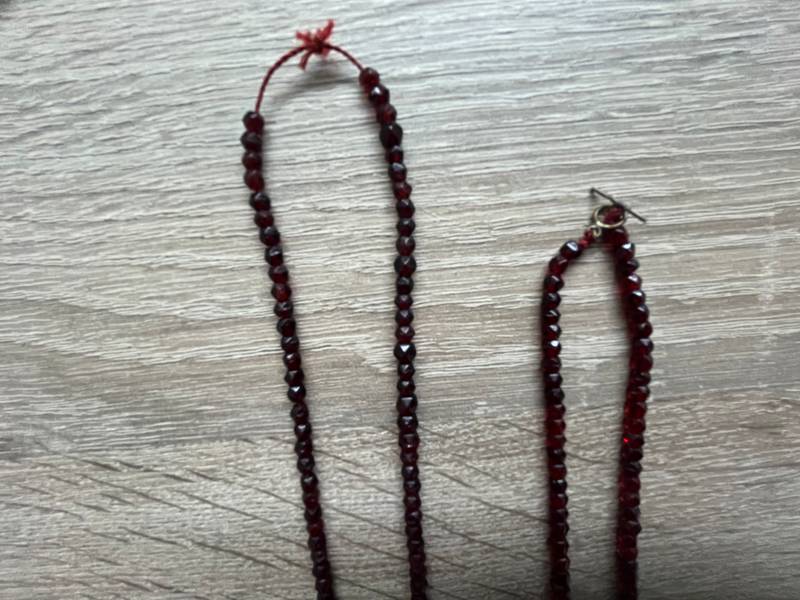
Faceted natural garnet beads, likely pyrope or almandine, presented as a strand or necklace. The beads exhibit the characteristic deep 'pigeon blood' to brownish-red hue associated with Bohemian garnet deposits. Each bead features a standard bicone or round rose-cut faceting, approximately 3mm to 4mm in diameter. The strand appears to be unknotted on a red thread, featuring a simple metal toggle or ring clasp on one end, while the other end terminates in a knotted thread, suggesting it may be a partial component or in need of restring.
CROSS-CULTURAL PARALLELS
Where This Object Echoes
Garnets were the primary gemstone for secondary mourning jewelry following the death of Prince Albert in 1861.
Ritual & Ceremonial Use
- •Traditional gift for the 2nd wedding anniversary or January birthdays.
Meaning Through Time
Symbol of constancy and loyalty in friendship and love.
PERIOD & PROVENANCE
COLLECTOR NOTES
During the late 19th century, the city of Turnov became the global center for garnet cutting, employing over 3,000 specialists by 1890.
SCARCITY
Standard antiques commonly found at estate sales and flea markets. Plentiful supply meets modest demand.
Typical Characteristics
- Moderate production runs
- Common at estate sales
- Entry-level collectibles
Confidence Factors
- Presence of glass imitations (Bohemian glass) common in this style
- Lack of hallmarks on the small metal clasp component
- Stringing method suggests later repair or assembly
GEMOLOGIST'S ASSESSMENT
Jewelry Historian & Gemologist-Informed Appraiser
Visual characteristics strongly align with Bohemian garnet strands of the late 19th century, though definitive stone identification requires magnification to rule out glass.
KEY EVIDENCE
- 1Standardized 19th-century rose-cut/bicone faceting pattern
- 2Color consistency matching pyrope-almandine garnet species
- 3Density and thermal conductivity (cool feel) typical of natural stone
- 4Construction on red silk/cotton thread common for period Bohemian exports
UNCERTAINTIES
- •Potential for 'Bohemian Glass' (Paste) mimics which were mass-produced in the same era
- •Incomplete toggle clasp may be a later 20th-century addition
WHAT WOULD IMPROVE CERTAINTY
- →Examine beads under 10x magnification for characteristic needle-like inclusions
- →Perform a thermal conductivity test with a gem tester to distinguish from glass
- →Restring on silk thread with knots between beads to prevent loss if broken
CONDITION & GRADE
Grading breakdown
The beads themselves are in good condition with localized chips, but the structural integrity of the strand is poor due to the frayed thread and missing clasp parts.
Condition
The stringing is compromised, with a simple knot at one end and no matching clasp component. Several beads show surface abrasions; restringing on silk with a period-correct clasp is required for wearability.
GEMSTONE & METAL VALUE
Updated: May 11, 2026
Antique Bohemian garnet strands typically sell for $75-$150 on eBay (2023-2024) depending on length and bead quality.
Who buys this
Victorian jewelry collectors looking for authentic components or 'Bohemian garnet' enthusiasts.
What increases value
- •Bead size uniformity
- •Depth and saturation of the red color
- •Total length of the strand
What lowers value
- •Broken or frayed stringing
- •Missing matching clasp components
- •Presence of glass 'paste' beads mixed within the strand
What makes top-tier examples
- •Graduated bead sizes in a complete, original necklace
- •Unusually large beads exceeding 6mm
Grade & condition
Facet crispness, presence of chips, and color uniformity.
Rarity & demand
For informational purposes only, not a formal appraisal.
ABOUT JEWELRY
Fine jewelry, costume pieces, rings, necklaces, bracelets, and brooches.
Jewelry value and rarity guideSHARE THIS CURIOSITY
Have your own curiosities to discover?
Scan Your Curiosity
COMMENTS