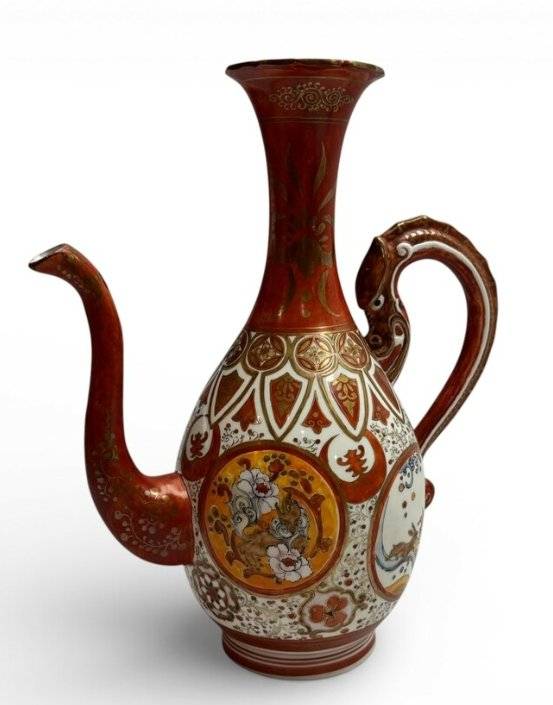
Kutani Ware Ewer with Dragon Handle
Estimated value
$150 - $450Rarity
Average(4/10)Category
Ceramics & PotteryBrand
KutaniEra
Late Meiji period, circa 1890–1910Origin
JapanAuthenticity
KUTANI WARE EWER WITH DRAGON HANDLE: IDENTIFICATION
A Japanese Kutani porcelain ewer featuring a slender neck, flared rim, and a characteristic S-curved spout. The piece is decorated in the Kinrande style, utilizing iron-red (aka-e) enamel grounds highlighted with extensive gold (kin) gilding. A dragon-form handle joins the neck to the shoulder. Medallions on the body contain hand-painted floral motifs and mythological figures, while the surrounding field is filled with dense geometric and scrolling clouds (yunwen) patterns.
PRODUCTION & FIRING
SCARCITY
Typical antique shop fare. Requires some searching but regularly available. This is where most genuine antiques fall.
Typical Characteristics
- Standard antique shop items
- Regularly available
- Moderate collector interest
Confidence Factors
- Stylistic consistency with late 19th-century Meiji export porcelain
- Typical 'Shoza' color palette and gilding wear patterns
- Form is a standard export shape documented in late 19th-century catalogs
CERAMICIST'S ASSESSMENT
Ceramics Historian & Kiln Specialist
The form, color palette, and decorative scheme are classic indicators of Meiji-era Kutani; however, the lack of a visible base mark and the missing lid prevent a higher confidence score.
KEY EVIDENCE
- 1Characteristic iron-red enamel color specific to Kutani kilns
- 2Use of Kinrande (gold brocade) technique consistent with Meiji export era
- 3Dragon-form handle modeled in the round, a common motif for the 1890-1910 period
- 4Medallion composition featuring traditional kacho-ga (bird and flower) and mythological elements
- 5White porcelain paste visible at the rim and spout interior
UNCERTAINTIES
- •Missing original lid/stopper, which significantly impacts market value
- •Blurred resolution on the base prevents verification of the 'Kutani' (九谷) mark
WHAT WOULD IMPROVE CERTAINTY
- →Provide a high-resolution photograph of the base to examine the kiln mark or artist signature
- →Perform a light-transparency test to confirm the thinness and purity of the porcelain body
- →Inspect the dragon's scales for any losses or professional restoration (UV light test)
CONDITION & GRADE
Grading breakdown
The primary detraction is the absence of the lid; however, the enamel integrity remains high with minimal visible crazing.
Condition
Visible rubbing to the gilding on the high-contact areas of the dragon handle and spout tip. The rim appears intact, though a missing lid is a significant factor as most ewers of this form were originally produced with matching stoppers.
CERAMICS MARKET VALUE
Updated: May 11, 2026
Who buys this
Collectors of Meiji-period export art and interior designers seeking Chinoiserie or Japonisme accents.
What increases value
- •Retention of gilding on the handle and spout
- •Complexity of the medallion paintings
- •Presence of a clear factory mark on the base (unverified)
What lowers value
- •The absence of the matching lid reduces value by 40-50% compared to a complete set
- •Any hairline cracks at the joint of the handle or spout
What makes top-tier examples
- •Signed by a known workshop like Watano or Tashiro
- •Complete with original matching stopper
- •Exceptional fine-line gilding without wear
Grade & condition
Completeness (lid), gilding retention, and absence of chips on the fragile dragon features.
Rarity & demand
For informational purposes only, not a formal appraisal.
ABOUT CERAMICS & POTTERY
Pottery, porcelain, stoneware, earthenware, and kiln-fired objects.
Ceramics & Pottery value and rarity guideSHARE THIS CURIOSITY
Have your own curiosities to discover?
Scan Your Curiosity
COMMENTS