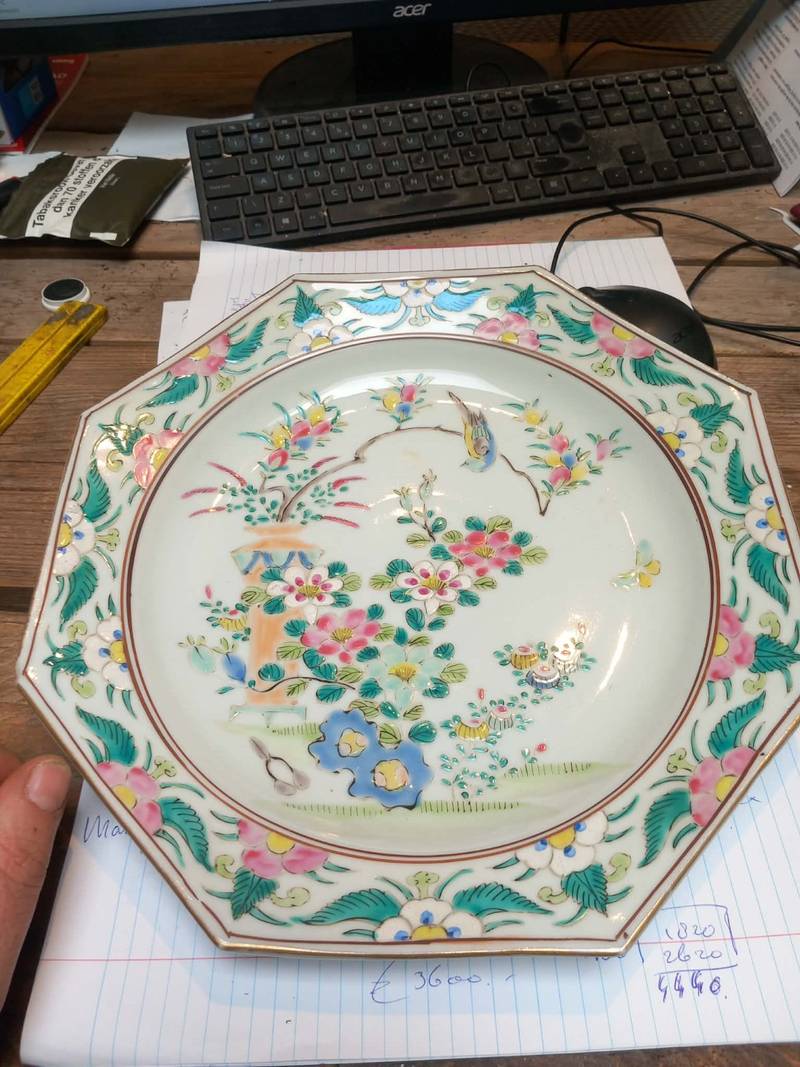
Octagonal Kakiemon-style Porcelain Charger
Estimated value
$450 - $1,200Rarity
Uncommon(5/10)Category
Ceramics & PotteryEra
Late 19th Century (Meiji Period)Origin
JapanAuthenticity
OCTAGONAL KAKIEMON-STYLE PORCELAIN CHARGER: IDENTIFICATION
An octagonal porcelain charger measuring approximately 30-35 cm in diameter, decorated in overglaze enamels with a classic Kakiemon bird-and-flower motif. The central well features a bird perched on a branch beside a stylized vase (hana-ike) filled with blossoming peonies and plum branches. The palette includes characteristic iron-red, greenish-blue, yellow, and a distinct violet-blue. The underside shows a blue underglaze 'fuku' (happiness) mark within a double circle and a distinctively unglazed, iron-stained footrim.
CROSS-CULTURAL PARALLELS
Where This Object Echoes
Meissen 'Yellow Lion' and 'Flying Fox' patterns were direct copies of these Arita imports.
Ritual & Ceremonial Use
- •Hana-matsuri (Flower Festivals) where floral motifs symbolize the transient nature of life.
Meaning Through Time
Symbol of high-status export trade and elite Japanese craftsmanship.
An essential reference point for 'Japonisme' in Western decorative arts.
SCARCITY
Genuine antiques with fewer examples on the market. Named makers, documented provenance, or early production examples.
Typical Characteristics
- Limited production
- Named makers
- Growing collector demand
Confidence Factors
- Blue-green tint of the glaze is more typical of 19th-century production than early Kakiemon
- High prevalence of 20th-century reproductions from Seto and Arita
- Enamel palette is vibrant but lacks the dry, matte quality of 17th-century originals
CERAMICIST'S ASSESSMENT
Ceramics Historian & Kiln Specialist
Identification of the style and region is certain (Arita, Kakiemon-style). Confidence is tempered by the difficulty in distinguishing between late 18th-century and 19th-century examples without physical handling.
KEY EVIDENCE
- 1Octagonal form consistent with VOC-period export shapes later revived in the Meiji era.
- 2Glaze exhibits 'pinholing' and minor kiln debris common in 19th-century Arita kilns.
- 3Iron-red enamel shows the specific 'orange-peel' texture found in authentic Japanese overglazes.
- 4The 'Fuku' mark is hand-painted in underglaze cobalt with a fluid, calligraphic hand.
- 5Unglazed footrim shows the sandy texture and oxidization characteristic of Japanese porcelain pastes.
UNCERTAINTIES
- •The glaze clarity is almost too perfect for 18th-century wares.
- •The blue lines defining the central well are very uniform, suggesting a more modern precision.
WHAT WOULD IMPROVE CERTAINTY
- →Perform a 'tap test' with a wooden stick to check for a clear ring (sound indicates lack of hidden cracks).
- →Examine the piece under UV light to verify if any repairs have been made to the rim points.
- →Measure the diameter precisely; specific sizes often correlate to documented VOC orders.
CONDITION & GRADE
Grading breakdown
The grade is supported by the lack of structural cracks or 'hairlines,' though enamel wear and footrim oxidation are present.
Condition
The footrim shows significant iron-red oxidation and some localized chipping/wear consistent with age. The face shows minor surface scratches to the enamels and some kiln-soot inclusions (tiny black specks) near the center.
Weight & feel
Substantial and dense, typical of stoneware-leaning porcelain from the Arita region; the thick walls suggest a weight of 1.5 to 2.0 kg.
CERAMICS MARKET VALUE
Updated: May 11, 2026
Who buys this
Specialist collectors of Japanese export porcelain and interior designers focused on Chinoiserie/Japonisme styles.
What increases value
- •Complexity of the 'hana-ike' (vase) motif
- •The octagonal shape, which is highly preferred over standard round forms
- •Absence of 'hairline' cracks on the rim points
What lowers value
- •Cracking at the sharp corners of the octagon
- •Significant fading or loss of the iron-red enamel
What makes top-tier examples
- •Nigoshide body (pure white)
- •Sparseness of design (purest Kakiemon style)
- •Documented 17th-century provenance
Grade & condition
Chips at the points of the octagon and the integrity of the gold/red rim line.
Rarity & demand
For informational purposes only, not a formal appraisal.
ABOUT CERAMICS & POTTERY
Pottery, porcelain, stoneware, earthenware, and kiln-fired objects.
Ceramics & Pottery value and rarity guideSHARE THIS CURIOSITY
Have your own curiosities to discover?
Scan Your Curiosity
COMMENTS