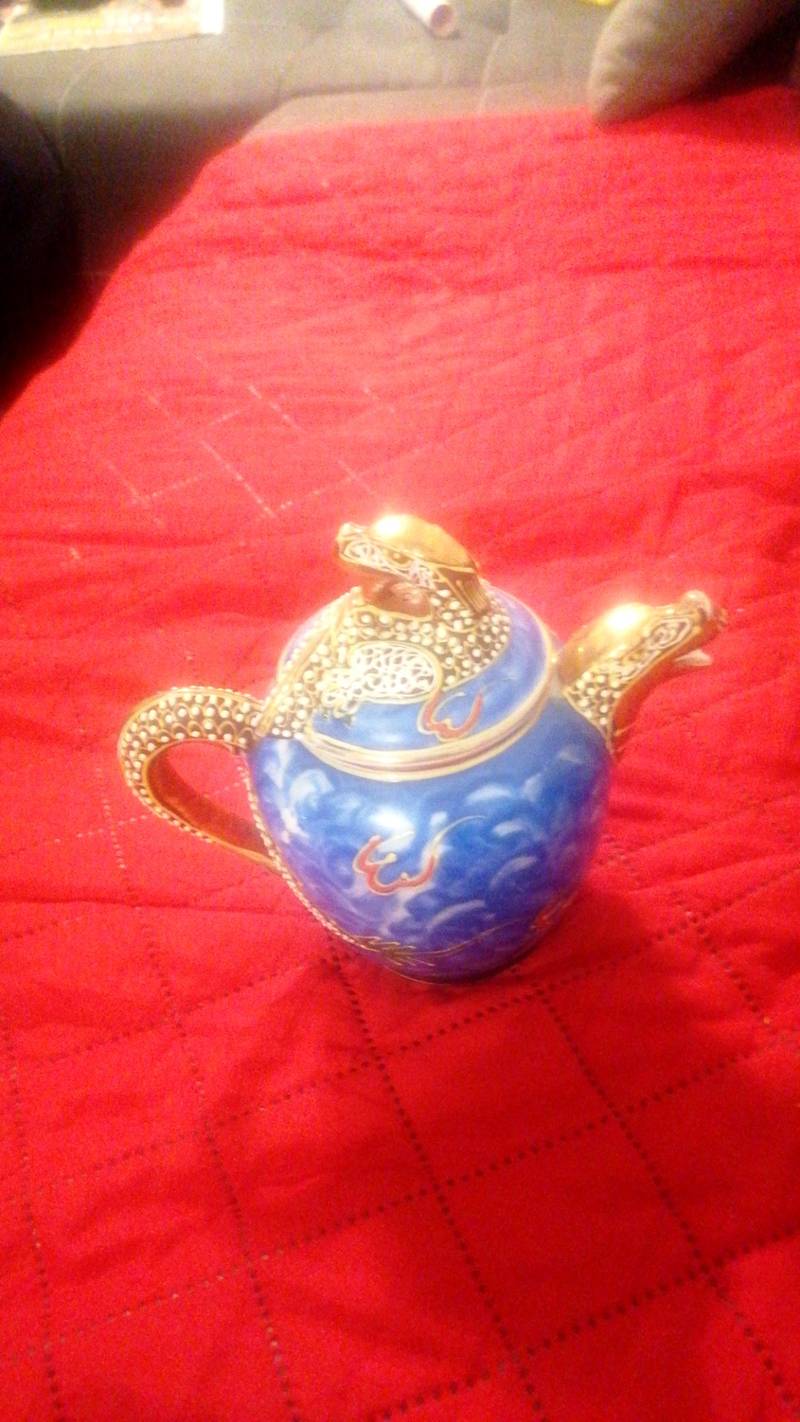
Chinese Export Porcelain 'Dragon' Teapot
Estimated value
$75 - $250Rarity
Average(4/10)Category
Asian ArtEra
Early to Mid 20th CenturyOrigin
ChinaArtist / Creator
Handpainted Lithophane dragon theepotAuthenticity
CHINESE EXPORT PORCELAIN 'DRAGON' TEAPOT: IDENTIFICATION
This appears to be a Chinese export teapot, likely of porcelain, featuring an intricate dragon motif. The body is adorned with a rich blue glaze, upon which a relief pattern, possibly depicting clouds or waves, is painted in a lighter blue. The gold elements, notably the dragon-head spout, the dragon-finial lid, and the handle, exhibit a raised, textured surface, often referred to as 'millefiori' or 'coral ground' enamel work, though here it's more like a textured gilding. This style points towards a manufacture intended for export markets, especially in the 20th century.
SCARCITY
Typical antique shop fare. Requires some searching but regularly available. This is where most genuine antiques fall.
Typical Characteristics
- Standard antique shop items
- Regularly available
- Moderate collector interest
Confidence Factors
- The mark on the base is difficult to discern clearly from the image, preventing definitive attribution.
- This style of export ware was widely produced, making exact dating and origin challenging without a clear maker's or period mark.
- Reproduction of these decorative items is not uncommon.
ASIAN ART SCHOLAR'S TAKE
Asian Art Specialist
My confidence is high in identifying this as a Chinese export porcelain teapot from the early to mid-20th century based on the visible decorative style and form. However, the inability to discern the base mark limits the precision of dating and maker attribution, hence a confidence level of 0.8.
KEY EVIDENCE
- 1The presence of a dragon-head spout and finial is a strong indicator of Chinese origin and cultural symbolism.
- 2The intricate gilded work with raised dots on the dragon segments and handle suggests an export-oriented decorative style common in the early to mid-20th century.
- 3The overall form of the teapot, while embodying Chinese motifs, leans towards a more robust and ornate aesthetic catering to foreign tastes rather than traditional Chinese tea ceremony.
- 4The faint mark on the base, while illegible, confirms it is an attributed piece, though its clarity is paramount to dating.
UNCERTAINTIES
- •The mark on the base is too indistinct to interpret, making precise dating or maker attribution impossible from these images.
- •The specific type of gold decoration could be an applied enamel or a more complex gilding process; clarity on this would refine the assessment.
- •Absence of provenance makes it harder to distinguish between period export decorative ware and later reproductions.
WHAT WOULD IMPROVE CERTAINTY
- →Provide a high-resolution, well-lit close-up image of the mark on the base from multiple angles.
- →Examine the footrim carefully for any signs of firing, glaze skips, or particular ceramic body characteristics.
- →Photographs of the interior of the pot to check for tea staining or signs of use.
- →If possible, comparison of the ceramic body's weight and resonance against known examples of export porcelain from the period.
CONDITION & GRADE
Condition
Visually, the teapot appears to be in good condition for its age, with no immediate signs of major chips or cracks. The gilding on the dragon's head and handle seems intact, though close inspection would be needed to detect any rubbing or loss to the gold enamel from handling or cleaning over time.
ASIAN ART VALUATION
Updated: Feb 27, 2026
- Market comparables from auctions & retail
- Condition, completeness & craftsmanship
- Current collector demand & trends
- Low = quick sale, high = patient seller
For informational purposes only, not a formal appraisal.
ABOUT ASIAN ART
Chinese, Japanese, Korean, and other Asian art and antiques.
Asian Art value and rarity guideSHARE THIS CURIOSITY
Have your own curiosities to discover?
Scan Your Curiosity
COMMENTS