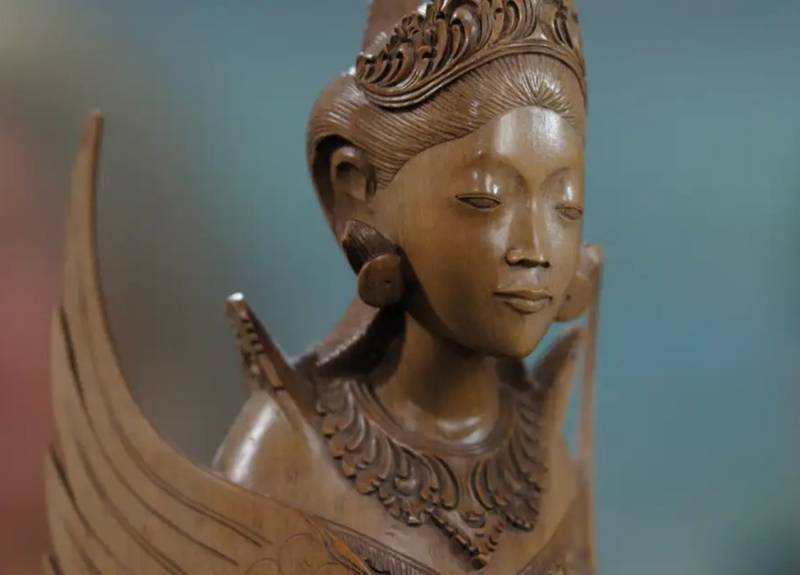
Balinese Art Deco Wooden Sculpture of a Winged Celestial (Kinnari)
Estimated value
$400 - $800Rarity
Uncommon(5/10)Category
Asian ArtEra
Circa 1930-1950 (Pita Maha Period)Origin
IndonesiaArtist / Creator
I Ketut RodjaAuthenticity
BALINESE ART DECO WOODEN SCULPTURE OF A WINGED CELESTIAL (KINNARI): IDENTIFICATION
A finely carved mid-20th-century Balinese wooden bust depicting a winged celestial being, likely a Kinnari, characterized by the elongated facial proportions of the Pita Maha movement. The figure features a meticulously detailed foliate headdress (gelungan), pronounced ear ornaments (subeng), and an incised collar (badong), contrasting with the highly polished, unadorned planes of the face and wings. Carved from a dense, fine-grained tropical hardwood, likely sawo (Manilkara kauki).
DYNASTY & PROVENANCE
COLLECTOR NOTES
Pita Maha era masterworks by named carvers like Ida Bagus Nyana have achieved auction results exceeding €10,000 at specialized sales such as Venduehuis der Notarissen.
SCARCITY
Genuine antiques with fewer examples on the market. Named makers, documented provenance, or early production examples.
Typical Characteristics
- Limited production
- Named makers
- Growing collector demand
Confidence Factors
- Stylistic details precisely match documented 1930s-1950s Pita Maha movement characteristics.
- Natural patination and correct wood selection (likely sawo) for the region and period.
- Lack of mass-production tool marks; intricate undercut details confirm hand-carving.
ASIAN ART SCHOLAR'S TAKE
Asian Art Specialist
The stylistic markers of the Pita Maha movement are unmistakable in the carving technique and proportions, though absolute certainty of the exact carver requires base inspection.
KEY EVIDENCE
- 1Pronounced Art Deco elongation in the facial features and neck.
- 2Unpainted, polished tropical hardwood construction replacing traditional polychrome.
- 3Traditional Balinese headdress (gelungan) and ear ornament (subeng) motifs.
- 4Natural oxidation and patina indicative of 70+ years of age.
UNCERTAINTIES
- •Lack of a visible carver's signature on the base slightly limits attribution to specific master workshops.
WHAT WOULD IMPROVE CERTAINTY
- →Examine the underside of the base for incised initials, workshop marks, or the 'Pita Maha' stamp.
- →Determine exact wood species (sawo vs. jackfruit vs. ebony) via close-up end-grain analysis.
CONDITION & GRADE
Condition
The wood exhibits a warm, stable patina consistent with mid-century production. A minor loss or chip is visible on the upper tip of the left shoulder wing element, alongside standard micro-abrasions on the highest points of the carved foliage.
Weight & feel
Given the density of tropical hardwoods favored during this movement, assuming standard 30-40cm proportions for such busts, the piece likely weighs between 1.5 and 2.5 kg.
ASIAN ART VALUATION
Updated: May 10, 2026
Venduehuis der Notarissen in The Hague handles similar mid-century unpainted Balinese carvings, with anonymous high-quality pieces regularly realizing €300-€600 in their biannual Indonesian Art sales.
Who buys this
Collectors of Southeast Asian Art Deco and enthusiasts of the mid-20th-century Balinese artistic renaissance.
What increases value
- •Refinement and smoothness of the facial carving
- •Intricacy of the undercut traditional headdress
- •Presence of signature Art Deco elongation
What lowers value
- •Lack of a documented carver's signature
- •The visible chip on the upper left wing tip
- •Fluctuations in the specialized Dutch/Indonesian auction market
What makes top-tier examples
- •Signed by recognized Pita Maha masters such as Ida Bagus Njana
- •Flawless condition with deep, undisturbed original patina
Grade & condition
Condition in this category is heavily penalized by missing wing tips, chipped headdress foliage, or deep un-patinated scratches in the smooth facial planes.
Rarity & demand
For informational purposes only, not a formal appraisal.
ABOUT ASIAN ART
Chinese, Japanese, Korean, and other Asian art and antiques.
Asian Art value and rarity guideSHARE THIS CURIOSITY
Have your own curiosities to discover?
Scan Your Curiosity
COMMENTS