Chinese Lapis Lazuli Snuff Bottle, Late Qing Dynasty to Republic Period (1900-1940)
Authenticity
CHINESE LAPIS LAZULI SNUFF BOTTLE, LATE QING DYNASTY TO REPUBLIC PERIOD (1900-1940): IDENTIFICATION
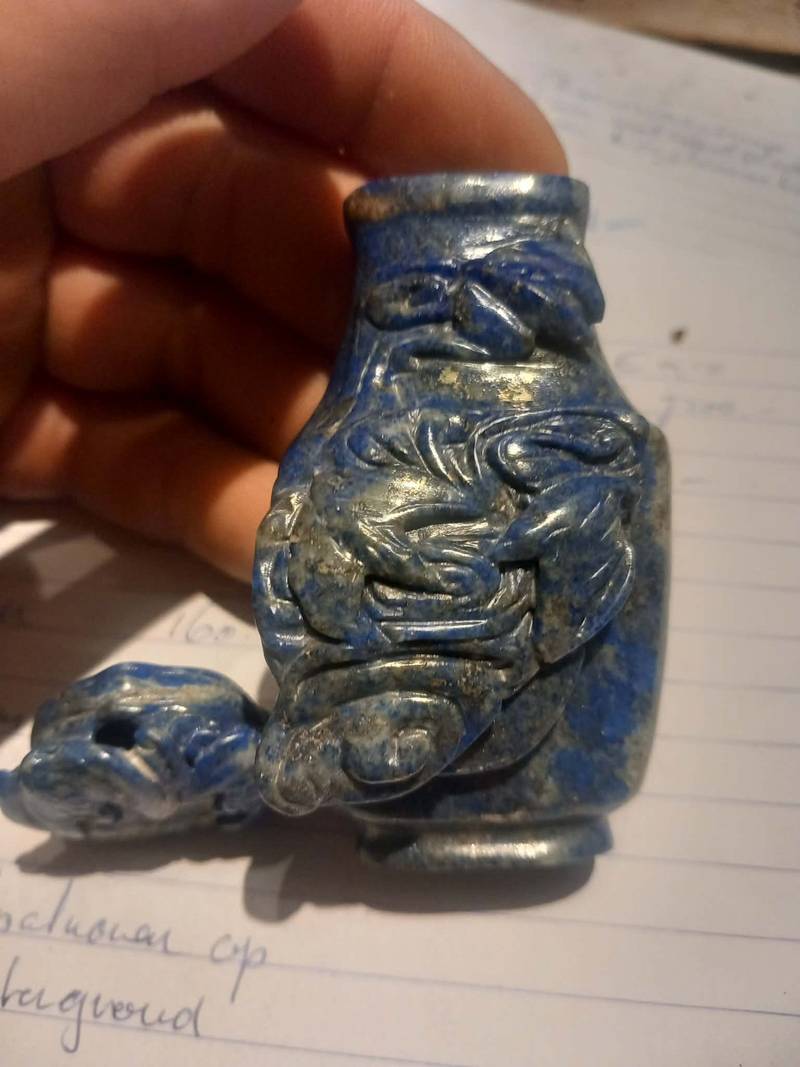
A hand-carved snuff bottle executed in natural lapis lazuli, featuring high-relief 'clambering' floral or lingzhi fungus motifs. The stone displays characteristic deep lazurite blue with visible brassy pyrite inclusions and grayish-white calcite streaks. The bottle stands on a small oval footrim and possesses a matching carved stopper.
DYNASTY & PROVENANCE
SCARCITY
Typical antique shop fare. Requires some searching but regularly available. This is where most genuine antiques fall.
Typical Characteristics
- Standard antique shop items
- Regularly available
- Moderate collector interest
Confidence Factors
- Presence of pyrite and calcite inclusions supports natural stone over resin or glass copies
- Surface wear and dirt accumulation in recesses consistent with mid-20th-century age
- Carving style is commercially focused, common in Republic-era export pieces
ASIAN ART SCHOLAR'S TAKE
Asian Art Specialist
The material is clearly identifiable as lapis lazuli due to specific inclusions, and the form is a standard late-period snuff bottle, though the absence of an interior view limits the assessment of carving quality.
KEY EVIDENCE
- 1Pyrite 'gold' inclusions and calcite 'white' streaks confirm natural lapis lazuli mineral composition.
- 2Form and carving technique are diagnostic of late 19th/early 20th-century Chinese lapidary workshops.
- 3The irregular, hand-cut mouth and footrim indicate pre-modern industrial production.
UNCERTAINTIES
- •Lack of a snuff spoon suggests it may have been used as a decorative 'cabinet piece' rather than a functional container.
- •Surface luster is somewhat dull, which could indicate a lower grade of stone or exposure to acidic cleaning agents.
WHAT WOULD IMPROVE CERTAINTY
- →Examine the interior for hollowing; a well-hollowed bottle (thin walls) significantly increases value.
- →Check for a 'spoon' attached to the stopper; bone, horn, or ivory spoons are period-correct.
- →Perform a UV light test; natural lapis typically remains inert, while dyed stones may show fluorescence.
CONDITION & GRADE
Condition
Small chips visible on the high points of the carved foliage and along the outer edge of the mouth. The stopper appears original but may lack the interior bone or ivory spoon typically associated with functional snuff bottles.
ASIAN ART VALUATION
Updated: May 10, 2026
Similar lapis snuff bottles have realized between $250 and $500 at specialist sales like Sotheby’s 'Snuff Bottles from the Mary and George Bloch Collection' (varied years), while standard specimens sell for $100-$300 on eBay.
Who buys this
Snuff bottle specialists and mineral-carving collectors focused on the late Qing and Republic transition periods.
What increases value
- •Degree of internal hollowing (thinner is better)
- •Vibrancy of the 'Imperial' blue color
- •Completeness of the stopper and spoon assembly
What lowers value
- •Significant chips to the relief carving
- •If the stone is found to be dyed (though pyrite suggests it is natural)
- •Lack of a functional spoon
What makes top-tier examples
- •Deep ultramarine color with minimal white calcite
- •Paper-thin hollowing that allows light through the stone walls
- •Provenance from a named 20th-century collection
Grade & condition
Condition of high-relief carvings, stone color saturation, and degree of internal hollowing.
Rarity & demand
For informational purposes only, not a formal appraisal.
ABOUT ASIAN ART
Chinese, Japanese, Korean, and other Asian art and antiques.
Asian Art value and rarity guideSHARE THIS CURIOSITY
Have your own curiosities to discover?
Scan Your Curiosity
COMMENTS